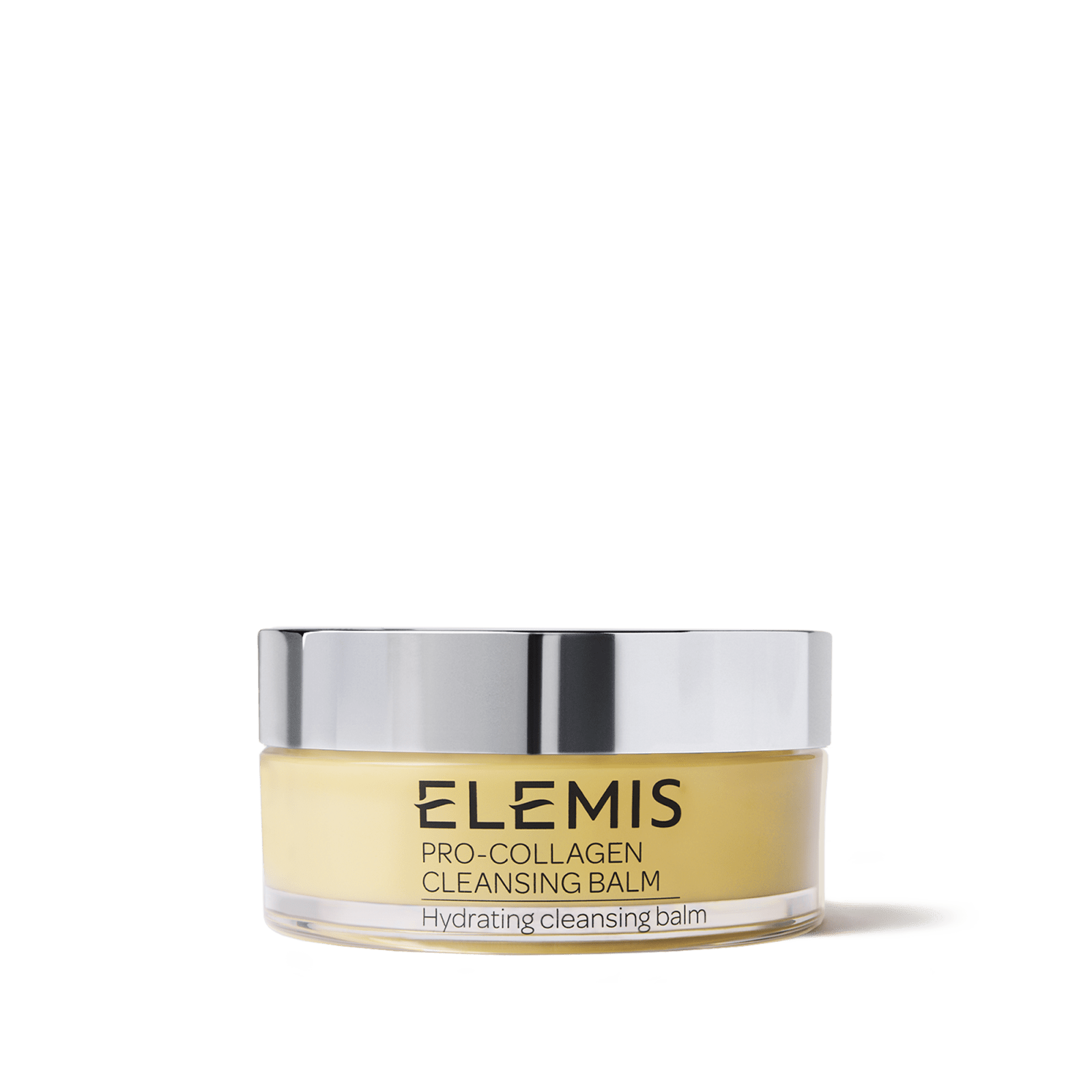
Elemis named its Pro Collagen line after the Mediterranean seaweed Padina pavonica. On the Pro Collagen Cleansing Balm's own label, read on us.elemis.com on November 11, 2026, Padina pavonica is the 38th and final ingredient, below menthol, clove leaf oil and fragrance.
Elemis just changed hands. On November 4, 2026, L'Occitane Group said it had agreed to sell the British skincare brand to the Paris private equity firm PAI Partners, closing expected in the first quarter of 2027 (PipelineRoad release). Terms weren't disclosed. Pre announcement press at Cosmetics Business reported the price was near a billion dollars, a figure the companies didn't confirm. For context, L'Occitane paid up to 900 million dollars for the brand in January 2019. Elemis net sales for fiscal 2026 topped 300 million dollars, with the US making up about half.
That's the deal.
It isn't the post.
The post is what the Pro Collagen Cleansing Balm, the hero that anchors the Pro Collagen line and sells at 55 dollars a jar, actually says on its label. We read that label on the brand's own US site this morning and numbered the 38 ingredients in order. What we found is the quiet joke of a luxury skincare sale: the ingredient the whole line is named after is in the last position on the label of its biggest cleanser.
Who just bought Elemis, and what did they pay?
Elemis was founded in London in 1990 by Noella Gabriel, Sean Harrington and Oriele Frank, with the botanical formulator Jan Kusmirek doing the first mixes. For decades it was owned by the US cruise and spa operator Steiner Leisure, which put the balms into cabin spas and hotel treatment rooms. Then in January 2019 the French group L'Occitane paid up to 900 million dollars for it. The brand kept growing on US digital and prestige retail. L'Occitane said this month that Elemis net sales for the fiscal year ended March 2026 were over 300 million dollars, with the US accounting for about half and online channels for nearly half.
The buyer is a familiar face in European private equity. PAI Partners manages around 30 billion euros in assets, and its portfolio has included Froneri (ice cream), Perstorp (specialty chemicals) and Ecotone (food). This is PAI's first big British skincare bet in years. In the release, PAI said it intends to accelerate the US and strengthen the UK, with work continuing on the Pro Collagen range. A sale like this is becoming a pattern in prestige skincare, after Henkel bought Olaplex in July 2026 and Galderma agreed to pay 1.5 billion dollars for ZO Skin Health in October.
That line is the whole bet. Pro Collagen Marine Cream, Pro Collagen Night Cream, Pro Collagen Eye Revive, the Rose, Green Fig and Black Cherry variants of the balm. Each one borrows the name of the seaweed and, through it, the implication that a cream or a balm is quietly rebuilding your face. The question a shopper actually asks at 55 dollars a jar is simpler. How much of the seaweed is in there?
What the Pro Collagen Cleansing Balm actually says on its label
I pulled the full ingredient list on us.elemis.com on November 11, 2026 and numbered every slot. The label has 38 ingredients. Caprylic/Capric Triglyceride and PEG 6 Caprylic/Capric Glycerides, two oil based cleansing esters, sit at 1 and 2. PEG 8 Beeswax is 3. Cetearyl Alcohol and Sorbitan Stearate are 4 and 5. Shea butter is 11. Glycerin is 13. Phenoxyethanol, the preservative, is 17. Fragrance (Parfum) is 33. Cocoyl Hydrolyzed Collagen is 28. Menthol is 35. Eugenia Caryophyllus (Clove) Leaf Oil is 36. Citral, a citrus allergen, is 37. Padina Pavonica Thallus Extract is 38. That is the last position on a US ingredient panel. The seaweed that gave the collection its name sits below menthol, below clove oil, below fragrance, and below a form of hydrolyzed collagen that is not even from the sea.
Padina pavonica is the ingredient the whole line is named after. What is it doing in last place?
US cosmetic labels list ingredients in descending order of weight down to the one percent line, then in any order under it. The brand doesn't publish where the one percent line falls in this formula. What the label order tells you is that Padina pavonica sits below every ingredient that must be declared above one percent, and below every fragrance allergen that regulators ask the brand to flag. It is almost certainly a sub one percent addition.
Is that a problem? Not exactly. It is how most branded actives work in cleansing balms. A balm's on the skin for seconds before it's wiped off, so even a well dosed active wouldn't do much. The honest read is that Padina pavonica is the brand story, not the chemistry. We saw the same pattern recently when we read Alastin's Restorative Skin Complex label and Clinique's Dramatically Different Moisturizing Lotion+: the name on the ad comes from one ingredient that then sits far below the stuff that does the work. The chemistry of the balm, the part that dissolves sunscreen and mascara, is PEG 6 Caprylic/Capric Glycerides emulsifying a base of medium chain triglycerides and beeswax. That is a competent oil cleanser. You can buy the same base, under different names, for a tenth of the price.
What about the seaweed itself? The research that exists is almost all in vitro. A 2017 paper in Journal of Chromatography A found Padina pavonica water extracts inhibited hyaluronidase, an enzyme that breaks down hyaluronic acid, in a bench assay. A 2024 paper in Marine Drugs identified phlorotannins from Padina pavonica with anti ageing enzyme activity in a lab and concluded there was cosmeceutical potential. Neither study is a human skin trial. Neither study used the Elemis formula. The brand's own copy credits the seaweed with hydration and firmness. That's reasonable marketing. It isn't a clinical claim.
"A lot of what you're paying for in luxury cleansers is the jar, the fragrance and the ritual, not actives," said cosmetic chemist Michelle Wong in her 2023 explainer on cleanser chemistry. "Cleansers rinse off, so the window for a real cosmeceutical effect is narrow."
What the record on Elemis actually shows
Here is where a transparency app can be more useful than a review site. I queried the FDA's Drug Enforcement Report API for Elemis on the same morning I read the label, and the search returned NOT_FOUND. Elemis has no US drug recalls on file. The brand has no FDA OTC drug registrations either, which fits: a cleanser is a cosmetic, not a drug. I also pulled the FDA CAERS adverse event database, which collects consumer reports on cosmetics, food and supplements. CAERS returned three lifetime reports for ELEMIS branded products: one on the Resurfacing Pads in May 2020 coded as hypersensitivity, one on a Milk Bath product coded as pharyngeal oedema and rhinorrhoea, and one from 2004 on a supplement line called Cal Metab Plus and Deep Drainage coded as arthritis, musculoskeletal stiffness, pain and swelling.
FDA's own caveat matters here, and we repeat it because people miss it. A CAERS report does not prove the product caused the reaction, and the counts cannot be used to estimate risk. Three lifetime reports on a brand that has been in the US for 25 years is a quiet record. It is not evidence of a problem. For context, a widely sold cleanser routinely clears 100 CAERS entries in a year.
The Resurfacing Pads filing is the one that reads most legibly for a cleansing balm shopper. The pads contain glycolic acid and salicylic acid. Hypersensitivity after an exfoliant pad is the kind of thing a patch test would catch. The Cleansing Balm is a different product with a different ingredient logic, and its fragrance load is the thing that would catch anyone sensitive to essential oils. If you react to lavender, clove or menthol, this balm will tell you about it quickly.
Is the Pro Collagen Cleansing Balm worth 55 dollars?
The honest answer is two sided. The balm cleanses well and it feels luxurious. The jar is heavy, the color is pale gold, the scent is warm and herbal, and the texture melts the moment it touches warm skin. People love the ritual.
Reviews back that up.
Now the honest part. In our read of its label, the base cleansing chemistry is solid: PEG 6 Caprylic/Capric Glycerides emulsified with beeswax, oat oil, wheat germ oil and shea butter. There is nothing on the label that will damage a face.
The caveat is the price and the story. You are paying 55 dollars for a 100 gram jar, or 55 cents a gram. The same category of oil in ester cleansers, with a similar emulsifier chemistry, sells for around 15 dollars at the drugstore. Banila Co Clean It Zero, the Korean balm that defined this category in the US, sells 100 milliliters for about 23 dollars. The Elemis premium is the jar, the scent and the Padina pavonica myth. If those three things feel like 32 extra dollars every six weeks to you, the balm is worth it. If they do not, the chemistry is reproducible.
The fragrance load is the second caveat. The label carries Lavender oil, Linalool, Lavandula Hybrida oil, Pelargonium Graveolens, Eucalyptus Globulus, Geraniol, Chamomile, Limonene, Menthol, Clove leaf oil and Citral. These are all common allergens that regulators in the EU now require brands to label individually. Most people will not react. A person with contact dermatitis, rosacea or a known lavender or clove sensitivity will. If that is you, pick an unscented balm.
A good upside line we won't bury: the base of this formula is a competent oil cleanser that rinses clean with warm water and a cloth, and that is unusual at the prestige tier, where silicone heavy formulas are still common. The balm is not the best cleanser in the world. It is also not a bad one.
What the sale changes, and what it doesn't
For the next quarter, there's not much to say. PAI said it will accelerate US growth, invest in digital and continue work on Pro Collagen. L'Occitane is cashing out seven years of US gains. The brand office stays in London. Noella Gabriel, who became chief executive in 2025, remains in post. The jars are the same. The INCI is the same. If you already use the balm, nothing is going to change in your bathroom in 2027.
What a private equity owner tends to change, over three to five years, is price architecture and line extensions. Expect new sizes, new scents, more limited editions and selective price rises. The hero stays the hero because the hero's why the brand sold for what it did.
None of that changes the label.
If you scanned this balm with Skinventry, the app would show you the same label we read today, the full owner chain from Elemis up through L'Occitane and PAI, and the FDA record we checked on the API this morning. The point is not to tell you to buy or not to buy. It is to tell you what is in the jar, who makes it and what is on the record, with a source for every line, so the decision is yours and the facts are the same ones the brand sees.
What we still don't know about the Elemis formula: the exact percentage of Padina pavonica thallus extract in the balm, and whether PAI will keep the current fragrance load or quietly reformulate. If you have reformulated jars from 2019 and 2026 side by side, write back. We are keeping a Pro Collagen folder open.
