Galderma agreed on October 14 2026 to buy ZO Skin Health for 1.5 billion dollars in cash from Blackstone, the Obagi family and management. We read ZO's FDA listings the same week. Four of its hydroquinone dark spot creams are filed as unapproved prescription drugs at 4 percent, a strength the EU has banned from skin creams since 2001.
1.5 billion dollars. That's what Galderma, the Swiss dermatology company that already owns Alastin and Cetaphil, agreed on October 14 2026 to pay for ZO Skin Health, the Irvine brand most shoppers have only seen behind a doctor's counter.
The seller is not quite who ZO's branding suggests. The majority owner of ZO Skin Health since October 2020 has been Blackstone Tactical Opportunities, the private equity arm of the asset manager Blackstone. The Obagi family (Dr. Zein Obagi and the family trusts around him) and ZO's management are selling alongside Blackstone. The Japanese drug company Rohto Pharmaceuticals, which held a slice of the brand before Blackstone, cashed out six years ago. On paper the brand still carries the dermatologist's initials. On the cap table it's a buyout. I'll walk you through what the deal is, what ZO really sells, and what FDA's own listings say about its best known line.
Who owns ZO Skin Health right now?
Today, four groups own ZO Skin Health. Galderma's own announcement on October 14 2026 names them: Blackstone, the Obagi family, management, and other minority holders. Blackstone has the majority stake. It took that stake in October 2020, and the sellers at the time were Dr. Zein Obagi, several Obagi family trusts, and Rohto Pharmaceuticals, per the Orange County Business Journal. Blackstone has not disclosed the price it paid. Galderma, which will fund the deal with cash and bank financing, says it will own all of ZO once the sale closes. That close is expected in the fourth quarter of 2026 or early 2027, pending regulatory approval. If that timeline holds, Blackstone's hold on ZO will have lasted a little over six years, and the Obagi family will have exited the second company bearing its name.
Is ZO Skin Health the same as Obagi Medical?
No. People ask us this all the time, and even skincare forums get it wrong. ZO Skin Health and Obagi Medical are two different companies, both started by the same dermatologist, Dr. Zein Obagi.
Obagi Medical is the older one, built around the Nu Derm regimen in the 1980s. The company has been sold and resold several times since Dr. Obagi left. It now sits inside a different holding structure, with no connection to the man whose name is on the box.
ZO Skin Health is the second attempt. Dr. Obagi founded it in Irvine, California in 2007 and gave it his initials. The brand pulled out of retail stores in 2018 and became doctor only, meaning every bottle is meant to be sold through a dermatologist, plastic surgeon, or medical spa. The brand's own site still lists a provider finder. The two brands look alike on a shelf and often confuse the same customer twice.
Why does the confusion keep happening? Shared founder, shared regimen style, shared color palette. Even one of the top Google suggestions for "zo skin health" is "by zein obagi," which is correct for ZO and wrong, now, for the brand called Obagi.
What does ZO Skin Health actually sell?
On October 19 2026 we read ZO Skin Health's listings in the FDA's National Drug Code directory and in DailyMed, the agency's label repository. The labeler ZO Skin Health, Inc. has 29 active drug product entries at FDA, split across three categories:
| Category | Count | What's in it |
|---|---|---|
| Sunscreens (OTC) | 20 | Mineral and chemical SPF 30 to 50; tints, powders and primers; some reformulated in 2024 and 2025 |
| Acne, astringent, antimicrobial (OTC) | 5 | Salicylic acid pads, aluminum acetate solution, benzoyl peroxide kits |
| Hydroquinone (prescription) | 4 | Pigment Control Creme, Pigment Control Blending Creme, Pigment Control plus Brightening Creme, and the Pigment Control Program kit; all at 4 percent hydroquinone |
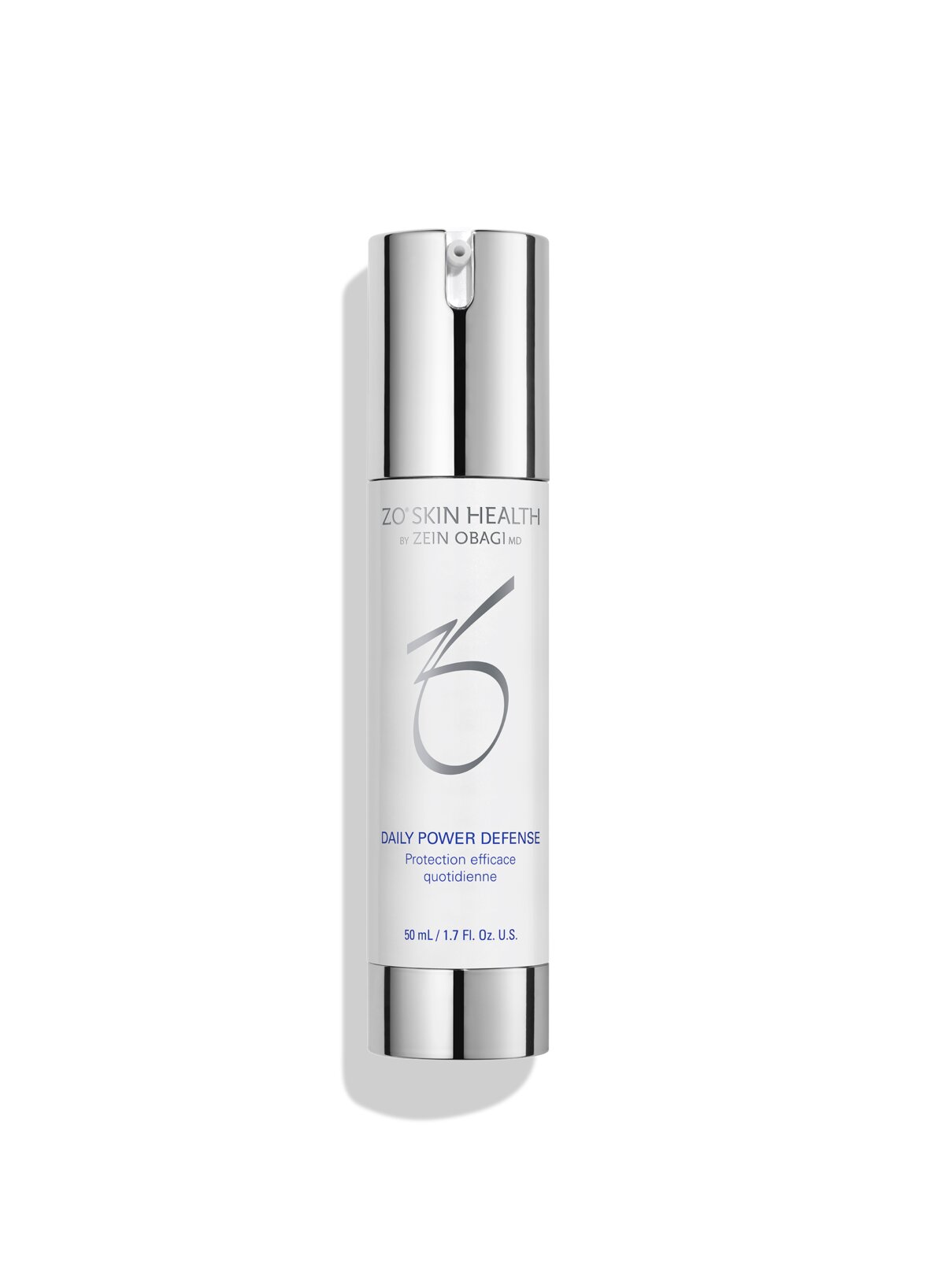
Most of the brand's famous bottles sit outside that list. Growth Factor Serum (200 dollars for 30 mL on the brand's own site) and Daily Power Defense (190 dollars for 60 mL on the brand's site) are cosmetics, so they don't file with FDA at all. Growth Factor Serum relies on plant and enzymatically derived growth factors, retinol, and peptides. Daily Power Defense carries retinyl palmitate, a milder vitamin A ester that releases retinol slowly, which is why ZO can tell its providers to use it both morning and night.
The dark spot line that FDA calls unapproved
The receipt is here. ZO's Pigment Control line, the dark spot creams every provider pushes, is the only part of the brand FDA treats as prescription drugs. For a longer walk through how the dark spot shelf reads at other brands, see our teardown of how Topicals' Faded serum stacks five dark spot ingredients on one label.
In the National Drug Code directory, each of the four Pigment Control products is listed with a marketing category of "unapproved drug other" and a product type of "human prescription drug." The DailyMed label for Pigment Control Creme Hydroquinone, updated August 21 2026, lists the active as hydroquinone at 40 mg per mL (4 percent). That's the standard prescription strength.
What unapproved actually means: FDA has not reviewed the product's safety or effectiveness, and the company has not filed a New Drug Application for it. That label is common for hydroquinone creams on the US market. For a long stretch, OTC hydroquinone sat under FDA's monograph process for over the counter drugs, and in 2020 the CARES Act ended that process without approving the ingredient. Prescription hydroquinone kept selling anyway, through doctors who feel comfortable dispensing it. ZO's listing is the regulatory consequence: not banned, not approved, prescription only.
Outside the US, the picture is different. The European Union bars hydroquinone from leave on cosmetics under Cosmetics Regulation 1223/2009, Annex II (entry 1339). The current ban on hydroquinone in skin creams has stood in CosIng since 2001. The EU allows hydroquinone only in professional artificial nail systems. A ZO patient in Paris who tries to pick up a tube of Pigment Control at a pharmacy will not find one. Health Canada's Cosmetic Ingredient Hotlist takes the same line for cosmetic products.
None of this is a safety verdict on a 4 percent hydroquinone cream a dermatologist writes for a specific patient. It does mean the dark spot cream everyone associates with medical seriousness is, on paper, a drug FDA has never reviewed.
In a statement on its current site, the company says its products are developed under medical supervision and dispensed by trained providers, and the Pigment Control line is described as a prescription option used alongside professional treatment. The company has not published a response to its hydroquinone creams' unapproved listing as of October 19 2026, per our search of its press page and the Wayback Machine captures of zoskinhealth.com. Galderma's October 14 2026 release does not mention hydroquinone either. Dr. Obagi's stated position, repeated in interviews since 2007, is that his dark spot regimen was designed for use under a doctor's supervision, and that the dispensing model is the point.
For context, our earlier post on The Ordinary's 1 percent retinol and Europe's new 0.3 percent face cap walks through the different rules EU and US regulators apply to vitamin A, a similar transatlantic gap to the one hydroquinone shows.
What has Blackstone done to ZO since 2020?
Six years of ownership tends to leave footprints. Blackstone's own 2020 press line said it would help ZO scale. On Galderma's deal page, we count what changed in the brand's shape: ZO now reaches more than 16,500 physician, medical spa and online accounts, up from a smaller base. Net sales reached about 330 million dollars for the twelve months through June 2026. Galderma is paying roughly 4.5 times that figure. Growth under Blackstone was not nothing. Doubling revenue in a six year hold is a passable number for a mid size consumer brand, if that is what happened.
Three other patterns show up when I compare the current catalog to older captures on the Wayback Machine. The sunscreen line widened: a Daily Sheer SPF 50 and tinted mineral options joined the SKU count. The provider finder expanded past a thousand US locations into more international markets. And the brand kept its retinol percentages: Retinol Skin Brightener still sells at 1 percent, alongside 0.5 and 0.25 percent variants, a holdover from the Obagi protocol era. The EU's new 0.3 percent cap on retinol in face products, which takes full effect May 1 2027, applies only inside Europe. ZO's US bottles are not affected by that cap. We did not find a public announcement of a US retinol reformulation.
One thing has not changed: the channel.
ZO is still doctor dispensed. Blackstone didn't take the brand back into Sephora, Ulta or Amazon, and nothing in Galderma's statement promises that the next owner will. It's not clear anyone wants that to change.
What stays the same if the deal closes?
Deals this size take time. Galderma's close is scheduled for late 2026 or early 2027, and antitrust review has to clear in the US and in Europe. In the meantime, three things are stable.
The channel is the same. ZO is sold through doctors and medspas, not retail. The regimen anchor is the same. Daily Power Defense is still the vitamin A step in nearly every ZO provider's protocol. The dark spot line is the same. Pigment Control Creme Hydroquinone 4 percent, filed with FDA on August 21 2026, is still the brand's third rail: the product that keeps dermatologists tied to ZO, and the one that cannot ship through a general retailer because of its prescription status.
What's likely to change after the close is further down the shelf.
Galderma already owns Alastin, a peptide led regenerative line, and Cetaphil, a mass drugstore cleanser. ZO fills the retinol and acid end of that portfolio. Expect overlap, with some pruning, and expect Galderma's medical sales force to start carrying ZO alongside Alastin into the same clinics. The company's statement calls the brands "highly complementary" and doesn't describe layoffs or discontinuations. We'll know more when Galderma reports its first quarter after close.
For a shopper, the practical question is price. If you buy ZO through a provider, your provider sets the markup. The brand's own suggested prices have crept up each year under Blackstone. A new owner that paid 1.5 billion dollars does not usually lower prices right after. If a 200 dollar growth factor serum is already a stretch, the deal is not a reason to switch; the deal is a reason to read the label on the bottle you already have.
How we read the record
On October 19 2026 we read every ZO Skin Health drug listing in the openFDA National Drug Code directory and in DailyMed. We cross checked Galderma's press release, Blackstone's 2020 announcement coverage, the brand's current product pages, and the FDA adverse event database. The adverse event file holds a single report under the brand name, from 2019, listing rosacea. FDA says a report in that system does not show the product caused the event, and the counts cannot be used to estimate risk. We did not find a recall under ZO Skin Health in the FDA Enforcement Report API, and we did not find a public FDA warning letter against the firm or its labeler.
None of this is a verdict on ZO or on hydroquinone. It is the record a shopper or a doctor can see for themselves.
1.5 billion dollars. That number stays on the deal page. The dark spot cream on the back shelf of your dermatologist's office is on the FDA page right next to it, and the family on the signature line sold it twice.
Snap a ZO bottle or any beauty or personal care product and Skinventry will show you who owns the brand right now, who makes it, and every public record FDA, DailyMed or an EU regulator holds against it, with a source for every line.
