The Ordinary's $9.90 Retinol 1% in Squalane holds 1% pure retinol, its own bottle says. A 2024 European Union rule caps retinol at 0.3% in face products, bars new stock above that line from November 1, 2025, and takes the rest off EU shelves by May 1, 2027. The US sets no limit. Estée Lauder has owned all of The Ordinary's parent company, Deciem, since May 2024.
You'll see it everywhere: if you want a strong retinol without a department store price, buy The Ordinary's Retinol 1% in Squalane. That part checks out. It costs $9.90 for 30 ml on the brand's US site, and the bottle reads "Solution of 1% Pure Retinol." What the advice leaves out is that the European Union decided in 2024 that a face product may hold no more than 0.3%, which puts this bottle at more than three times the line.
We read the labels of 4 retinoid serums on The Ordinary's US, German and French sites on October 16, 2026, then checked the record behind the brand: its owner's filings with the SEC, its federal drug labels, and FDA's recall and adverse event data. Here is what the product page won't tell you.
What Europe's Retinol Rule Actually Says
Commission Regulation 2024/996, published on April 4, 2024, added retinol, retinyl acetate and retinyl palmitate, the three forms the rule calls vitamin A, to the EU's list of restricted cosmetic ingredients. The regulation sets the limits at 0.3% retinol equivalent in leave on and rinse off products and 0.05% in body lotion. Any product that contains them must also carry this line: "Contains Vitamin A. Consider your daily intake before use."
The deadline comes in two steps. From November 1, 2025, a product above the limit may not be placed on the EU market. From May 1, 2027, it may not be made available there at all, which means it comes off the shelf.
The reason isn't irritation. The EU's scientific committee on consumer safety concluded in October 2022 that vitamin A in cosmetics is safe up to those two levels, and the regulation says the extra vitamin A from cosmetics "may be of concern for consumers with the highest exposure to vitamin A," the 5% of people who already get the most from food and supplements. The cap is about your total intake, not about your skin.
Nothing like it exists in the US. FDA's list of prohibited and restricted cosmetic ingredients does not include retinol, and no federal rule sets a ceiling on how much a cosmetic can hold.
Which of The Ordinary's Retinoids Sit Above the Line?
The three squalane serums share one ingredient list of eight items, word for word. Only the strength changes. Here is how each one reads against the EU's 0.3% ceiling, using the brand's own US pages on October 16, 2026.
| Product | What the page says | US price | Against the EU's 0.3% line |
|---|---|---|---|
| Retinol 0.2% in Squalane | "0.2% retinol" | $8.10, out of stock that day | Under it |
| Retinol 0.5% in Squalane | "0.5% retinol" | $9.30 | Above it |
| Retinol 1% in Squalane | "1% retinol"; the bottle says 1% pure retinol | $9.90 | More than three times it |
| Retinal 0.2% Emulsion | Retinal, which the page calls "very high strength" | $14.90 | Not covered; retinal isn't one of the three forms the rule names |
One more bottle sits in a gray zone. Granactive Retinoid 2% Emulsion lists retinol after its main retinoid but doesn't print how much, so its standing can't be read off the page. Retinal sits outside the rule only because the rule names three ingredients and retinal isn't one of them.
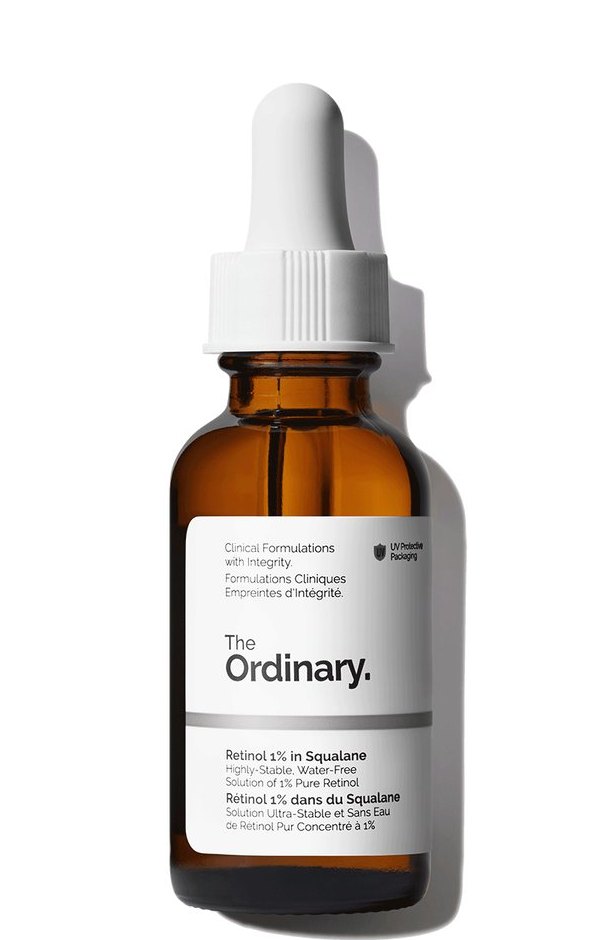
Is The Ordinary's 1% Retinol Still Sold in Europe?
Yes, for now. On October 16, 2026, The Ordinary's German site listed Retinol 1% in Squalane as in stock at €10.60, and its French site showed the same price, with the same ingredient list and the same "1% retinol" description as the US page. Retinol 0.5% was in stock at €10.40 on both.
The rule has room for that. It lets products placed on the EU market before November 1, 2025 stay on sale until May 1, 2027, and a product page doesn't say when its stock reached Europe. The company says on the same pages that its formulations "are updated from time to time" and that "the ingredient list shown here may vary from the box of the product depending on time and region of purchase." So a bottle in a European shop could differ from what the page shows. The German and French pages we read on October 16 matched the US page word for word, and The Ordinary has made no public statement about the EU rule that we could find.
For a shopper in Europe, the date that matters is May 1, 2027.
Who Owns The Ordinary?
Estée Lauder. The Ordinary is the flagship brand of Deciem, a Canadian company Estée Lauder bought in three steps. It already held about 29% when, on February 23, 2021, it agreed to raise its stake to about 76% for roughly $1 billion, a deal that put Deciem's total enterprise value at about $2.2 billion, according to Estée Lauder's filing with the SEC.
It closed on the rest on May 31, 2024. Estée Lauder said in its June 3, 2024 release that it paid an estimated $860 million in cash for the remaining interests, and put its total investment at about $1.7 billion net of cash. The same release said The Ordinary ranked among the top two prestige skin care brands in the US and Canada in the quarter that ended March 31, 2024.
Who Actually Makes It?
Estée Lauder describes Deciem as vertically integrated, meaning it makes what it sells, and the federal drug labels line up with that. FDA's directory of drug listings shows three over the counter products from Deciem as of October 16, 2026. The label for The Ordinary UV Filters SPF 45 Serum names Deciem Inc. as the company that labels, manufactures and packs it.
One of the three is newer than you might expect. The Ordinary's $6.70 Salicylic Acid 2% Solution is sold in the US as an over the counter acne drug. Its US page lists salicylic acid 2% as the active ingredient for acne treatment, and its Drug Facts label on DailyMed shows a marketing start date of September 9, 2025, filed by Deciem. A drug label has to print its strength and follow FDA's acne rule; a cosmetic doesn't, which is why the acne washes we compared read so differently on the back.
The Rest of the Record
FDA's drug recall records list no recall by Deciem as of October 16, 2026, in the agency's enforcement report database. FDA's adverse event database for foods and cosmetics, last updated in July 2026, holds 5 reports naming The Ordinary products, filed between 2020 and 2023. They name its caffeine eye serum, its glycolic acid toner and its niacinamide serum, among others, and the reactions listed most often are itching and allergic reactions, in 2 reports each. FDA says a report doesn't show that a product caused the reaction, and the counts can't estimate how common one is.
What to Check Before You Buy
In the US, the bottle prints the strength, so start at the bottom of the ladder. The company's own tip is to begin with Retinol 0.2% in Squalane and work up to 0.5% and then 1%, and it points people prone to sensitivity toward its Granactive Retinoid 2% Emulsion instead. The same page says to apply it in the evening, wear sun protection during the day, refrigerate the bottle after opening, and expect some irritation, redness and peeling early on while skin builds tolerance. Those are the brand's words, and they're sensible ones. As for results, the research on how long retinol takes to show results puts the honest window at 12 weeks, whatever the strength. If you're weighing retinol against retinal or a prescription, our guide to choosing a retinoid by concern covers the options.
In Europe, look for the line "Contains Vitamin A. Consider your daily intake before use." on anything with retinol in it, and expect strengths above 0.3% to leave shelves by May 2027. And if you take a supplement with vitamin A, the EU's reasoning was written with people like you in mind; it's worth a word with your doctor before you stack a strong retinol on top.
Anywhere, read the list, not the name. A product can say retinol on the front and carry very little of it, which is the trap we covered in reading where retinol sits on an ingredient list. The Ordinary is one of the brands that prints the number.
What we still don't know: whether The Ordinary will sell a 0.3% version in Europe after May 2027, or keep its 0.5% and 1% serums for the countries with no ceiling. Its product pages don't say yet.
Photograph a bottle of Retinol 1% in Squalane and Skinventry shows its published ingredient list, Deciem as the company that makes it and Estée Lauder as the owner, with a source on every line.
