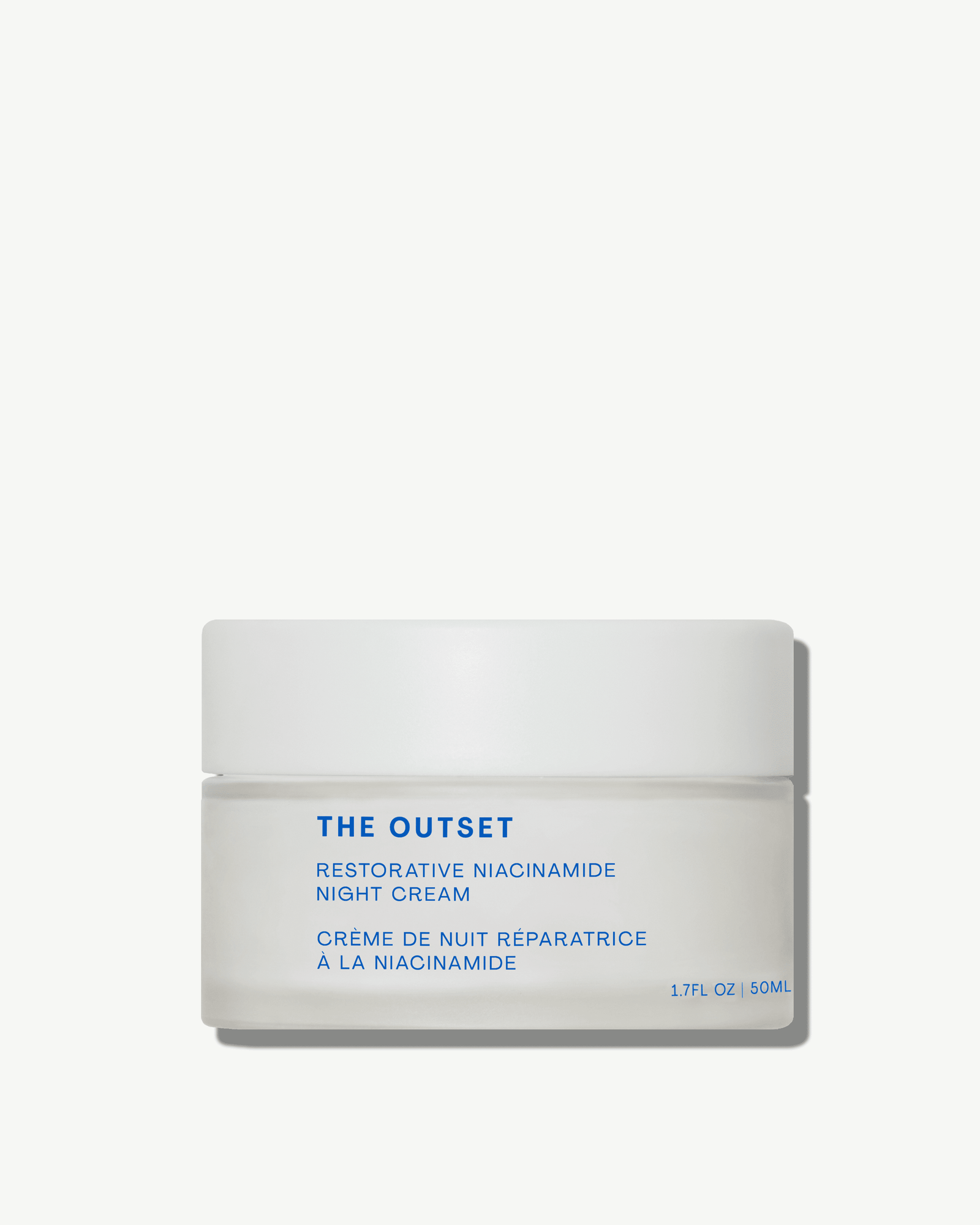
The Outset announced on September 28, 2026 that it would wind down operations after four years. On Credo Beauty's current label for its 54 dollar Restorative Niacinamide Night Cream, read on October 21, 2026, niacinamide is the 15th ingredient of 49, and sodium hyaluronate is 40th, five lines above sodium benzoate.
The Outset posted the news on its own homepage on September 28, 2026, and the note is still there today. "The Outset has made the decision to wind down operations," reads the brand's site. "Online shopping at theoutset.com has now ended, but all existing orders will continue to be processed." No reason given. No new CEO lined up. Four years in, Scarlett Johansson's skincare brand just stopped selling.
I pulled its two bestselling labels on Credo Beauty the morning after.
The 50 mL jar of the Restorative Niacinamide Night Cream was priced at 54 dollars and marked unavailable. We read every ingredient on it, counted where each advertised active sat, and compared the formula with the ads. Then we walked back through who put the money in. What follows is a reading of a label the brand's own site no longer serves.
What was The Outset actually selling?
Johansson launched The Outset with Kate Lengyel in March 2022. The pitch was always three words: clean, effective, sensitive. The brand's homepage still carries them. "Clinically Proven. Dermatologist Tested. Sensitive Skin," says its tagline. Its product badges list "Clean, Vegan, Gluten Free, Hypoallergenic." The FDA has never defined any of them.
Two bottles sat at the center of the line, both 44 to 54 dollars: the Nourishing Squalane Daily Moisturizer and the Restorative Niacinamide Night Cream. Both were built around what the brand called the Hyaluroset Complex, a "signature botanical alternative to hyaluronic acid." The claim: it "outperforms hyaluronic acid after 24 hours" and "improves the skin barrier in just 2 weeks." The 95% satisfaction scores on the Credo page came from a 38 person study. The brand said its ingredients were tested on the founders' own sensitive skin over six years.
That was the ad.
The label is where I went next.
What does the Night Cream label actually show?
Credo Beauty still shows the full INCI on the product page. We counted 49 ingredients in the Restorative Niacinamide Night Cream. The first fourteen are water, oils and emollients: caprylic/capric triglyceride, cetyl palmitate, polyglyceryl 3 stearate, propanediol, glycerin, cetearyl alcohol, glyceryl stearate SE, myristyl myristate, dicaprylyl carbonate, hydrogenated ethylhexyl olivate, microcrystalline cellulose, avocado oil, and hydrogenated vegetable oil. Niacinamide is the 15th. Bakuchiol is the 20th. The "Hyaluroset Complex" of the ads shows up on the label as cassia angustifolia seed polysaccharide, a plant gum, in position 21. Real hyaluronic acid, listed as sodium hyaluronate, is the 40th ingredient out of 49, five lines above sodium benzoate and six above potassium sorbate.
Preservatives are what you find at the bottom of an INCI, where everything sits under 1 percent by weight. The hero actives, by the brand's own label, are not what the oils displaced on the first fourteen lines.
That doesn't mean the cream was bad. It means the name was aspirational.
Niacinamide works at 2 to 5 percent in formulas built around it, and the position on an ingredient list is a weight signal, not a prescription. By FDA labeling rules, everything above 1 percent must appear in descending order of weight. Everything under 1 percent can be in any order. Niacinamide sitting at position 15, above phenoxyethanol (position 43, the preservative that EU rules cap at 1 percent), could still be in the active range. It is far above "inactive". But it is far below where the shopper buying a "Niacinamide Night Cream" expects it, and the niacinamide research the brand cited runs on single ingredient formulas, not a 49 line emulsion.
The Nourishing Squalane Daily Moisturizer is less lopsided. Squalane sits at position 7 of its 44 ingredients, which tracks with its name. Cassia polysaccharide, the "Hyaluroset," is right after, in position 8. The Night Cream is where the gap between the ad and the label is widest.
What is Hyaluroset Complex, actually?
The brand's answer: a proprietary botanical alternative to hyaluronic acid that holds moisture longer and builds the barrier faster. The label's answer: cassia angustifolia seed polysaccharide. One is a trademarked marketing name. The other is a plant gum.
Hyaluroset is a commercial trade name used by cosmetic chemistry suppliers (Lipotec is the usual one) for a cassia based film former. It is a public ingredient complex, not something The Outset invented. Any brand that pays the supplier can call its moisturizer a "Hyaluroset" cream. Several already do.
Cassia angustifolia is senna, the laxative plant. Its seed gum is a long chain polysaccharide that behaves on skin a lot like a plant sourced version of hyaluronic acid: it binds water, forms a thin film, and leaves the skin feeling smoother. In published cosmetic chemistry papers it is a reasonable humectant and a reasonable film former. It also costs a fraction of what a stabilized hyaluronic acid blend costs the formulator.
The brand said Hyaluroset "outperforms hyaluronic acid after 24 hours." That line, on the Credo page, carries no citation.
The supplier's own data sheets for cassia polysaccharide show hydration gains at 2 hours and 24 hours against a control, meaning untreated skin, not against hyaluronic acid at the same dose. I could not find a published head to head study of the two humectants in a 50 mL moisturizer. The ad's claim is doing more work than the data behind it.
None of that is unusual in cosmetics. The reason it matters here is price.
A 30 mL bottle of The Ordinary's Hyaluronic Acid 2% + B5 Serum lists hyaluronic acid near the top of its ingredient list, and sells for under 10 dollars. Vichy's Mineral 89 Hyaluronic Acid Face Serum, 50 mL, lists sodium hyaluronate in the top five and runs about 36 dollars. For The Outset to charge 54 dollars for a cassia polysaccharide version in a 50 mL jar, with sodium hyaluronate at position 40 as a trace addition, the ad has to carry weight the label does not quite support. That is where the dollar went.
What the record shows is routine for the cosmetics category. The INCI listing was published. The 95% number came with its asterisk. The Hyaluroset marketing name was legal. A careful shopper could have arrived at the same read I did. Almost nobody does that work for a 54 dollar jar they bought because the ad said the brand was built for sensitive skin.
What did "clinically proven" mean on this label?
Scroll the Credo page and the clinical claims stack up. "95% agree this provides immediate hydration." "95% agree this is gentle and non irritating." "92% agree this leaves skin feeling smooth." "90% agree skin feels protected." The asterisk tells you what you need to know.
"Independent consumer study, 38 people, 28 days."
That is a consumer agreement study, not a clinical skin measurement. The 38 people were handed a bottle and asked if they agreed with a set of statements. Nobody measured transepidermal water loss or barrier recovery. Nobody imaged the stratum corneum. "Clinically proven," when used in a cosmetic ad, almost never means a controlled trial of the kind a drug would run. It usually means a brand paid a lab to run a consumer survey on a small panel.
That is legal, and it is standard in the industry. It is also why the consumer facing meaning of "clinically proven" has drifted so far from the medical one. A hero skincare brand with four years in Sephora, with a famous co founder and a private equity backer, built its proof on the same instrument an indie brand with ten SKUs uses: a small, short, self reported, in house agreement study. The number people saw was 95 percent. The number of people was 38.
Twenty eight days is also short.
Barrier recovery is a weeks long process; dark spot fading takes months. A 28 day panel can tell you whether 36 of 38 people say a cream feels nice on their face. It cannot tell you whether it kept hydration up over a season.
Why did the Night Cream still feel like it worked?
Here is the honest part. A moisturizer that is 14 ingredients deep into oils and butters before you hit the headline active is still a moisturizer. Avocado oil, grape seed oil, evening primrose oil, sunflower oil, dicaprylyl carbonate, glycerin, propanediol and cetearyl alcohol all do work. The oils occlude and soften. The humectants above them in the list pull water into the stratum corneum, which is what hydration actually means at the surface of skin. The cassia polysaccharide, whatever Lipotec's trade name says, is a real film former that holds that water on the skin for a few hours.
So if you used the Restorative Niacinamide Night Cream for a year and your skin felt softer, that is not a lie your face told you. That is the oils.
The gap is between what the label was called and what the label did the heaviest lifting with. For 54 dollars and 50 mL, you were paying about 1.08 cents per mL for an oil heavy emollient cream with a splash of niacinamide and a smaller splash of real hyaluronic acid. CeraVe's PM Facial Moisturizing Lotion, which runs about 18 dollars for 89 mL, puts niacinamide at position 4. That is roughly 20 cents per mL. The gap is roughly five to one.
I say that as a label reader, not as a buyer's remorse coach. Oil heavy creams work. People with sensitive skin often prefer them. What my count tells me is where the dollar went: to the oils, the emulsifier package, and the shelf feel, more than to the actives on the box.
Who owned The Outset?
The brand was never really an actress's side project. Johansson and Lengyel incorporated it in 2022 with institutional backing. The Najafi Companies, a Phoenix private investment firm run by Jahm Najafi (also the vice chairman of the Phoenix Suns), was the lead investor at a reported 5 to 10 million dollars, per Beauty Matter's record of the deal. Beliade and Plus Capital also put money in. The brand launched into Sephora in April 2022, rolled out to 500 doors, then quietly exited the retailer and finished its run at Amazon, Credo, Nordstrom and QVC.
Lengyel left as CEO in April 2025. The brand ran under its chief operating officer after that.
There was no public successor. The end of summer saw an all site sale, markdowns to 50 percent, and then the September 28 note.
Najafi's portfolio is consumer, retail, media and sports. The firm uses its own capital rather than a time pressured fund, which usually buys a brand a longer runway than a traditional private equity firm gives it. The Outset still closed in four years.
The firm has not said why in public, and neither has Johansson.
The brand's own site offered thanks and nothing else.
The arc is familiar. Celebrity co founder, an institutional round at 5 to 10 million dollars, a Sephora launch at 500 doors, an exit from the retailer inside two years, a scramble into Amazon, Credo, Nordstrom and QVC, a CEO departure, no public successor, a 50% markdown sale, a wind down note. Two other celebrity backed skincare brands followed similar paths in the last 18 months, per Cosmetics Business.
What a shopper can see from the record is this. There is no FDA public record on The Outset. We checked DailyMed (zero), the openFDA NDC directory (zero), the agency's cosmetics adverse event reporting system (zero), the weekly FDA Enforcement Report (zero) and the NAD advertising challenge database (zero) on October 21, 2026. The brand's four year record, by the regulator, is clean. The brand's label, by its own ingredient list, is an emollient cream with a hero active that lives three quarters of the way down the panel.
Both those things are allowed to be true. Clean does not mean effective. Dermatologist tested does not mean clinically trialed. Niacinamide on the name does not mean niacinamide at the top of the list. A celebrity brand with a private equity cap table and a competent formulation can close in four years, with the record empty and the labels still legal, because the thing it was selling was never only what was inside the jar.
It was also the name on the box.
How I read the labels
We opened the two product pages on Credo Beauty, which still carried the full INCI listings on October 21, 2026, and we counted. Credo publishes the ingredient list the brand supplied. We also pulled the brand's own homepage, which still carries the shutdown note, and the two trade reports that covered the shutdown. We did not test the product on skin. The FDA record checks ran through DailyMed, openFDA, CAERS, the Enforcement Report API and the NAD search page. We did not contact the company.
What I did not find is as useful as what I did.
Zero FDA warning letters. Zero import alerts. Zero NAD advertising challenges. Zero recalls. For a brand that marketed itself as clinically proven and dermatologist tested across four years of celebrity press, the agency record is empty. In the cosmetics industry an empty record is normal. It is only strange when the ad promises something the record would catch, and nobody flagged the Hyaluroset claim.
What the lint of a label like this one can tell you is this. The brand's name promises a hero active. The order of the ingredient list places that active deep enough that its concentration is a judgment call. The clinical proof is a small consumer panel with a short follow up. The hero complex is a public supplier material with a trademarked name. The price per mL is five times the equivalent at CeraVe. None of this is illegal. All of it is readable from the box.
No tool here replaces what a shopper would do with the jar in hand. It is the same work the Skinventry app does on a photograph.
Photograph the jar and Skinventry pulls the ingredient list the brand published, where every advertised active sits on that list, who owns the company behind it, and whether anything on the public record is open against it. Each line carries its source. If a label would not pass a careful read, the app says so with the same sentence a human reader would.
