Topicals is a private, venture backed company, not part of a big beauty group, that Olamide Olowe cofounded in 2020, and since September it's been run by former Fenty Beauty executive Sukiana Chancy. One of its hero products, the Faded serum, lists 35 ingredients. Niacinamide and tranexamic acid are listed near the top. Azelaic acid and melatonin are listed so far down that they're likely at 1 percent or less.
Topicals says it has sold more than 10 million eye masks. That number comes from founder Olamide Olowe herself, who posted it on X in September alongside two others: 12 times revenue growth in five years, and more than $22 million raised from venture investors, as Black Enterprise reported on September 8, 2026.
She posted them on her way out of the CEO job.
So here's who owns Topicals now, who runs it, and what's actually inside Faded, the dark spot serum the trade press lists first among its hero products. I read the labels myself, and the order on one of them tells a different story from its product page.
Who owns Topicals?
No big beauty group sits above Topicals. It's a private company that Olowe cofounded with Claudia Teng, and it launched in 2020. Both founders had originally planned careers in dermatology, according to TheIndustry.beauty, and the brand pitches itself on doing a lot with a few products at prices people can reach. Its outside money comes from venture investors. In November 2022, the brand raised $10 million in a round led by CAVU Consumer Partners, and in January 2026 the basketball player Angel Reese and the singer Rema joined as investors, according to Black Enterprise. Topicals hasn't published who holds what share of the company, so that part of the chain stays private.
That's a different shape from the Neutrogena story we covered earlier today, where the brand sits inside a public company that's in the middle of being sold. Here, the chain stops at the company itself.
What changed at Topicals in September
On September 3, 2026, Topicals named Sukiana Chancy chief executive, with Olowe moving to chair. Chancy spent almost four years at Fenty Beauty as global general manager and vice president, and before that held senior marketing roles at Cay Skin, DevaCurl, The Estée Lauder Companies and Elizabeth Arden.
Olowe isn't leaving. She told Business of Fashion she wanted a partner who had built a global brand and managed a far bigger profit and loss than Topicals has, and Black Enterprise reports she'll stay involved in daily operations. The plan is growth across Africa, Europe and the Middle East. Topicals already sells through Sephora in the US, Canada and the UK, where it launched in April 2024, and through Beauty Hut in Nigeria.
"My role is creating more infrastructure to help amplify [the message] and bring it to as many eyeballs and faces as possible," Chancy told Business of Fashion, as quoted by Black Enterprise.
Chancy, for her part, said she'd been obsessed with Topicals since it launched, and Black Enterprise reports that the brand's cultural positioning was one of the reasons she took the job. Beyond Faded, the UK lineup that Sephora carries includes High Roller, a bump relief tonic, Slick Salve, a mint lip balm, and an exfoliating body serum.
For a shopper, a new CEO doesn't change a formula overnight. What it can change is where you'll find the brand, and how quickly.
What does Faded actually contain?
On October 5, 2026, we read the full ingredient list for Faded Brightening and Clearing Serum, the unscented version Topicals sells now, on its own product page. It lists 35 ingredients. The page leads with five: tranexamic acid, niacinamide, azelaic acid, kojic acid and melatonin.
| Ingredient | Spot on the list | What Topicals' page says it does |
|---|---|---|
| Niacinamide | 4th of 35 | Improves the look of dark spots, blotchiness, sallowness and fine lines |
| Tranexamic acid | 6th | Has shown efficacy on UV induced hyperpigmentation when applied to skin |
| Arbutin | 8th | Not one of the five the page leads with |
| Kojic acid | 12th | Visibly reduces hyperpigmentation |
| Phenoxyethanol, the preservative | 14th | Keeps the formula from spoiling |
| Azelaic acid | 20th | Helps prevent the look of hyperpigmentation and smooths texture |
| Melatonin | 34th | Helps reduce the look of dark spots |
Three of the five headline ingredients sit above the preservative. Two sit below it.
Here's why that line matters. Under US rules, a cosmetic label can list every ingredient above 1 percent in descending order of amount and then the ones at 1 percent or less in any order at all. Phenoxyethanol is a preservative that EU rules allow at a maximum of 1 percent. If Faded's phenoxyethanol sits at or under that limit, everything printed after it, azelaic acid and melatonin included, is at 1 percent or less. We walk through the same logic in our breakdown of the 1 percent line on retinol labels.
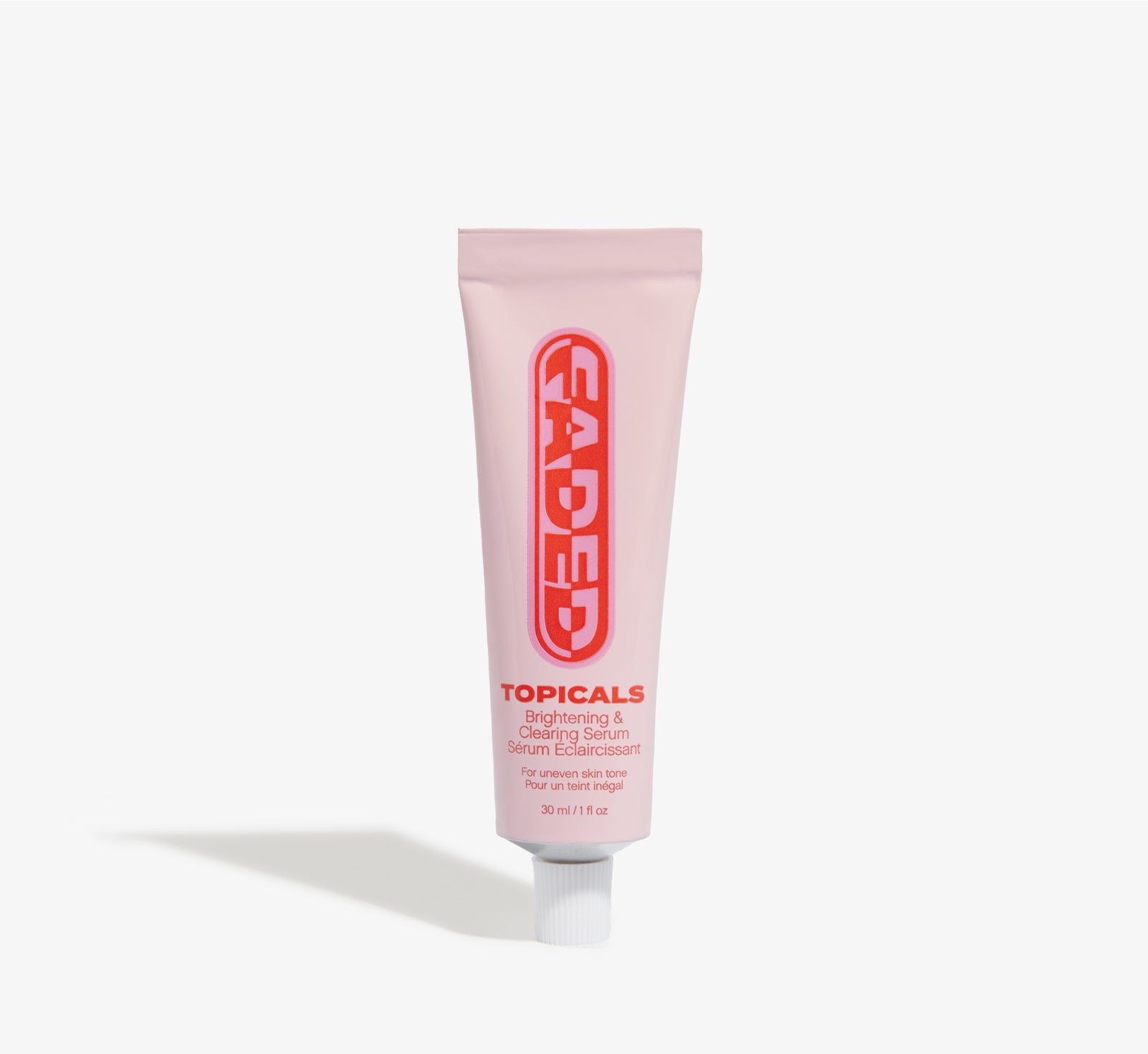
Most of the rest is the base. Water, caprylic and capric triglyceride and glycerin come first, with shea butter 5th and jojoba seed oil 9th. Squalane is 21st, turmeric extract 26th, centella leaf extract 33rd, and licorice root extract closes the list at 35th. When I set the page's five headliners against that full list, the gap between what's featured and where it sits was the most useful thing I learned. The tube itself says it's for uneven skin tone.
For scale, prescription azelaic acid comes as a 15 percent gel or a 20 percent cream. If Faded's azelaic acid is at 1 percent or less, it's a small fraction of either. Topicals doesn't claim otherwise, and it doesn't publish the number.
Does tranexamic acid work on dark spots?
Tranexamic acid has a sizable body of research behind it for melasma, a common cause of stubborn brown patches on the face. A 2024 meta analysis in the Journal of Dermatological Treatment pooled 22 randomized trials with 1,280 patients and found it significantly reduced melasma severity scores. The catch is how it was given. Taken by mouth, it showed the biggest drop, followed by injections, with topical use behind both. Treatment in those trials ran from 8 weeks to nearly two years. The authors flagged high variation between studies and said dosing still needs to be standardized. Across the trials, reported side effects included stomach upset, skin irritation and menstrual changes.
So a serum with tranexamic acid sixth on its list is using an ingredient with real evidence, through the route with the least of it. That isn't a reason to skip Faded. It's a reason to expect weeks, not days, and to keep up daily sunscreen while you wait. If you want the backstory, here's how a drug made to stop bleeding ended up in dark spot serums.
The rest of the Topicals lineup
We read two more ingredient lists the same day. Faded Under Eye Masks, sold in packs of 6 or 18 pairs, list 24 ingredients, with niacinamide 6th, tranexamic acid 8th, kojic acid 9th, two forms of arbutin 10th and 11th, and caffeine 12th. Like Butter, a $34 moisturizer in a 1.7 fluid ounce size, is built around 1 percent colloidal oatmeal, which Topicals describes as an FDA approved over the counter ingredient for redness and irritation from dry skin. Its 50 item list also puts niacinamide 4th.
I lined the three lists up side by side, and a few things repeat. None lists fragrance. Niacinamide shows up in every one, never lower than 6th. Tranexamic acid appears in two of the three.
That much niacinamide adds up. If you're already using another niacinamide product, it's worth checking how much you're stacking before you add Faded on top of it.
Where Faded falls short
The upside is easy to see. Faded puts niacinamide, tranexamic acid, arbutin and kojic acid, four ingredients Topicals' own pages pitch for uneven tone, above its preservative. It's unscented, and on Topicals' site it comes in a $9 trial size, an $18 mini and a $38 jumbo, so you can try it before committing.
The downside is what the label can't tell you. Topicals doesn't publish percentages, so there's no way to know how much tranexamic acid or niacinamide is in the tube. Two of the five ingredients the page advertises are listed so far down that they're likely at 1 percent or less. And the strongest evidence for tranexamic acid comes from routes a serum can't use.
None of that makes Faded a bad buy. It does make the front of the page a poor guide to what's doing the work.
Is Faded worth it?
Worth it for the niacinamide and tranexamic acid near the top of its list. Not for the azelaic acid and melatonin near the bottom.
Photograph the tube and Skinventry lays out every ingredient in Faded, names the company behind it, and tags the source for each fact it shows.
