Neutrogena belongs to Kenvue, the consumer health company Johnson & Johnson spun off in 2023, and Kimberly Clark has agreed to buy Kenvue once regulators outside the US sign off. Its two new face sunscreens carry bemotrizinol, a filter the FDA allowed in June 2026, at 6 percent, next to three older filters.
In 1994, Johnson & Johnson agreed to pay a net price of about $924 million for Neutrogena, according to its own filing that year. J&J bought about 98.6 percent of the shares through a tender offer in the last week of September and completed the merger on October 3, 1994. Thirty two years later, the brand could soon answer to its third corporate parent since that deal.
That's the business story. The product story landed on September 17, when Neutrogena launched two face sunscreens built on bemotrizinol, a filter American brands couldn't use until this summer. I read both labels today. Here's what's inside, and who you're actually buying from.
Who owns Neutrogena right now?
Kenvue does. Johnson & Johnson moved its consumer health brands into Kenvue, sold Kenvue shares to the public in May 2023, and finished the split through a share exchange it reported on August 23, 2023. Neutrogena went with it. In that final exchange, J&J took back 190,955,436 of its own shares and handed out 1,533,830,450 Kenvue shares. Kenvue is the same company that makes Tylenol.
So a Neutrogena bottle bought today is a Kenvue product.
That chain, from a drugstore brand up to a listed parent, is exactly the kind of thing we started mapping for every brand you buy last month. It rarely shows up on the box.
Is Kimberly Clark buying Neutrogena?
Yes, though it isn't done. On November 2, 2025, Kimberly Clark, the Kleenex maker, signed an agreement to buy Kenvue. Its quarterly filing for the period ended June 30, 2026 lays out the terms: each Kenvue share converts into 0.14625 of a Kimberly Clark share plus $3.50 in cash, which works out to roughly 280 million new shares and about $6.7 billion in cash.
Shareholders of both companies have approved it. The US antitrust waiting period expired on February 4, 2026. What's left is approval abroad, and on September 23 Reuters reported that Kimberly Clark had offered the European Commission concessions to address its antitrust concerns, while the Commission moved its decision deadline from September 29 to October 13. The filing still expects the deal to close in the second half of 2026.
Reuters added that the Commission would likely ask rivals and customers for feedback before it accepts the concessions, asks for more, or opens a full investigation that would run about four months. The stakes aren't small on either side. Under certain circumstances in the merger agreement, either company may owe the other a $1.1 billion termination fee, and Kimberly Clark reported $157 million in acquisition related costs in the first six months of 2026 alone.
Until it closes, nothing changes hands. The merger note in that filing also says nothing about what happens to individual brands like Neutrogena afterward. That part is unwritten.
What we found on the two labels
On October 5, 2026, we read the Drug Facts panels for both new sunscreens on Neutrogena's own site: the Clear Face SPF 60 and the Ultra Sheer Daily Face SPF 70. Each is a 1.4 fluid ounce bottle.
| On the label | Clear Face SPF 60 | Ultra Sheer Daily Face SPF 70 |
|---|---|---|
| Avobenzone | 3% | 3% |
| Bemotrizinol | 6% | 6% |
| Homosalate | 15% | 15% |
| Octisalate | 5% | 5% |
| Filters in total | 29% | 29% |
| The one different inactive ingredient | Niacinamide, 15th of 17 | Acetyl dipeptide 31 amide, 16th of 17 |
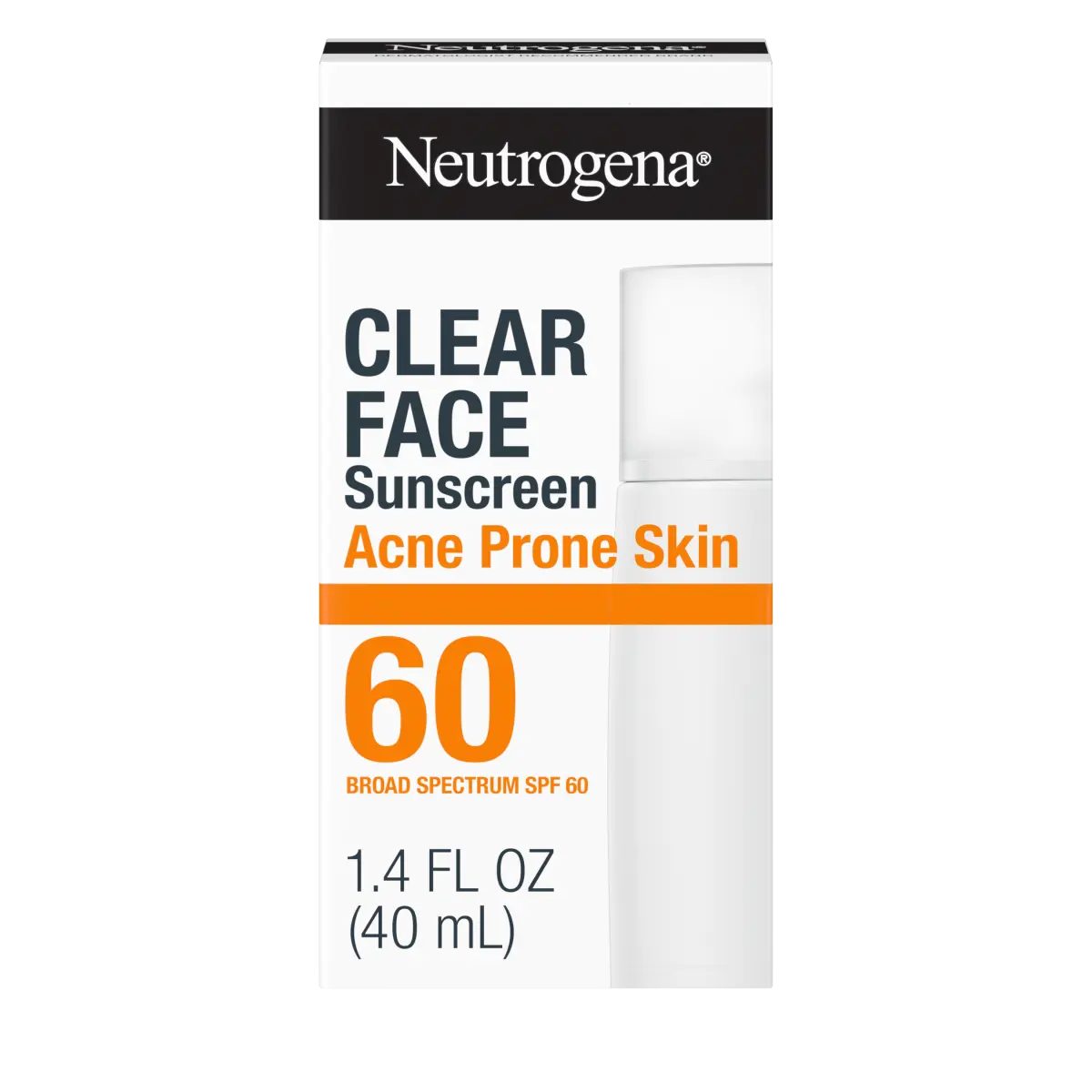
The filters are identical, down to the percentage. Of the 17 inactive ingredients on each label, 16 are the same and run in the same order. The skincare extras each brand page leads with sit near the bottom of their lists, after the preservatives, and neither label says how much of either is in the bottle. If you want to know why the spot an ingredient holds on the list matters more than the front of the box, that's the short version.
What does bemotrizinol do, and what can't it do alone?
Bemotrizinol, often shortened to BEMT, is a sunscreen filter. The FDA's final order, announced in the Federal Register on June 10, 2026, added it to the US sunscreen monograph at concentrations up to 6 percent. A sunscreen that uses it within those conditions is generally recognized as safe and effective. The request came from DSM Nutritional Products, which filed it on September 23, 2024. Both Neutrogena formulas use the full 6 percent the order allows. Kenvue's own launch release is plain about the limit: it says BEMT drives higher UVA protection than filters without it, but that at concentrations up to 6 percent it needs additional filters for full UVA and UVB coverage. That's why the other three filters are there. In these bottles, bemotrizinol supplies 6 of the 29 percentage points of filter. Homosalate supplies 15.
The order comes with conditions, too. It limits which other filters and skin protectants bemotrizinol can be combined with, and which forms a product can take, from oils, lotions and creams to gels, ointments and sticks. A brand can't simply drop it into anything.
UVA is the part of sunlight tied to visible aging, and the US label never gives it a number of its own, which is a gap the PA rating used in Asia tries to fill.
"As a leader in suncare, Neutrogena has a responsibility to keep advancing the category," said Chris Riat, Global Neutrogena Brand Leader, in Kenvue's September 17 launch release.
How to wear them, going by the label
The directions are the standard ones. Both labels say to apply generously and evenly 15 minutes before sun exposure, then reapply at least every 2 hours. Kenvue's own launch release names the catch: heavier, high SPF textures lead some people to underapply sunscreen or skip it altogether. That matters more than the number, because the protection you get depends on how much you put on.
Neither one is water resistant.
The label tells you to switch to a water resistant sunscreen if you're swimming or sweating, so these are for an ordinary day, not the pool or a long run. Both also warn that they may stain some fabrics and say not to use them on damaged or broken skin.
A few other things we checked while reading. Neither ingredient list includes fragrance. Both list feverfew flower, leaf and stem juice near the bottom, and both rely on the same three preservatives: phenoxyethanol, hydroxyacetophenone and chlorphenesin. Counting the four filters, the two bottles share 20 of their 21 ingredients.
So which one? Neutrogena pitches the SPF 60 at acne prone skin and the SPF 70 at visible signs of aging. On paper, the difference is one inactive ingredient and ten points of SPF.
Where the new formulas fall short
The upside is real. Neutrogena, which calls itself the top sunscreen brand in the US, is putting a filter its own product page says is used in many Korean sunscreens into two drugstore bottles, and both carry the most the FDA allows. It wasn't first, though: Ultra Violette announced the first US bemotrizinol sunscreen weeks earlier.
The downside is everything around the new filter. Homosalate makes up more than half the filter load. In 2021, the FDA proposed that homosalate, octisalate and avobenzone, the three older filters in these bottles, need more data before the agency can call them generally recognized as safe and effective, and it says that request is not a conclusion that they're unsafe. In Europe, a 2022 Commission regulation caps homosalate at 7.34 percent in face creams and pump sprays, less than half the level printed on these two labels.
US rules allow all four filters. Still, the newest one is about a fifth of the filter load, and the oldest of the four supplies more than half.
Availability is the other practical limit for now. Kenvue's September 17 release says both sunscreens are on amazon.com and will reach retailers nationwide soon, so the drugstore shelf near you may not carry either one yet. If it doesn't, that's why.
If you're pregnant or shopping for someone who is, our read of five pregnancy sunscreen picks walks through how the advice treats chemical filters like these.
What I still don't know
I don't know whether the European Commission signs off on October 13, or what Kimberly Clark agreed to give up to get there, because the Commission didn't publish the remedies. If the deal closes, the next Neutrogena bottle you pick up would come from the company that makes Kleenex. Write back if you've tried either one and noticed how it wears.
Photograph either bottle and Skinventry lists its four filters, follows the brand up through Kenvue, and lays out the public record, with a source on every line.
