We compared five serums marketed for freckles and dark spots on their published formulas and the research behind their actives. Our pick is DRMTLGY Hydra Fader at $56, a kojic acid serum on a hydrating base that DRMTLGY pitches as safe for sensitive skin.
A serum sold for freckles can lean on niacinamide, vitamin C derivatives, or peptides as the hero. Those are support actives. That is how a $60 bottle bought in March can do little for the freckles that bloom after one beach weekend. Fading research centers on blocking tyrosinase, the enzyme that makes melanin, which is the subject of a 2019 review of tyrosinase inhibitors in the Journal of Enzyme Inhibition and Medicinal Chemistry. Barrier support is not that.
This piece compares five serums on what can be checked: the active each one leads with, its dose where the brand discloses it, its price, and the research on that active. What the evidence says about copper peptides, and about why the honest answer to freckle fading is not a serum at all, is at the bottom. Read that part.
How this comparison works
Every claim below is checked against primary sources: PubMed indexed research, the American Academy of Dermatology's guidance on dark spots, and each brand's own product page. The full source list is at the bottom.
Who this is for
Adults over 21 who have visible freckles, sun spots, or post inflammatory hyperpigmentation from acne, and who want a serum they can layer under sunscreen daily. If your dark spots are melasma, meaning a diffuse patch across cheeks or forehead that darkens with heat and hormones, none of these serums will solve the underlying trigger. For a fuller treatment, read our cysteamine 5% explainer on melasma, or the derm route that is tretinoin with hydroquinone under a doctor's supervision.
How we picked
The four picks had to meet three rules. One, lead with a pigment active rather than a support act. Two, cost under $80 at retail. Three, be available without a prescription in the US. That knocked out hydroquinone (prescription only in the US since 2020), cysteamine cream (currently a niche buy), and every product whose only actives were niacinamide or vitamin C alone. Those are barrier and antioxidant plays. They are not first line pigment faders.
Our pick: DRMTLGY Hydra Fader ($56)
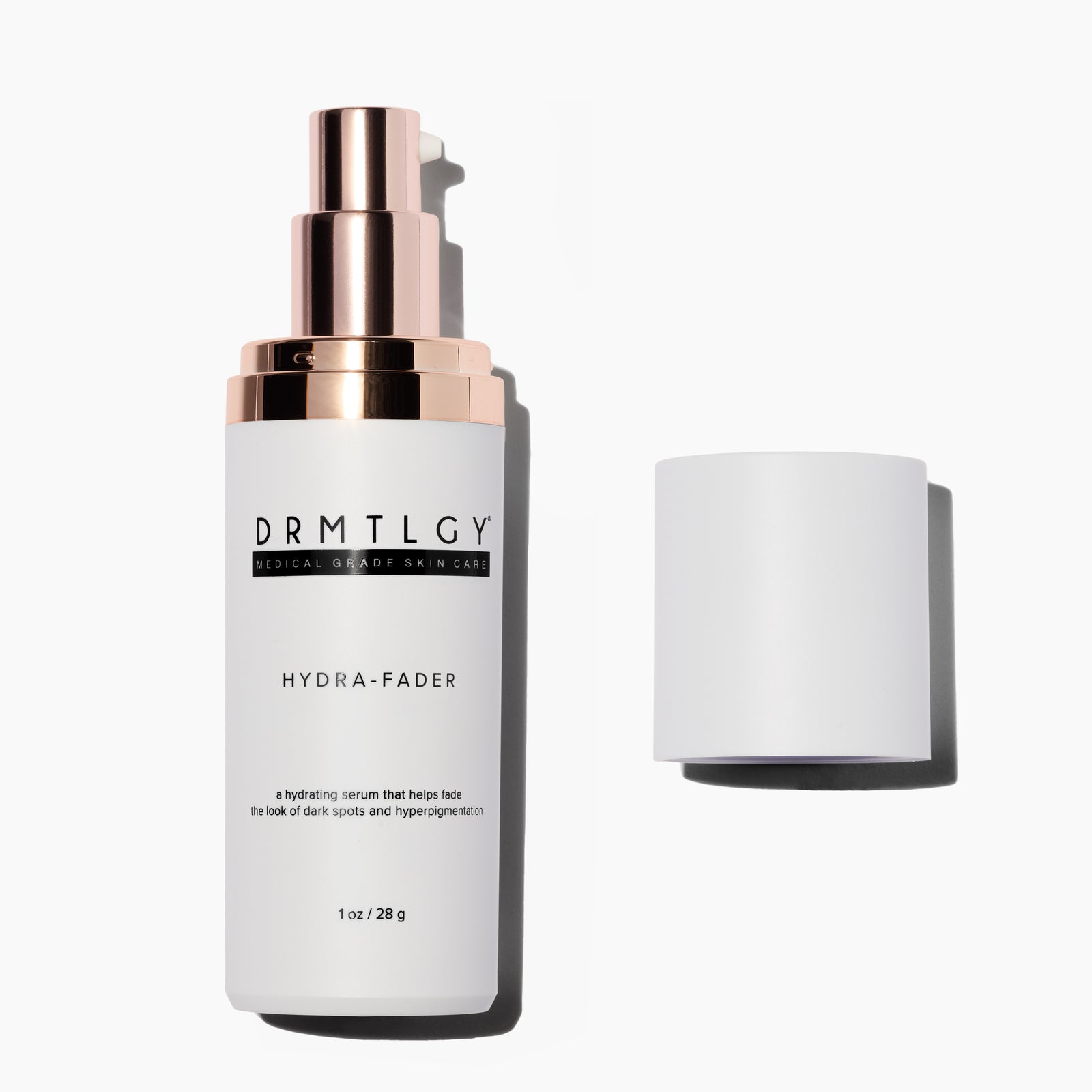
Hydra Fader pairs kojic acid with a hydrating base of peptides, ceramides, and panthenol. Kojic acid is the benchmark tyrosinase inhibitor that newer candidates get measured against in a 2019 review of tyrosinase inhibitors in the Journal of Enzyme Inhibition and Medicinal Chemistry. DRMTLGY does not publish the exact concentration on the label, so the bottle cannot tell you how strong it is. What you should expect from a gentle fader is a modest shift over months, not weeks.
The trade off is speed. A gentle formula is easier to live with and slower to show results. You cannot buy a fast timeline and a soft one in the same bottle.
Runner up: Good Molecules Discoloration Correcting Serum ($16)
Good Molecules quietly ships one of the most honest formulas in the category: 3% tranexamic acid, plus 4% niacinamide as a supporting cast. Tranexamic acid is the real story here. It started life as a bleeding control drug. Then dermatologists in Japan noticed that patients on oral doses lost pigment. Then someone put it in a serum. The topical evidence is thinner than the hype: in a 2012 randomized, split face trial in the Journal of Cosmetic and Laser Therapy, 5% tranexamic acid lightened melasma over 12 weeks, but no more than the plain vehicle cream did, and it caused more redness. If you want more of the story, read our full tranexamic acid explainer.
Also great: Naturium Tranexamic Topical Acid 5% ($20)
Same primary active as the Good Molecules bottle at a higher dose, 5%, the dose used in the trial above, with kojic acid, niacinamide, and licorice root alongside it. At $20 it costs about a third of the DRMTLGY price.
Budget pick: The Ordinary Alpha Arbutin 2% + HA ($13)
Alpha arbutin is a hydroquinone cousin. A 2021 review of alpha arbutin reports that it inhibits human tyrosinase more potently than natural arbutin in lab testing, and says larger, high quality trials are still needed to confirm how well it works on skin. The $13 price makes it the honest pick for anyone who wants to start slow. If it works, layer up. If it does not, you spent thirteen dollars.
The competition
The fifth entry stands in for a whole category: copper peptide serums, which keep trending in freckle content. Copper tripeptide 1 was never a first line freckle fader. Copper peptides do real work on wound healing, hair follicle signaling, and collagen synthesis. They do not block tyrosinase at any meaningful rate. Cite whoever you want for the anti aging case. Do not put copper peptides at the top of a freckle stack.
The comparison at a glance
| Serum | Primary active | Dose | Price | Best for |
|---|---|---|---|---|
| DRMTLGY Hydra Fader | Kojic acid | Undisclosed | $56 | Sensitive skin, slow fade |
| Good Molecules Discoloration Correcting | Tranexamic acid | 3% | $16 | Best value, watch for redness |
| Naturium Tranexamic 5% | Tranexamic acid | 5% | $20 | Anyone who wants the 5% trial dose |
| The Ordinary Alpha Arbutin | Alpha arbutin | 2% | $13 | Anyone starting from scratch |
| Copper peptide serums (category) | Copper tripeptide 1 | Varies | Varies | Not this concern |
What every one of these serums cannot beat
The strongest lever on freckles is not which serum you use. It is whether you wear sunscreen every day. The American Academy of Dermatology has been calling daily broad spectrum SPF 30 or higher the foundation of every pigmentation treatment. If you are picking one product to fight freckles, pick the sunscreen you will actually wear. Then add a serum. Not the other way around.
Care and maintenance
Apply the serum to clean, dry skin in the morning or evening. Layer sunscreen on top in the morning. Give any new fader 8 weeks before judging results. Take a photo the day you start and again at week 4 and week 8, in the same light, so you can actually see the shift instead of guessing. If your bottle stings, cools too much, or leaves your face pink after five minutes, stop. That is the barrier telling you the dose is wrong for your skin, not that the product is bad.
An honest caveat
None of these serums will erase a freckle. Freckles, technically ephelides, are melanocytes doing exactly what they evolved to do when they meet UV. You can lighten them. You can slow their return. You cannot bleach them permanently without prescription level actives and a real physician plan. If someone selling you a $200 bottle promises freckle removal, they are counting on you giving up before you notice they lied. Read the label. Read our water cream analysis if you want to see how thin most pigment claims are. Photograph a serum before you buy it and Skinventry shows its published ingredient list and checks the label's fading claims against it, with each fact linked to its source.
Sources
- Zolghadri S, et al. A comprehensive review on tyrosinase inhibitors. Journal of Enzyme Inhibition and Medicinal Chemistry, 2019. PubMed 30734608
- Kanechorn Na Ayuthaya P, et al. Topical 5% tranexamic acid for the treatment of melasma in Asians. Journal of Cosmetic and Laser Therapy, 2012. PubMed 22506692
- Saeedi M, et al. A comprehensive review of the therapeutic potential of alpha arbutin. Phytotherapy Research, 2021. PubMed 33724594
- American Academy of Dermatology. How to fade dark spots in darker skin tones. 2025.
- DRMTLGY. Hydra Fader product page. 2026.
