Henkel of Dusseldorf, the German consumer giant that also owns Schwarzkopf, Dial soap and Persil detergent, closed its $1.4 billion all cash purchase of Olaplex on July 7, 2026. The new CEO is a 13 year Henkel executive. The old No. 3 Hair Perfector was replaced in February 2026 by a reformulated bottle called N°.3 Plus.
Olaplex is now a Henkel brand.
That sentence wasn't true a year ago. On July 7, 2026 Henkel announced it had successfully closed its acquisition of the Santa Barbara haircare company, in a cash deal priced at $2.06 per share in the signed merger agreement and widely reported at about $1.4 billion. Olaplex delisted from Nasdaq that day. On September 21, 2026 the brand named Christoph Kaul as CEO, a Henkel executive of more than 13 years, succeeding Amanda Baldwin. Three weeks later Boots began selling Olaplex at 36 UK stores and online from October 9, 2026.
We did the record sweep on October 28, 2026. We read the labels of 2 Olaplex products on olaplex.com, pulled the Henkel press release, reviewed the Olaplex quarterly filing with the merger text, opened the European Commission's own copy of Regulation 2021/1902, and queried the US Food and Drug Administration's openFDA enforcement endpoint and the agency's warning letter database for anything tied to Olaplex. Our count: zero US recalls and zero US warning letters for the brand. The one record Olaplex sits in belongs to a different regulator, in a different country, and it's five years old.
Who owns Olaplex now, and what else sits in that house?
The chain is short. The brand Olaplex sits inside Olaplex Holdings, which until July was a Delaware company traded on Nasdaq. It's now a wholly owned subsidiary of Henkel US Operations Corporation, which rolls up into Henkel AG and Co. KGaA, a 150 year old firm headquartered in Dusseldorf, Germany. Henkel runs two divisions. Adhesive Technologies, the bigger one, sells industrial glues and threadlockers. Consumer Brands, the one Olaplex joined, sells laundry and home care alongside hair color and salon care.
Henkel's hair shelf is already crowded. Schwarzkopf is the professional color and salon care brand most US stylists know by sight. got2b is the drugstore styling line. Nair is the depilatory. Dial soap and Right Guard antiperspirant are Consumer Brands too. Persil is the European laundry detergent Henkel also sells in the US under license. Henkel's own closing release said in plain terms that Olaplex will become part of that division and run its US business from Culver City.
Christoph Kaul fits that pattern. Before his promotion to CEO he'd spent more than 13 years at Henkel, most recently as Regional Head of Strategy and Transformation in the US, and before Henkel he put in five years at L'Oreal. He isn't a hair chemist and he isn't a founder.
His LinkedIn post, which the industry trades picked up on September 21, said he'd been appointed to lead the team.
That's the posture Henkel bought: a listed brand with a bond building reputation, taken private, folded into a global consumer business, and handed to one of their own. See the sister post on how Flower Knows ended up under Proya in May 2026, and the one on how rhode became an e.l.f. Beauty subsidiary, for the same shape of deal.
Who makes it, and what does the patent actually cover?
Olaplex's whole pitch has rested on one molecule since 2014: Bis Aminopropyl Diglycol Dimaleate, discovered by two chemistry PhDs who later sold the technology into the brand. The compound sits inside the US Patent and Trademark Office under US Patent 9,713,583 and a family of related filings, assigned to Olaplex LLC. The license sits with Olaplex Holdings, which Henkel now owns.
Henkel hasn't disclosed where Olaplex's bottles are physically made on the current label. The company registers under the EU's Cosmetic Products Regulation, which requires a Responsible Person inside the EU for products sold there, and files the US paperwork required by the 2022 Modernization of Cosmetics Regulation Act. Both show the brand owner, not the contract manufacturer.
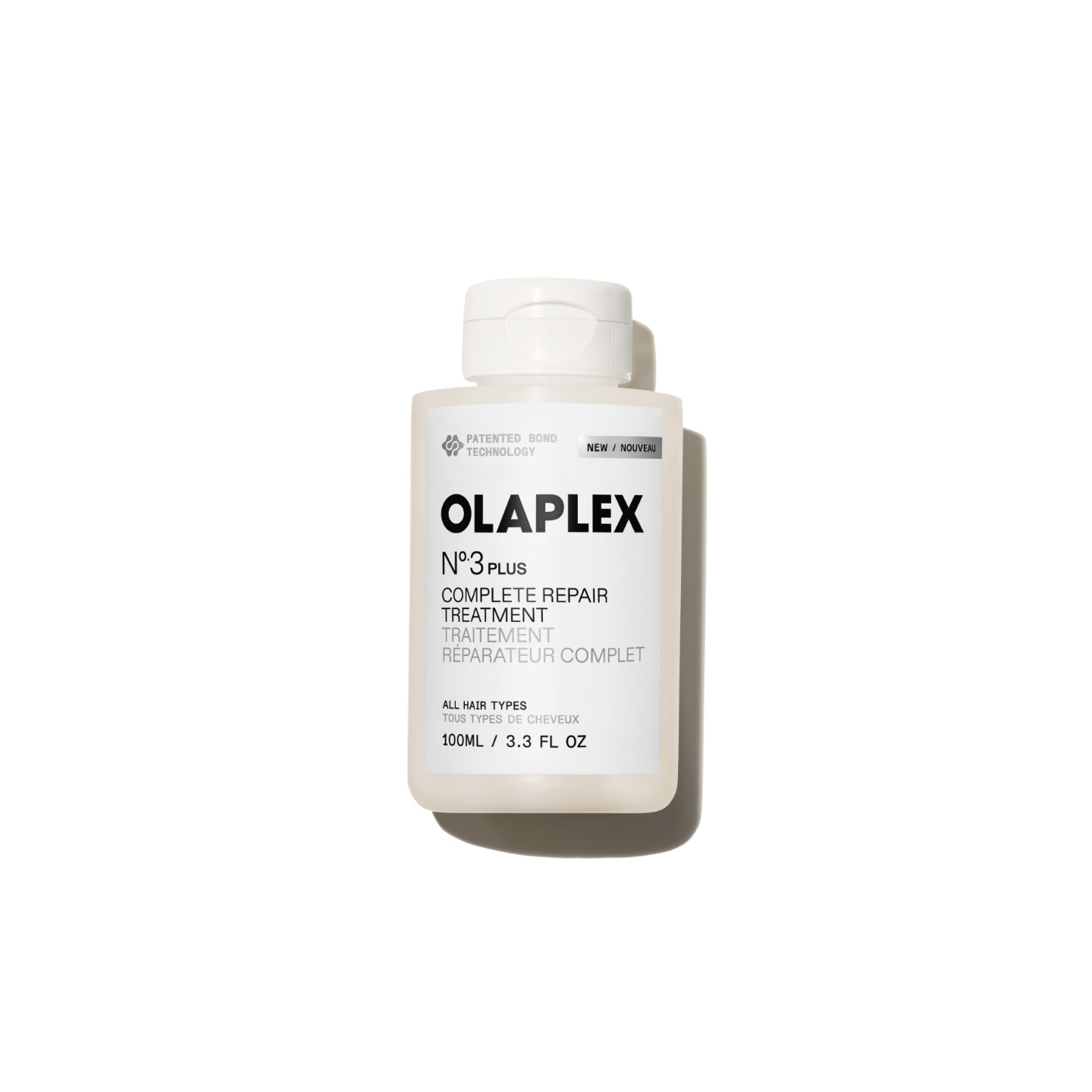
What a shopper gets to see is the ingredient list. On October 28, 2026 the published ingredient list for the current N°.3 Plus Complete Repair Treatment begins: Water, Cetearyl Alcohol, Behentrimonium Methosulfate, Bis Aminopropyl Diglycol Dimaleate, Hydroxypropyl Starch Phosphate. In cosmetic labels anything above 1% is in descending order of weight. The patented active sits fourth. The first three slots are water, a fatty alcohol used to give the cream its body, and a mild cationic conditioning emulsifier. That's normal for a cream treatment. It's also why no outside chemist can tell you the exact percentage of the active without the formula sheet, which Henkel won't publish.
What changed in the February reformulation?
Between the Henkel deal signing in March and the deal closing in July, Olaplex replaced its most famous product. On February 24, 2026 the brand launched No. 3 Plus Complete Repair Treatment, a reformulated version of the original No. 3 Hair Perfector. The trade press called it the next evolution.
The product page keeps the same patented active, cuts the recommended use time from ten minutes to three, adds what the brand calls a Damage Defense Cationic Complex, and ships at the same $34 price point for 100 ml at olaplex.com. The new 250 ml jumbo size runs $64.
Three things are worth saying out loud about that reformulation, in the brand's own words wherever possible, and in no one else's. First, the active molecule is still Bis Aminopropyl Diglycol Dimaleate. The pitch hasn't changed. Second, the time cut from ten minutes to three is a shelf benefit, not a chemistry breakthrough: a shorter wait makes the product easier to use, which is a different claim from making the product work better. The brand hasn't published a side by side clinical versus the old formula. Third, the distribution expanded. The brand's own announcement says No. 3 Plus is sold at olaplex.com, Sephora, Ulta, SalonCentric, Beauty Systems Group, TikTok Shop and Amazon.
Boots joining in October closes that loop in the UK. Retail Gazette reported on October 9, 2026 that Olaplex would be stocked at 36 Boots stores and on boots.com, with the retailer pitching the launch as a response to search demand on its own site. For a brand that spent its first decade protecting a salon only aura, that's a doctrinal change.
What record does Olaplex sit in?
On October 28, 2026 we queried the FDA's openFDA enforcement reports endpoint for any entry with openfda.brand_name or openfda.manufacturer_name containing Olaplex. The returned count was zero. We searched the agency's warning letter database for the same string. The returned count was zero. For our purposes that is the US record on Olaplex, in one line.
The FDA's adverse event reporting for cosmetics ran on a voluntary basis until the 2022 Modernization of Cosmetics Regulation Act began phasing in mandatory reporting. Bloomberg reported in June 2023 that the agency had received about 98 adverse event reports concerning Olaplex products via a Freedom of Information Act request. The agency's own standing note on such numbers is that for any given report there's no certainty that the product caused the reaction. The brand said in a statement to Bloomberg at the time that Olaplex products do not cause hair loss or breakage. No US recall exists. No US warning letter exists.
The record that does exist is European. On August 5, 2022 the French cosmetics industry safety bulletin recorded a recall of Olaplex Hair Perfector N°3 for containing Butylphenyl Methylpropional, better known as lilial. Lilial is a synthetic fragrance ingredient that smells of lily of the valley. The European Commission's Regulation 2021/1902 added lilial to Annex II of the EU Cosmetic Products Regulation, which lists ingredients prohibited in cosmetics, effective March 1, 2022, on the basis of the European Chemicals Agency's classification of the substance as a Category 1B reproductive toxicant. From that date no cosmetic product containing the ingredient could legally be placed on the EU market.
Olaplex said at the time that it had already removed lilial from products sold globally in an abundance of caution, before the EU made the ban formal. Henkel's July closing release didn't reference the matter. The current labels for N°.3 Plus, which we read on olaplex.com on October 28, 2026, don't list it. US regulators placed no equivalent restriction. The US version of No. 3 shipped without lilial anyway. That's the choice Olaplex made under its previous owners. It's also a choice Henkel now inherits.
Two other fragrance notes in the current ingredient list, Hydroxycitronellal and Alpha Isomethyl Ionone, remain on the EU's Annex III of allergens that must be declared on label above 0.001% in leave on products and 0.01% in rinse off. Both are listed on No. 3 Plus. Neither is banned in the US. The ingredient list makes them visible, which is the point of the EU rule.
What does the label still carry, and what has it dropped?
Reading the full published N°.3 Plus ingredient list line by line on October 28, as I did, shows a short list of things worth knowing before buying. Panthenol, the pro vitamin B5 that pulls water into the hair shaft, sits at position 14. Butyrospermum Parkii, shea butter, sits at 15. Several plant oils follow: Crambe Abyssinica, sunflower seed oil, avocado oil, coconut oil, sunflower seed oil again from the sprout fraction.
Fragrance comes last, as Parfum, followed by its declared allergen notes under EU law. Phenoxyethanol and sodium benzoate are the preservatives. Phenoxyethanol is capped at 1% in the EU. The two FD and C dyes CI 19140 and CI 15985, better known as Yellow 5 and Yellow 6, color the cream and sit at the very bottom of the list, so by weight they're present at trace amounts. Both are allowed in cosmetics in the US and the EU.
What's not on the label is as interesting as what is.
There's no lilial, as noted. There is no formaldehyde or formaldehyde releaser, which is the family our shampoo label read found still present in two of five US shampoos. There's no sodium lauryl sulfate. There's no silicone body, which is unusual for a hair treatment at this price point: the slip comes from the cationic quaternary salts, not from a dimethicone finish.
The price and the shelf
The product that costs $34 in the US costs £32 for 100 ml at Boots in the UK, which with value added tax and the current pound to dollar rate works out close to the same number. The 250 ml jumbo size runs $64 in the US and £64 in the UK. Pro backbar sizes, the ones salon professionals buy, run at a lower unit price. Sephora, Ulta, Amazon and TikTok Shop list the same consumer sizes.
Compared with the drugstore bond builder shelf, the price is high. Compared with the salon treatment shelf, the price is middle of the road. The patented active and the brand have historically given Olaplex pricing power. Henkel bought that pricing power with the brand. What Henkel does with it next is the open question. Schwarzkopf hasn't seen a positioning change under Henkel. Dial, which Henkel bought in 2004, kept its own identity under Henkel's roof. Olaplex may do the same.
How does this fit with the rest of the shelf?
Three practical lines sit under all of the above. The first is that an ownership change doesn't automatically change what's in the bottle. The patented active is the same.
The second is that Olaplex's shelf is now broader than it was: a Boots launch and a reformulation announced inside the same calendar year, with a new CEO handed the keys three weeks before Boots went live, is a brand pushing hard into mass retail. The third is that the record a shopper can see is still thin on the US side and clear on the EU side. The 2022 lilial action in Europe is the one line to know. The ownership walkthrough on Beauty of Joseon's parent company looks at a different parent structure, but does the same work.
What I still cannot see
Three things, and we'll say so plainly. One, Henkel hasn't disclosed where our Olaplex bottle is physically made. Two, the brand hasn't published the exact concentration of Bis Aminopropyl Diglycol Dimaleate in our N°.3 Plus or in the professional No. 2. That number lives behind the formula sheet, under confidential business information. Three, the 98 Freedom of Information Act adverse event reports as of June 2023 are a floor, not a ceiling, and the agency's reporting rules under the 2022 Act are still phasing in. If any of those three things change, Skinventry will update this page with the date and the source.
Three things I read while writing this
- Henkel's own closing release on July 7, 2026, which names the price mechanism and the Culver City base.
- Olaplex's own quarterly filing with the merger agreement text and 2.06 dollars per share figure, filed with the Securities and Exchange Commission for the quarter ended March 31, 2026.
- The European Commission's Regulation 2021/1902 PDF, which added lilial to Annex II of the Cosmetic Products Regulation effective March 1, 2022.
Point your camera at an Olaplex jar in our Skinventry 4.0 app and the lookup names Henkel AG and Co. KGaA as the parent, lists the full ingredient list in label order with its allergen notes, flags the 2022 EU lilial action and the deal timeline, and labels each line Official, Government or Independent. If a shopper has flagged an allergen like Linalool, the lookup says so. No scores, no verdicts. The source for every fact is a tap away.
