Flower Knows debuted at 450 Ulta Beauty stores on September 20, 2026, part of its 10th anniversary push. Since May 25, 2026, the fairytale brand has been 51 percent owned by Proya Cosmetics, a Shanghai Stock Exchange listed Chinese beauty company, and three of six shades in its hero Swan Ballet palette list talc as the first or second ingredient.
Flower Knows markets a fairytale. The company that owns it is listed on the Shanghai Stock Exchange.
At the Ulta Beauty off Market Street I walked into on Thursday afternoon, the Flower Knows endcap was a candy pink wall of ribbon tied palettes and lip glosses, framed as the ten year anniversary of a tiny Chinese indie brand. The display is real; the indie read isn't. On May 25, 2026, Proya Cosmetics (SHA:603605) paid founder Yang Zifeng RMB 351 million, about USD 51.6 million, for a 12.55 percent tranche, taking its holding to a 51 percent controlling stake. Proya is a public Chinese beauty company whose first half 2026 operating revenue was RMB 5.37 billion. The Ulta launch sits on top of that control.
Who owns Flower Knows?
Proya Cosmetics owns 51 percent of Flower Knows through Proya Hainan, its wholly owned subsidiary. Yicai Global reported on May 25, 2026 that the deal valued the brand at RMB 2.8 billion, about USD 416 million, or roughly ten times its 2025 earnings. Yang Zifeng, who founded Flower Knows in 2016 with Zhou Tiancheng, stepped down as chairman the same day. Hou Yameng, Proya's general manager, took the chair. Zhou left the board. Yang stays on as a director and keeps running the brand as general manager, per BeautyMatter's writeup. When I pulled up the brand's own site and its Ulta pages, nothing named the parent. For an American shopper who meets the brand on TikTok or at an endcap, the ownership is invisible unless they go looking in Chinese market news. This matches the pattern we saw in rhode after e.l.f.'s acquisition.
Did Flower Knows ever read as an indie brand?
Yes, for most of its ten years. Yang and Zhou launched the brand in Hangzhou in 2016, bootstrapped out of a cosplay community, and most of its growth happened on Chinese e commerce platforms before a US retailer picked it up. The aesthetic (ribbon, pearl, ballet, cherub) is specific enough that it reads as the opposite of a mass brand. For a long time it also was: Proya didn't become its second largest shareholder until 2025, and the controlling tranche is only five months old. The May 2026 deal didn't change what the lipsticks look like on the shelf or who draws the cherubs.
What changed on May 25, 2026?
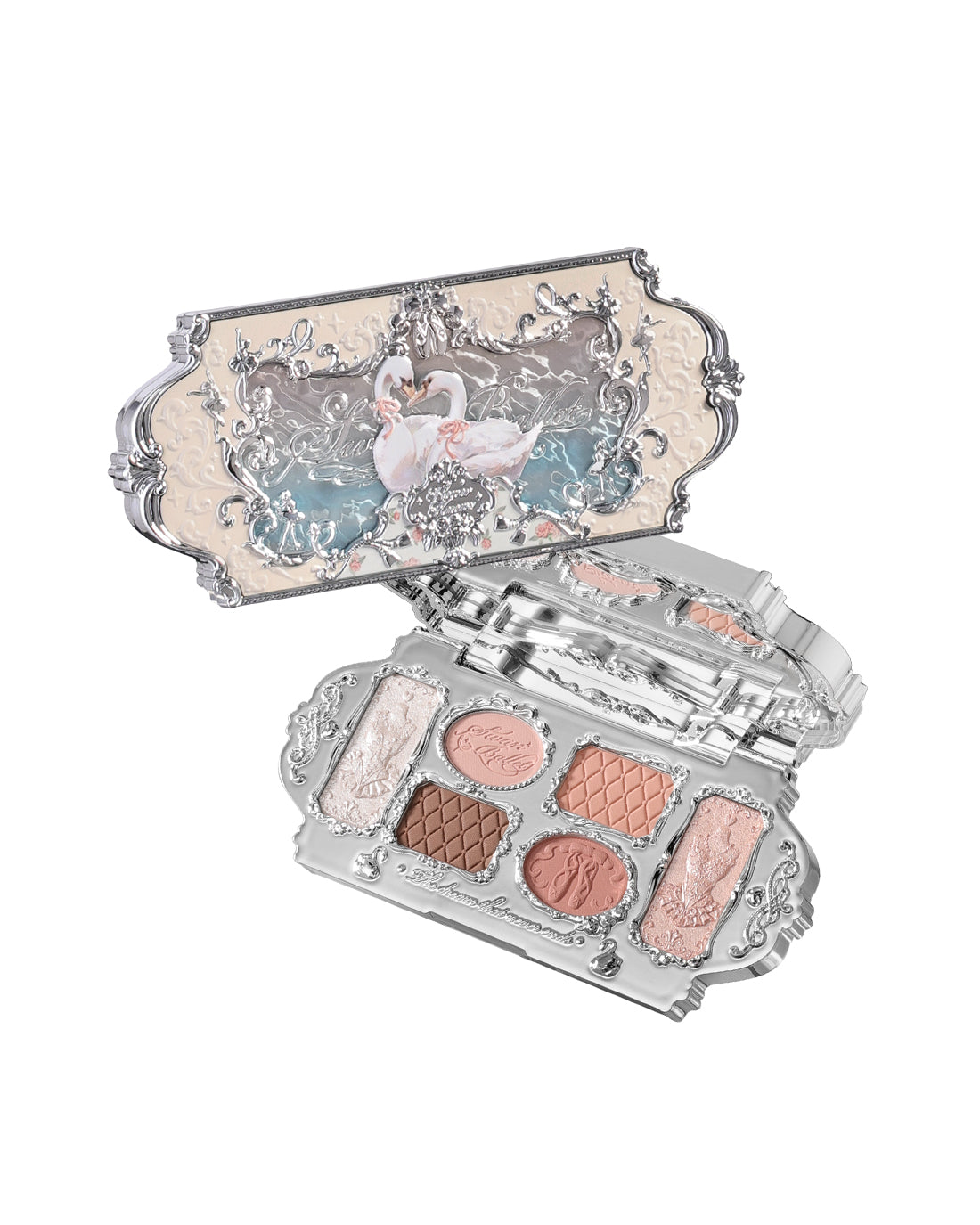
Proya isn't a passive investor. It writes the strategy, consolidates the P&L and sends its own managers into the board seat. Proya's half year report booked RMB 445.36 million in investment income from the Flower Knows consolidation, carrying the brand as a business combination, not a stake. The US rollout is the first thing a controlling owner does after a deal closes: push the brand into a new, higher margin channel. Ulta's own announcement talked about three to four Flower Knows collections every year, which is a Proya cadence. And the brand's hero at Ulta, the Swan Ballet Six Color Makeup Palette at USD 35, isn't a lipstick. It's a pressed powder palette whose first ingredient in half the shades is talc, a raw material whose US rules are mid rewrite.
What is actually in the Swan Ballet palette?
We read the full per shade INCI of the Swan Ballet Six Color Makeup Palette on its Ulta product page on October 23, 2026, and we counted which shades name talc first. The per shade pattern is this:
- Shade 1: Synthetic Fluorphlogopite leads. No talc listed.
- Shade 2: Calcium Aluminum Borosilicate leads; mica in position eight; no talc.
- Shade 3: Calcium Aluminum Borosilicate leads; no talc.
- Shade 4: Talc leads. Mica second.
- Shade 5: Mica leads, talc second.
- Shade 6: Mica leads, talc second.
Shades 1 through 3 are the shimmery pastels; shades 4 through 6 are the matte setting powders and matte eye shades most people apply across a wider area of the lid, cheek or face. Those are the three shades talc dominates. The brand doesn't publish a certificate of analysis for asbestos or heavy metals on either its Shopify site or its Ulta pages.
Why does the FDA talc rule matter right now?
A rule FDA proposed on December 26, 2024 under the Modernization of Cosmetics Regulation Act. The proposal, titled "Testing Methods for Detecting and Identifying Asbestos in Talc Containing Cosmetic Products," would require every batch of talc cosmetics sold in the US to be tested using both Polarized Light Microscopy and Transmission Electron Microscopy with Energy Dispersive Spectroscopy and Selected Area Electron Diffraction, per Covington's December 2024 writeup. That's the dual method FDA's interagency working group settled on in 2020. FDA says in the same proposal that a product that is not tested, or whose test fails, is adulterated under the Food, Drug, and Cosmetic Act. The rule was MoCRA's first proposed cosmetics regulation, and FDA's own talc page says it is still at the proposed stage as of this writing. Separately, FDA's 2019 sampling program found asbestos in 9 of 52 talc cosmetics tested, per the same FDA page, so the agency isn't writing a hypothetical rule. Talc is a mined mineral that forms in rock that can also contain asbestos; sorting them from each other at the microscopic level is the entire reason the dual method exists.
The empty public record is still a record
We checked the US public record for Flower Knows and Proya on October 23, 2026, across six endpoints. openFDA's cosmetic adverse event API returned zero reports for brand "Flower Knows". FDA's recall enforcement API returned zero recalls under Proya or Flower Knows. The FDA warning letter database and the cosmetics import alert list had no entries. The National Advertising Division had no decisions. California's Safe Cosmetics Program search returned nothing. An empty record is still a record. A brand that has sold in the US only online, through small distributors, until this fall simply hasn't had the US retail footprint to generate inspections or complaints yet. The 450 store rollout changes that math starting now, and the pattern echoes what we saw with another Asian brand's US push.
What has the company said?
The brand's product page on its own site leans into texture claims: "melts into skin", "luminous", "silky", "soft focus". Talc is a pressed powder binder; many color cosmetics use it; the ad isn't wrong that it's what gives the matte shades their soft focus feel. What the ad doesn't do is name talc, cite an asbestos test, or state where the talc is mined. In a 2012 interview with a trade outlet, Proya said it sources many of its raw cosmetic ingredients overseas because China's approvals are tighter, but the interview didn't name a talc supplier. Neither Flower Knows nor Proya has published any statement in response to the December 2024 FDA MoCRA talc proposal; the routine never contacts companies, so we are reporting what their public record and public pages say on October 23, 2026, and that same mix of public record and silence is what FDA listings show for most new US entrants. Proya's half year report also carried progress on the brand integration, listing the May 25, 2026 consolidation among the half's three business milestones.
What should a shopper check on the box?
Before anyone buys any talc cosmetic in the US right now, FDA's own talc page says the useful signal is a third party asbestos test certificate issued by a laboratory using the dual method, not Polarized Light Microscopy alone. If the brand doesn't publish one, write and ask. A brand that tests its own talc has the certificate ready. For a palette whose first or second ingredient in three of six shades is talc, that isn't a nice to have. It's the point. The brand's parent has the resources to publish one; Proya runs a listed company with a research center in Hangzhou.
Photograph a Flower Knows palette with Skinventry and the app shows the parent company behind the box, the full ingredient list, how each ingredient is used, and the US public record the brand has walked in with. Where that record is empty, as Flower Knows' is today, the app says so plainly and labels every line with its source.
Three things worth reading next:
- Covington's writeup of FDA's December 26, 2024 proposed MoCRA talc testing rule, which lays out why the dual method matters.
- BeautyMatter's May 25, 2026 piece on Proya's control of Flower Knows, with the price per percent breakdown.
- The brand's own INCI on the Swan Ballet palette product page, if you want to read the full per shade list yourself.
