Clinique's Dramatically Different Moisturizing Lotion+ costs 34 dollars for 4.2 oz, with a 0.5 oz starter at 7 dollars (clinique.com, read November 9, 2026). The current ingredient list on that page puts mineral oil at position 2 of 24, and the 21 percent barrier repair figure the brand advertises comes from a clinical test on 21 women.
In April 1968, Clinique opened a counter at Saks Fifth Avenue in New York with 117 products at once. One of them was a yellow bottle a Vogue beauty editor named Carol Phillips and a dermatologist named Norman Orentreich had helped design, and Estee Lauder's daughter in law Evelyn Lauder had helped name. Fifty seven years later, that bottle still sits on the shelf. The front still carries the same words: allergy tested, fragrance free, dermatologist developed. Inside, the formula has changed. We read the current product page on clinique.com on November 9, 2026, and pulled Clinique's full FDA record from the openFDA Drug Enforcement database on the same day. Here is what Dramatically Different's label actually says in 2026, and what it does and does not back up.
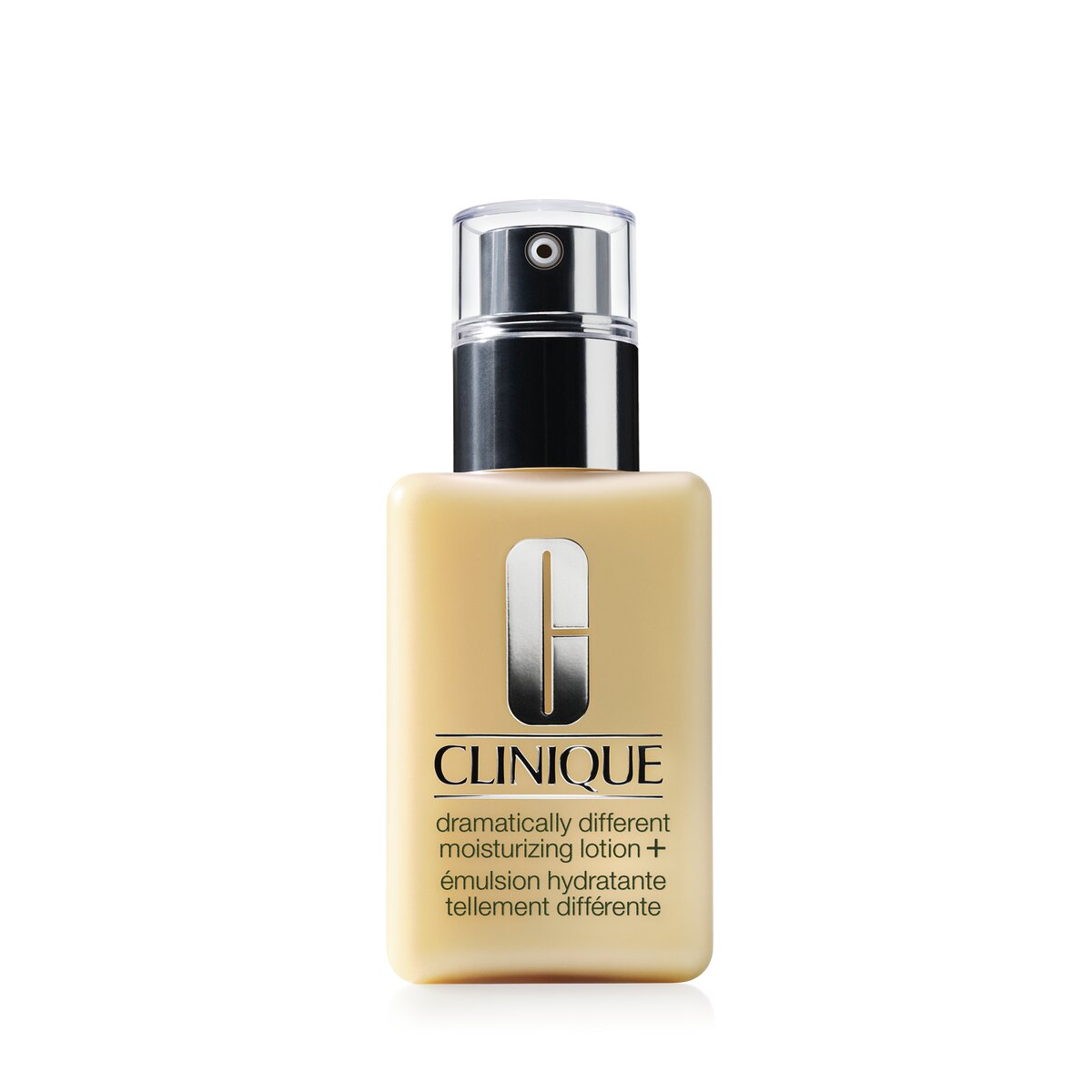
What Clinique says the yellow lotion does
The brand gives the current formula four quotable claims on its own page. The silky lotion "rapidly strengthens the skin barrier." "Pure urea and pure glycerin" together deliver "8 hours of hydration." The product "instantly boosts skin's moisture by 119%." And "in just 2 hours, this face lotion significantly improves skin barrier repair by 21%."
That last line carries an asterisk on the page. The asterisk goes to the fine print: "Clinical testing on 21 women." Twenty one. One of the cleanest numbers Clinique puts on this page, a round 21%, comes from a panel of twenty one people. The other round number, that 119% instant moisture boost, cites a second small instrumental test on the product page. Neither is published in a journal we could find, and the methods are not posted on clinique.com. That does not make the measurements wrong. It does mean the evidence behind two of Clinique's four main selling claims sits on panels you can count on two hands and a few fingers.
What the label actually lists
Here is the ingredient order Clinique publishes on the Dramatically Different Moisturizing Lotion+ product page, in the order it appears, read on November 9, 2026:
Water. Mineral Oil. Glycerin. Petrolatum. Stearic Acid. Glyceryl Stearate. Sesame Oil. Urea. Lanolin Alcohol. Triethanolamine. Barley Extract. Cucumber Extract. Propylene Glycol Dicaprate. Sodium Hyaluronate. Butylene Glycol. Sunflower Seed Extract. Pentylene Glycol. BHT. Disodium EDTA. Tetrasodium EDTA. Phenoxyethanol. Red 33. Yellow 6. Yellow 5.
Read as a story, this is a classic occlusive emollient. Mineral oil and petrolatum form a film on the skin that slows water loss; stearic acid, glyceryl stearate and the sesame oil thicken and smooth that film. The humectants that actually pull water into skin follow: glycerin at position 3, urea at 8, sodium hyaluronate at 14. A 2004 British Journal of Dermatology study found that a 10 percent urea cream reduced transepidermal water loss in dry skin after two weeks; a 2022 JEADV review notes that urea at humectant doses works through the same water binding mechanism as glycerin. Both are real, cited mechanisms. Neither trial is on this specific product.
Urea at position 8 sits well above the formula's preservative, which puts its concentration somewhere in the low single digits by weight. That is a real humectant dose, in line with the brand's "pure urea" line, if not the keratolytic levels dermatologists prescribe at 10 percent or more for heels and elbows. Glycerin at position 3 is doing the heavy lifting here, as it does in almost every moisturizer in every price tier, from a drugstore 4 dollar lotion to a 90 dollar night cream. We wrote the same thing in our teardown of Alastin's 258 dollar Restorative Skin Complex last week: when a brand names its hero ingredient, it is worth checking whether that ingredient is the thing actually doing the work.
Mineral oil at position 2 is not the problem. The sales pitch around it is.
Mineral oil, paraffinum liquidum on the INCI, gets a bad reputation in beauty forums it does not deserve. Cosmetic grade mineral oil is one of the most studied, safest, non comedogenic occlusives in the pharmacy. It is in Aquaphor, which we wrote about last week; its FDA label lists petrolatum at 41 percent and it is still a skin barrier staple for people with eczema. The question is not whether mineral oil belongs in a moisturizer. The question is what you are paying for when it is the second thing in a 34 dollar bottle.
A CeraVe Moisturizing Lotion (12 fluid ounces at drugstore prices) carries three ceramides, hyaluronic acid and the MVE delivery system that releases them over hours. It uses petrolatum and mineral oil higher up its list, but it also builds in ingredients the Dramatically Different formula skips entirely. Clinique's lotion backs up its barrier message on urea and glycerin, two humectants with real evidence; CeraVe backs up its own on ceramides, the lipid actually missing in a damaged barrier. Neither claim is wrong. They are just different claims, and the 34 dollar bottle is not obviously the stronger one.
What has been changed, quietly
Clinique's own FAQ on the product page lists the current formula as "formulated without SLS, SLES, drying alcohol, fragrance, parabens, and phthalates." Historical reviews on third party ingredient sites, including SkinSort's Dramatically Different Moisturizing Lotion entry, archive earlier versions of the label that contained parabens as the main preservative. The current formula replaces those with phenoxyethanol and pentylene glycol, which is the industry standard swap and a real, documented change. Clinique has not dated the reformulation on its own site.
Two other label items belong in that history. The first is BHT at position 18, a long used preservative antioxidant whose use in cosmetics was tightened by the EU in Regulation 2022/2195 and capped at 0.8 percent in leave on cosmetics. Clinique has not published the percentage for Dramatically Different, so a shopper reading the label alone cannot know whether the US formula sits inside or outside the EU cap; both are plausible at position 18. The second is the trio of synthetic colors at the very end, Red 33, Yellow 6 and Yellow 5. Three FDA approved dyes are what makes the famous bottle yellow in a product the front of the pack calls "100 percent fragrance free, dermatologist developed." The dyes are permitted and not a safety issue at these doses; the quiet contrast between the clinical positioning and the three food colorings on the INCI is worth clocking anyway.
The record, then and now
Clinique's FDA record is thinner than many of the brands we have taken apart on this desk. We pulled Clinique and its parent Estee Lauder Companies through openFDA's Drug Enforcement Report API on November 9, 2026, and found seven US recalls since the API's records begin, all Terminated and all of over the counter sunscreen products. Six were Clinique Moisture Surge Tinted Moisturizer Broad Spectrum SPF 15 lots recalled on May 17, 2016 (recall numbers D 1473 through D 1478, each Terminated by the FDA). The seventh was Repairwear Laser Focus Line Smoothing Cream Broad Spectrum SPF 15, recalled March 15, 2019 (D 1132 2019, Terminated). There are no Dramatically Different Moisturizing Lotion+ recalls, no FDA cosmetics warning letters for the brand, and no NAD ad claim decisions we could find for this lotion specifically. On the record, the yellow lotion has been boringly clean for 57 years.
Who owns Clinique in 2026
Clinique is a wholly owned subsidiary of The Estee Lauder Companies, Inc. (NYSE: EL). Estee Lauder has had a hard two years. On its Q3 fiscal 2026 earnings call on May 1, 2026, the company said Clinique and Origins were still in decline in skin care even as prestige fragrance pulled the group back toward growth. The parent is in the middle of a 1.5 to 1.7 billion dollar restructuring program expected to close by the end of 2026, which has also meant a shorter lineup of brands and a tighter product roster at the mall. None of that changes what is in this bottle. It does mean that the brand selling Dramatically Different Moisturizing Lotion+ at 34 dollars is also under pressure to keep those margins, and that a reformulation by cost reduction is more likely in the next cycle than it was in the last.
So, is Dramatically Different Moisturizing Lotion worth it?
The honest answer has two parts. The product works as a moisturizer. Mineral oil and petrolatum occlude; glycerin and urea pull water back; the lotion is fragrance free, parabens are out, and it is used after procedures for a reason. The 8 hour hydration claim rests on humectants that genuinely do that job, even if the specific instrumental number on clinique.com is from a small internal panel. People who have bought it for 20 years and like the ritual are not wrong.
The product is also not an advanced barrier treatment, and the brand's marketing frames it as one. The 21 percent repair figure comes from 21 women. The ingredient list reads more like a well made drugstore emollient than a 34 dollar prestige serum. There are no ceramides in the formula, no niacinamide, no peptides, no actives beyond humectants and occlusives. If you are paying for the Clinique name, the clean fragrance free positioning and the yellow bottle as a daily ritual, you are getting all three. If you are paying for a technology that outperforms a 15 dollar drugstore barrier cream on the same job, the label on clinique.com will not back that up.
Our view, after the desk audit: fine product, honest humectant and occlusive chemistry, overpriced for what the INCI delivers, with marketing claims that rest on smaller evidence than the confident percentages suggest.
The caveat worth naming
Two honest things to put on the other side of the ledger. The first is that Clinique's fragrance free discipline, which has been part of the brand since 1968, is real and uncommon at the prestige tier. Fragrance is the most common trigger for cosmetic contact dermatitis in the published literature, and a widely sold prestige moisturizer that does not use it is genuinely useful for people with reactive skin. The second is that the brand has reformulated in the right direction over the decades. Parabens are out, the preservative system is modern, the EU restricted BHT is on the label at the trace zone. Not every mass prestige brand has done that quietly and without complaint.
If you still want it
The 0.5 fluid ounce tube at 7 dollars is the honest way to try the lotion. The 4.2 ounce jumbo at 34 dollars is the shelf staple price; the 6.7 ounce at 49 dollars is the lowest per ounce if you already know you like it and intend to finish it. Nothing we found in the label or the record suggests any size is better formulated than any other; you are buying ounces of the same formula. If you already own it and the ritual is working, carry on. If you are deciding whether to switch to it, the label will not tell you it is a clear upgrade from a well chosen under 20 dollar moisturizer.
Worth the ritual. Not worth paying the ritual tax.
Photograph the bottle and Skinventry shows the full ingredient list with position and what each one does, the Estee Lauder parent company, and the public record from openFDA, each line with a source and a date. The flags you have set, for a fragrance you avoid or a dye you react to, run on every lookup. No scores, no verdicts, just the receipt.
