Alastin's Restorative Skin Complex costs 258 dollars for 29 mL and sells itself on peptides, but the brand's own ingredient list puts niacinamide third, above every peptide in the formula. Parent Galderma, which bought Alastin in January 2022, agreed on October 14, 2026 to buy sister brand ZO Skin Health for 1.5 billion dollars.
Position three on the ingredient list. Above every peptide the ad celebrates. That is where niacinamide, the drugstore vitamin B3 The Ordinary sells at ten percent for about seven dollars, actually sits in the Alastin Restorative Skin Complex, the brand's hero at 258 dollars for a 29 mL pump. The pump itself now carries a new line of fine print under the logo: "ALASTIN by GALDERMA". That one line is doing a lot of work, because on October 14, 2026 Galderma agreed to pay 1.5 billion dollars cash for ZO Skin Health, the brand whose Growth Factor Serum shoppers already compare Alastin's hero to. Two of the most quietly expensive bottles in a dermatology office are about to ship from one company.
So here is the question a 258 dollar bottle deserves from us. Who owns this brand now, what is really in it, and does that peptide claim earn the price?
Who owns Alastin?
Alastin Skincare Inc was founded in Carlsbad, California in 2015. On January 5, 2022, Swiss dermatology giant Galderma announced from Zug that it had completed the acquisition, with U.S. antitrust clearance in hand. Financial terms were not disclosed. Galderma's own words: the deal would "enhance Galderma's integrated dermatology platform," and Alastin would sit there as "a specialty aesthetics company dedicated to developing innovative and clinically tested physician dispensed skincare products."
What Galderma is: a 29 billion franc company at IPO, floated on the SIX Swiss Exchange on March 22, 2024 at CHF 53 a share. Its catalog already carried Cetaphil, Restylane and Dysport when it bought Alastin. Now it is adding something louder.
Here is the October deal in plain English. Galderma is buying 100 percent of ZO Skin Health from Blackstone and the founding Obagi family for 1.5 billion dollars, all cash. ZO reported roughly 330 million dollars in net sales for the twelve months ending June 2026, so the price is about 4.5 times sales. Closing is expected in the fourth quarter of 2026 or early 2027. And the brand ZO sells its biggest serum under is the one Alastin's hero gets bench pressed against in every Google Suggest result: "alastin restorative skin complex vs zo growth factor serum." Search is quietly telling Galderma that its two upcoming sister brands are already competing for the same wallet.
ZO's Growth Factor Serum lists at 200 dollars for 1 fl oz. Alastin's Restorative Skin Complex lists at 258 dollars for the same 29 mL. They sit on the same clinic shelves. After the deal closes, they will sit on the same corporate shelf too.
What is actually in the 258 dollar bottle?
On November 6, 2026, we read the printed ingredient list on alastin.com for the Restorative Skin Complex and wrote down the position of every active the brand names in its marketing. Here is what the brand's own page lists, in the order it lists them:
Water. Glycerin. Niacinamide. Isopropyl Palmitate. Polyacrylate 13. Butylene Glycol. Palmitoyl Hexapeptide 12. Palmitoyl Tripeptide 1. Palmitoyl Tripeptide 5. Palmitoyl Dipeptide 5 Diaminobutyroyl Hydroxythreonine. Palmitoyl Dipeptide 5 Diaminohydroxybutyrate. Acetyl Hexapeptide 38. Octapeptide 45. Swertia Chirata Extract. Magnolol. And then forty more rows of ceramides, extracts, emollients, buffers and preservatives.
Niacinamide is third. It is the first named active after water and glycerin. Palmitoyl Hexapeptide 12 (one of the two peptides the brand calls TriHex) is seventh. Palmitoyl Tripeptide 1 (the other half of TriHex) is eighth. The proprietary Octapeptide 45 the brand highlights in its newer formula is thirteenth. Magnolol, the plumping botanical the ad names in its own sentence, is fifteenth.
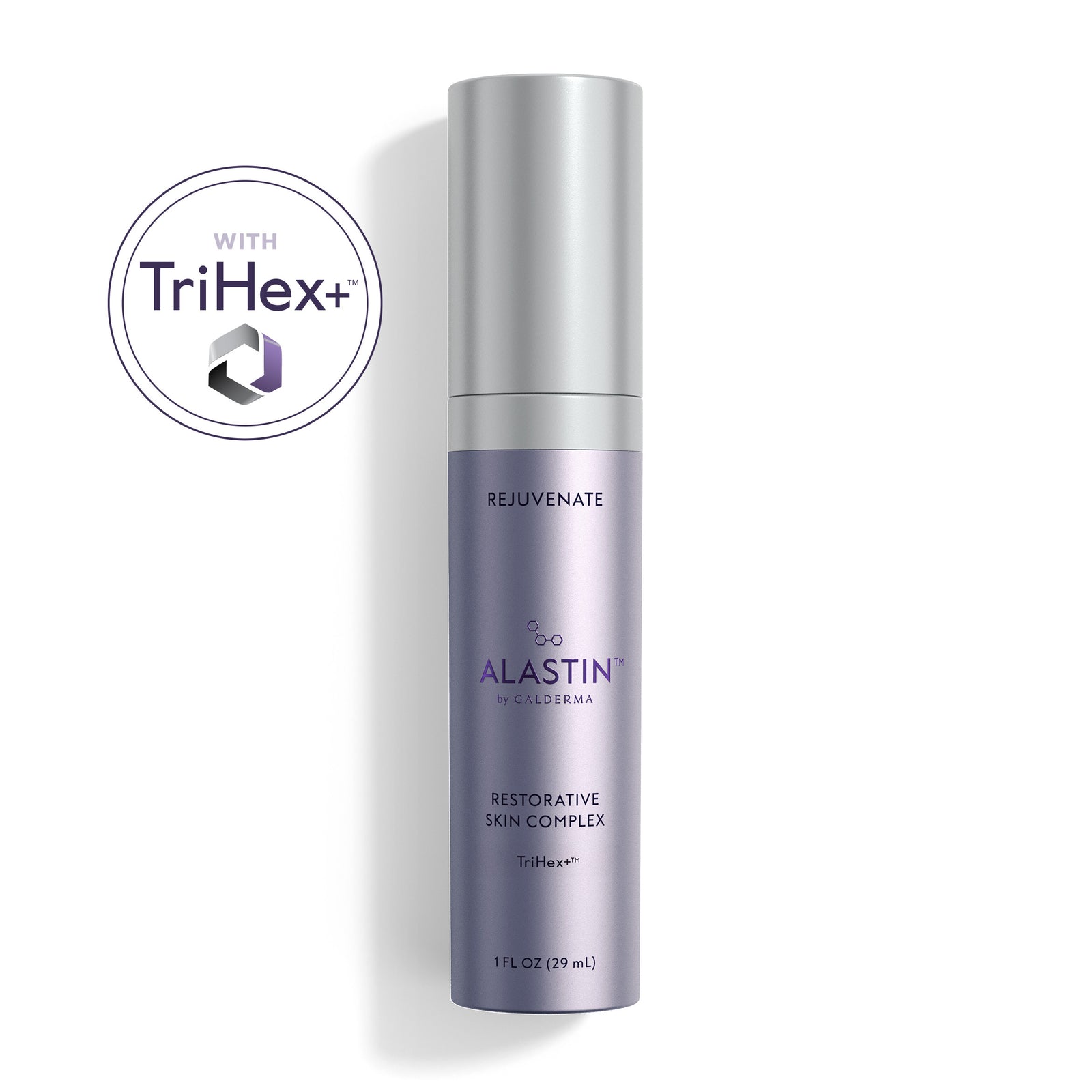
INCI order is not a precise concentration readout. US cosmetics rules require ingredients at or above one percent to be listed in descending order of concentration, and ingredients below one percent can be listed in any order under that. So the one percent line sits somewhere down the label, usually just above the preservatives at the end. Only Alastin knows where exactly. What the order DOES tell us is this. Every ingredient in a cream that outranks another is present in a larger amount, unless both sit below the one percent threshold. Niacinamide, at position three, is above the first peptide by four slots. A cosmetic chemist looking at that would not call it a peptide serum. It is a niacinamide serum with peptides underneath.
There is nothing wrong with a niacinamide serum. Vitamin B3 has a real body of evidence for barrier support, pore appearance and pigment. There is also nothing wrong with peptides. The question is what a shopper thinks they are buying for 258 dollars.
What is TriHex Technology, really?
TriHex is a Palmitoyl Tripeptide 1 and Palmitoyl Hexapeptide 12 pair. Alastin's about page says the brand "developed our patented TriHex Technology." US Patent 10,286,030, filed June 8, 2018 and issued May 14, 2019, is one of the foundations. Its title: "Compositions and methods for invasive and non invasive procedural skincare." Its assignee: Alastin Skincare Inc. Its named inventors: John A. Garruto and Alan David Widgerow, Alastin's founding formulation scientist and its chief medical officer.
Both names still work there, now under Galderma. Alastin's own about page lists Widgerow, remarkably, as "Chief Scientific Officer Galderma." The brand's science lead is the parent's science lead.
That tells us how absorbed into Galderma Alastin already is.
About the peptides themselves. Palmitoyl peptides are small protein fragments with a fatty acid tag so they can cross the stratum corneum. The ingredient suppliers that sell them to formulators spec them at fractions of a percent in a finished product, because they are expensive and because the published in vitro work is done at micromolar doses. That is standard across the industry; it is not an Alastin fault. But it is why peptides, almost always, sit low on a label, and why their presence in a cream is not the same as their presence doing work on skin.
The brand's own product page lists a 12 week consumer study: 98 percent "agreed it improved skin hydration," 89 percent "reported improvements in overall skin texture," 93 percent "reported overall satisfaction." Read the verbs with us. These are self reported satisfaction scores, not instrument measurements of hydration or elasticity or wrinkle depth. A consumer perception study is a real thing, and it can be run cleanly, but it is not the same as the "clinically proven" shorthand the category trades in.
A sister brand under the same roof
Galderma already owns Cetaphil (the drugstore barrier line), Restylane (the hyaluronic acid filler) and Dysport (the botulinum toxin injectable). It owns Alastin. Within months, it will also own ZO Skin Health. That is the narrow slice of "physician dispensed" skincare, med spa pricing, prescriber relationships and peptide and growth factor serums under one parent. For context on how fast this category is consolidating, see how Galderma framed the ZO deal and what FDA still lists against the brand, and the Olaplex and Henkel teardown on how the same money is buying the mid prestige shelf.
What a buyer sees on the shelf when the deal closes. An Alastin Restorative Skin Complex at 258 dollars, selling peptides as its headline. A ZO Growth Factor Serum at 200 dollars, selling plant and enzymatically derived growth factors as its headline. Both pitched in offices where a clinician sells a routine. Both the same parent's money now.
So what is the record?
We checked the openFDA Enforcement Report for recalls with recalling firm "Alastin" on November 6, 2026 and the API returned no matches. The openFDA NDC directory returned no entries under brand name "Alastin," because the Restorative Skin Complex is a cosmetic, not a monographed over the counter drug. The FDA cosmetics warning letters page lists none against the brand. The EU Safety Gate's cosmetics alerts list none. The National Advertising Division's public index lists none.
The record is clean.
And a clean record is an answer in itself. Alastin is not a brand to flag for a shopper on safety. It is a brand to understand for price and claim. Which is the Record Law's point: the reader gets the record, the reader decides.
What to check if you are shopping Alastin
Three things from our end to yours. First, read the ingredient list on the brand page before the clinic adds it to a routine. The ad names peptides; the label puts a vitamin above them. Both facts are true. You just need to see both. Second, note the wording of the clinical claim. "Agreed" and "reported" are satisfaction verbs; "measured" and "showed" are instrument verbs. Alastin's are the former. That does not make the cream useless. It does make the price a judgment call. Third, if you are weighing it against the sister brand under the same parent, note that ZO's Growth Factor Serum has its own self reported style of claim and its own 200 dollar price. You are shopping within one company's portfolio either way.
For comparison on how a label can carry the story rather than the ad, the Aquaphor teardown on what the FDA label actually says about petrolatum is a cheaper case of the same principle, and the Rare Beauty read on the two base formulas hiding across 25 shades shows the same gap between claim and list in a different vertical.
Photograph the Alastin bottle and Skinventry tells you what the pump is now printed with, in plain words. It names Galderma as the owner, with the date of the deal. It reads back the ingredient list in the order the brand prints it, so niacinamide sits above every peptide where it sits on the bottle. It shows the ZO acquisition as a separate line in the parent's record, so a shopper knows the two bottles come from the same company. Each line carries its source.
That is the receipt. The pump says ALASTIN by GALDERMA. The label puts a drugstore vitamin above every peptide. The parent that already owns this brand is 1.5 billion dollars into owning its closest competitor too. Take the three sentences to the counter and ask the clinic to show you where, on the ingredient list, the peptides actually fall. The person selling it should know the answer.
