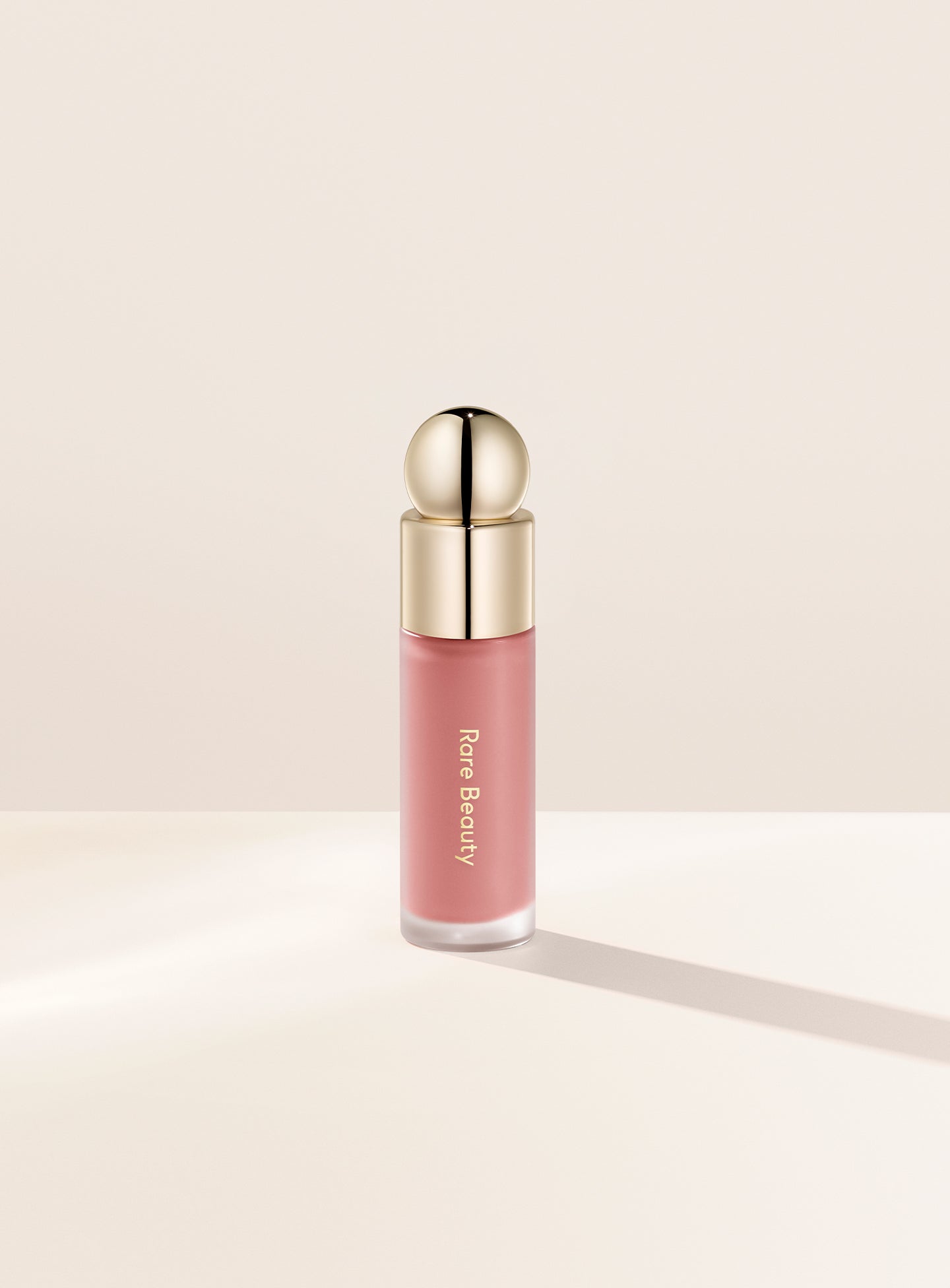
Rare Beauty markets its viral Soft Pinch Liquid Blush with a Botanical Blend of lotus, gardenia and white water lily that it says soothes, calms and nourishes skin. On the brand's own label, all three sit at position 16 or later in every shade. Under FDA cosmetic labeling rules, that puts each of them in the one percent or less zone.
On Rare Beauty's Soft Pinch Liquid Blush label, the Botanical Blend sits where the fragrance usually does. Selena Gomez's private brand launched in 2020, crossed into more than 1,500 Ulta Beauty US stores in February 2026, and Bloomberg put its net sales near 400 million dollars for the twelve months ending February 2024. Soft Pinch is the hero, 25 dollars, 25 shades, carrying a short story on the page: Gardenia, Lotus and White Water Lily, blended to soothe skin while the color sets. On November 2, 2026 we read the Full Ingredients modal on rarebeauty.com for every shade and logged where each of those three plants actually sits. The label, read all the way down, tells a different story.
What is actually in a Soft Pinch Liquid Blush?
Open the Full Ingredients modal and you don't see one formula. You see two. The 2020 launch shades, which Rare Beauty names Grace, Bliss, Faith and Love, start with Isododecane, Silica, Dimethicone and Methyl Trimethicone, a silicone and hydrocarbon base built for long wear. The newer shades, which Rare Beauty names Joy, Happy, Lucky, Grateful, Worth, Virtue, Adore and Hope among others, open with Hydrogenated Polyisobutene, Hydrogenated Poly(C6 to C14 Olefin), Mica and Octyldodecanol. Different base chemistry, same box, same price, same product name.
Deeper down in both formulas you'll find the pigment system (Mica, Titanium Dioxide, Iron Oxides, the FD&C Lakes), the texturizer (Trimethylsiloxysilicate, Disteardimonium Hectorite, Dimethicone crosspolymer) and the preservative chain. The older formula ends with BHT and the colorants. The newer formula drops BHT and uses Tocopherol plus Pentaerythrityl Tetra di t butyl Hydroxyhydrocinnamate in its place. Everything after that chain is a bit player.
Where does the Botanical Blend sit on the label?
Here's the count, taken from Rare Beauty's own ingredient modal on November 2, 2026, every shade read in full.
| Shade formula | Lotus | White Water Lily | Gardenia | Total ingredients |
|---|---|---|---|---|
| Grace (2020 launch, silicone base) | position 22 | position 23 | position 21 | 28 |
| Bliss (silicone base) | position 22 | position 23 | position 21 | 25 |
| Joy (newer hydrocarbon base) | position 17 | position 18 | position 16 | 23 |
| Hope (newer base, the Rare Impact face) | position 17 | position 18 | position 16 | 25 |
No matter which shade you pick up, the three botanicals land after Phenoxyethanol, after Caprylyl Glycol, after 1,2 Hexanediol, after Propanediol and after Sunflower Seed Oil. Then the plants. Then the colorants.
Why does the position of an ingredient matter?
FDA's cosmetic labeling rule, 21 CFR 701.3, says a brand has to list each ingredient on the label by name, in descending order of predominance, with one exception. Ingredients present at one percent or less don't have to follow that order; they can appear anywhere after the ingredients above one percent.
Cosmetic chemists use the preservative chain as a waterline. In US color cosmetics, Phenoxyethanol is used at roughly 0.5 to 1 percent, Caprylyl Glycol around 0.3 to 0.5, 1,2 Hexanediol at 0.5 to 1. Those three in a row usually mark the point where the formula has slipped under one percent. Anything after is almost certainly below that line. On every Soft Pinch shade we read, Lotus, White Water Lily and Gardenia all land past the waterline.
That doesn't make the product bad. It's a blush, it's for color, and the Botanical Blend is a top note. The quieter question is whether that top note is doing the skin work the page says it does, or whether it's a story the chemist signed off on because the dose doesn't matter at the levels the formula actually carries. By position, the second one. In cosmetic trade shorthand, botanicals used at a fraction of a percent are called marketing actives: too low to deliver a measurable effect, present so the brand can print the name.
Why does Rare Beauty use two different base formulas?
Darker pigments and lighter pigments behave differently in a liquid cheek product. The 2020 shades needed a silicone heavy base to hold pigment without separating. The newer shades skew lighter and were built on a hydrocarbon base that's easier to stabilize without BHT. That's the formulation reason. There's a quieter one too.
BHT, Butylated Hydroxytoluene, is a cheap, decades old antioxidant that the EU added to Annex III of its cosmetics regulation under Regulation (EU) 2022/2195, with a 0.8 percent cap for most leave on and rinse off products. The scientific committee behind the decision cited endocrine disruption concerns in its December 2021 opinion. New products placed on the EU market from July 1, 2023 must comply; stock on EU shelves had to come off by January 1, 2024. FDA has no concentration cap on BHT in cosmetics, so the US version of Grace and Bliss can continue to carry it. The newer shade formulas, launched into a US market that's watching the EU closely, don't. The brand hasn't posted a press release about the swap. The ingredient panel is the press release.
Per the European Commission's own 2021 scientific committee opinion, restricted elsewhere does not mean unsafe: the committee set a 0.8 percent cap for leave on products, not a ban, and our FDA has not followed. Our read of the two Soft Pinch formulas shows that Rare Beauty itself has decided, for a growing set of shades, that BHT isn't the antioxidant it wants to lean on.
Who owns Rare Beauty today?
Rare Beauty is a private LLC. Selena Gomez founded it, launched the brand in September 2020, and there is no public parent. CEO Scott Friedman, COO Mehdi Mehdi and chief product officer Joyce Kim all came out of NYX Cosmetics before L'Oreal bought that brand in 2014 for a reported 500 million dollars. New Theory Ventures has been reported as a minority investor. Bloomberg classified Gomez a billionaire in September 2024, attributing most of her roughly 1.3 billion dollar net worth to her Rare Beauty stake and estimating she holds at least 51 percent. Reuters has valued the brand in the one to two billion dollar range during on and off sale talks; no deal has been announced.
Same day we checked the US public record. The FDA Enforcement Report API returned zero results for Rare Beauty as a recalling firm. FDA's cosmetics covering adverse event API returned zero entries. FDA's warning letter database shows none directed at Rare Beauty. For a brand that moves this much product, the empty record is itself a finding. The disclosed positive on the page is the Rare Impact Fund: one percent of annual sales committed to mental health programs.
What should a shopper actually do with this?
Three habits worth building. When a makeup product leans on a plant blend, we'd find the full ingredient list on the brand's own site and see where the plants sit relative to the preservative chain; if they're after it, treat the plant story as scent and look, not treatment. When one brand uses the same product name across a shade range, we'd open two shade cards. Different pigments sometimes mean different base chemistries, which can matter for sensitivity and for personal avoidances like BHT. If a specific ingredient avoidance matters, use the brand's shade level panel, not a generic ingredient summary. Soft Pinch Liquid Blush is one product name and at least two formulas.
None of this makes Soft Pinch a bad product. It's a durable, popular, well made color cosmetic from a brand with an unusually clean US record. What it isn't is a skincare product in a blush bottle. The label is clear about that. The marketing is less so.
Photograph the bottle and Skinventry shows the full ingredient list for the exact shade you're holding, where each one sits, who makes the brand, who owns it, and what the public record says, with a source on every line.
Three things we read while writing this
- Rare Beauty's own Full Ingredients modal, every shade, read in full on November 2, 2026.
- FDA's cosmetic labeling rule at 21 CFR 701.3, the one that lets ingredients at one percent or less be listed in any order.
- The CEWay regulatory brief on EU Regulation 2022/2195, which added BHT to Annex III with a 0.8 percent cap.
And three Skinventry posts that live near this one: how the retinol position on a label often tells a different story than the ad, seven skincare buzzwords the FDA has never defined, and the brand teardown on who owns Fenty Beauty and what's quietly changing inside it.
