Ultra Violette's Unblock Screen SPF 50 reached US Sephora shelves on October 2, 2026, at 40 dollars for 50 mL. It's the first US sunscreen to use bemotrizinol, a filter the FDA cleared at up to 6% on June 9 after a 20 year wait. For 40 dollars you get three filters, a tint and a soft matte finish. Neutrogena's own 6% version runs about 5 dollars an ounce.
On October 2, 2026, a shelf tag flipped from "Coming Soon" to "Now Selling" at Sephora stores across the US. The product behind it: a 50 mL blue tube from an Australian brand most American shoppers had never heard of until this summer. Ultra Violette's Unblock Screen SPF 50, 40 dollars, with bemotrizinol listed first in its UV filter mix. The brand's own release called it "the first SPF to launch in the US" with the filter the FDA cleared at concentrations up to 6% in a June 9, 2026 OTC Monograph Final Order. Marie Claire said the same thing. Who got there first turns out to matter less than why American drug stores still couldn't get a sunscreen filter sold in Berlin and Seoul since 2005.
We spent the morning reading three labels, the Federal Register notice behind the June order, and a June 12 CU Anschutz dermatology interview about what the filter actually does in a bottle. Here is what Unblock Screen is, where it fits, and what you lose for the 25 dollars Ultra Violette charges over a drug store option.
Who makes Ultra Violette?
Ultra Violette is a Melbourne based suncare brand founded by Bec Jefferd and Ava Chandler Matthews, two beauty industry veterans who met at the Australian retailer Mecca. The pair started shaping the business in 2016 and launched online in January 2019 with five products, built around the gap they saw between Australian pharmacy sunscreens and the newer Asian and European chemical filters. The brand is privately held. Canada came first, with Sephora Canada in April 2024, and the US range arrived in March 2025, when Supreme Screen SPF 50+ and a US exclusive called Vibrant Screen hit Sephora.com and 592 US stores. Beauty Independent reported in 2025 that Aria Growth Partners took a minority stake worth 10 million US dollars to fund the North American push. Jefferd and Chandler Matthews still run the company.
What arrived on US shelves on October 2
The product is a tinted, soft matte, zinc and bemotrizinol hybrid, in a 50 mL blue bottle with a pale green cap. Ultra Violette sells it as a "breakout friendly skinscreen" for oily, acne prone and reactive skin. The brand launched online at ultraviolette.com and in Sephora's US app on August 31, with physical stores going live on October 2. Fave Screen SPF 50, a sister launch with 5% bemotrizinol next to niacinamide and vitamins C and E, is scheduled for January 2027.
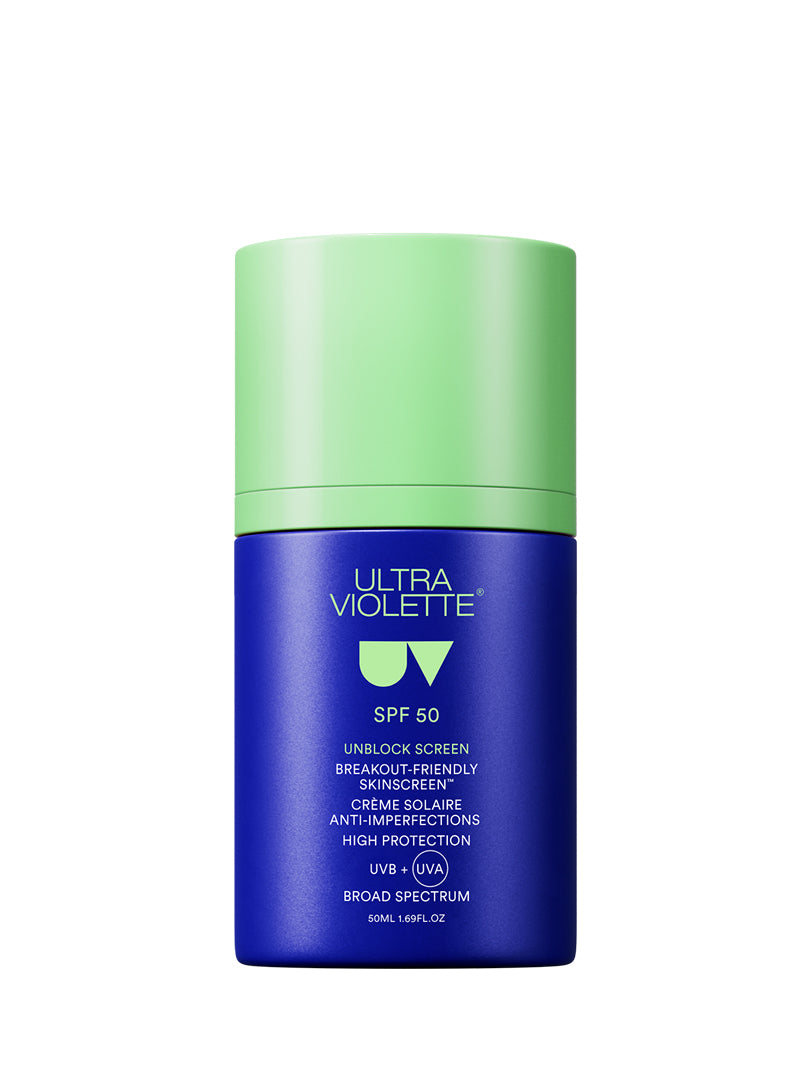
We read the three UV filters off the brand's own ingredient panel and the Australian regulator's registry entry on October 12, 2026: bemotrizinol, octocrylene and zinc oxide. Two chemical, one mineral. The brand's language of "zinc bemotrizinol hybrid" is accurate for how most of the UV coverage is split; octocrylene is the smaller role player, a filter the brand has used across its range for years to stabilize other chemicals in the mix. The tint is subtle. The finish is soft matte. 1.69 fluid ounces. For 40 dollars.
How did the US get its first new sunscreen filter in 20 years?
The filter is the point. Bemotrizinol has been sold on European pharmacy counters since 2005, in Australia and much of Asia almost as long. It covers more of the UVA band than any older US filter and holds up longer in the sun before degrading. UVA is the slice of the spectrum tied to photoaging and to several skin cancers. US brands could not use it until this summer.
The reason's bureaucratic, not scientific. The FDA regulates sunscreens as over the counter drugs under its OTC monograph system, a path that treats a new UV filter like a new medicine. Europe and Australia treat sunscreens as cosmetics, which lets a new filter clear faster. The last time the FDA added a UV filter to the sunscreen monograph was the late 1990s. On June 9, 2026, that changed: the agency issued an OTC Monograph Final Order published in the Federal Register the next day, adding bemotrizinol to the sunscreen monograph at concentrations up to 6%, for adults and children 6 months and older. The order responded to a Tier 1 request DSM Nutritional Products filed on September 23, 2024.
The order took effect on August 9, 2026, which gave manufacturers 60 days to label and ship. Three weeks later Ultra Violette's PR said Unblock Screen was "the first SPF to launch in the US" with the filter; Neutrogena shipped its own two bemotrizinol face sunscreens on September 17, which Dermatology Times framed as the first drug store launch. Both can be true. Ultra Violette shipped online first by about two weeks, and Neutrogena hit mass drug store aisles first. There is no official first.
The Practical Dermatology write up of the June order called it the first new organic UV filter in more than 20 years. It is. A second request, for bemotrizinol in combination with other filters at higher concentrations, is pending at the FDA. A third, for the filter bisoctrizole, is still earlier in review.
What's actually in the 50 mL tube?
We read three labels for this piece: Ultra Violette's own US product page, the Sephora listing, and the Australian regulator's entry for the Australian version, which carries ARTG number 528472. The three UV filters are bemotrizinol, octocrylene and zinc oxide. The brand does not publish percentages for either filter on US panels. The regulator does not either. What we can report: bemotrizinol sits first among the actives on the US label, which under FDA order rules means it is present at up to 6%, and the US version is listed at around 15% zinc oxide. The base carries Bix'Activ for oil control and Pentavitin for hydration. Fragrance appears at under 1%. For a 40 dollar sunscreen, that is less than we want to see.
What dermatologists say about the new filter
The reviews read upbeat. The strongest praise we found came from Theresa Pacheco, MD, a professor of dermatology at the CU Anschutz School of Medicine, in a June 12 interview:
"The other countries just have more ingredients. They're more advanced, and they look at data differently than our FDA. So this is actually a really big deal. Bemotrizinol is a chemical filter. It protects against UVA and UVB."
Dr. Pacheco's point stacks against a specific irritation: as she said in the same piece, the US has had only 17 approved UV filter ingredients for years, and several good ones used in Europe and Asia never cleared the OTC monograph path. The MD Anderson Cancer Center's own public read is similar. In its July 2026 explainer, the center said bemotrizinol "doesn't break down as quickly as many existing chemical sunscreen ingredients and is less absorbable in your skin," and that it does not leave a white cast the way mineral sunscreens often do.
The quieter voices worth hearing came from the pharmacy side. The AJMC guide for pharmacists noted two things the beauty coverage mostly skipped. One, the FDA's safety determination covers adults and children aged 6 months and older, which closes a long debate about which chemical filters are appropriate on children. Two, "reef safe" has no legal US meaning, so a bemotrizinol based sunscreen that advertises itself as reef friendly is making a marketing claim, not a regulated one. The ocean toxicity record for the filter is thinner than it is for zinc.
None of what we read called bemotrizinol a problem. Several US derms used "big deal" or "long overdue." The caveat they all agreed on: the filter's new to US labels, not to human use.
Where does Unblock Screen fall short at 40 dollars?
The upside is real. A broader UVA block in a lighter texture than most mineral options is what a lot of oily, acne prone shoppers have been asking for. The brand pedigree is strong. If a Sephora shelf tag that reads "first with the new filter" is what moves you to wear SPF every morning, the premium pays for itself in burn free Octobers.
The downsides are also real, and a review has to say them out loud. First, the price. 40 dollars for 50 mL works out to about 24 dollars per fluid ounce. Neutrogena's new Clear Face Sunscreen SPF 60, built on the same filter, lists for about 15 dollars for 3 fluid ounces, roughly 5 dollars per ounce. If your reason to try bemotrizinol is the filter, the cheaper American launch runs the same chemistry in a drug store bottle. We walked through who's behind the other new sunscreen filter launch last week.
Second, the formulation is not minimal. Unblock Screen carries octocrylene, which a 2021 Chemical Research in Toxicology study found can accumulate benzophenone when stored for months in warm conditions. The FDA still considers octocrylene generally safe at monograph concentrations, and the finished dose in a sunscreen is small. Still, people who want to avoid the filter in a pregnancy routine often check for it. If that is a priority, the three hybrid sunscreens that cleared our September pregnancy read are a cleaner start.
Third, the "breakout friendly" claim is marketing, not a regulated term. There is no legal US definition of non comedogenic or acne safe. Nothing on the published formula flagged as high risk for pore clogging, and the base is mostly water, humectants and silicones. But if you are acne prone enough that the finer grained choice between Beauty of Joseon's acne prone picks matters to you, you'll want to patch test for a week first. Sunscreen reactions can look like, and worsen, a perioral dermatitis flare.
Fourth, the tint. The brand calls it a "subtle" tint that minimises white cast. In our scroll through the brand's own swatches on October 12, the shade reads warm neutral, which blends on olive to light brown skin and sits a touch yellow on cool fair skin. It is not shade matched. Deeper skin tones still need to swatch in person. Ultra Violette has not released a shade range for Unblock Screen.
Fifth, the recall question. SPF 50 bottles have had a recall year. A reader who wants context on how a product recall actually unfolds should read what 82,596 bottles of a different SPF 50 told us about the recall system. Nothing in Unblock Screen's record so far points to a problem, but a new launch is a new launch.
What's coming in the next six months?
Fave Screen SPF 50 is next, scheduled for January 2027 at the same brand. It is billed with 5% bemotrizinol, niacinamide, and vitamins C and E, in a serum style finish aimed at a wider skin type range than Unblock Screen's acne prone brief. The brand's PR describes it as the first US launch of a bemotrizinol vitamin blend at that concentration. We'd wait for the final label to publish before taking the sentence at face value, but if it holds, the Fave Screen launch will be more interesting than this one.
Beyond Ultra Violette, the pipeline is thin and worth tracking. Neutrogena's two September launches are the mass face of it, and a third brand is widely expected to debut a bemotrizinol body sunscreen before next summer. On the FDA side, a second order request pending at the agency would permit bemotrizinol in combination with other filters at higher concentrations than the June rule allows. If that goes through in 2027, US formulators get something closer to the European playbook, where bemotrizinol often sits next to Tinosorb S and Mexoryl 400 in a single bottle.
What we would do with 40 dollars and a shelf of options
If your skin runs oily and reactive and you can wear a tint, Unblock Screen is a credible premium pick. The texture is lighter than most mineral SPFs on the shelf, and the UVA coverage is a real step up for a US bottle. For the shopper who just wants bemotrizinol in their routine, Neutrogena's SPF 60 does most of the same work for about a third the per ounce price. For the shopper who cares about octocrylene, there are now mineral and hybrid routes to broad UVA coverage without it.
We asked Dr. Pacheco's own framing of the moment:
"So this is actually a really big deal," Pacheco said in her June 12 interview. "The other countries just have more ingredients."That's exactly the right size claim. Not a cure. Not a reset. A long overdue filter on US shelves at last, in a 40 dollar Australian bottle this week and a 15 dollar American one next week.
We'll be watching the January Fave Screen launch for a cleaner read.
Until then, I'm wearing it.
And so is my cheaper Neutrogena one.
Photograph the Unblock Screen panel and Skinventry reads it back: the three UV filters, who makes it, what the Australian regulator's register says about the Australian version, and the June FDA order that put the first of those filters on US shelves. Each line sourced. The app does not score the bottle. It names what is inside and who is behind it, and lets you decide whether the 40 dollar price pays for itself.
