If you're new to Beauty of Joseon and you break out, start with the Glow Serum: $17 for propolis, niacinamide, and betaine salicylate in a light serum. The one to try last is the Dynasty Cream, the richest formula in this lineup.
Beauty of Joseon knows plenty of its buyers break out. Its site has a whole Breakouts collection now, and many product pages market a version of gentle enough for sensitive, acne prone skin. That framing isn't wrong. It's also not useful when you're trying to decide which of dozens of products to actually buy.
So this guide ranks the line's likeliest picks on their published formulas, with two kinds of breakouts in mind: garden variety hormonal acne, and a subtype called acne mechanica, which the American Academy of Dermatology describes as breakouts caused by heat, friction, and occlusion. Chin strap acne from a bike helmet. Cheek breakouts from a phone. The small cluster on the bridge of the nose from glasses. It responds badly to heavy occlusive creams. That mattered for the ranking.
Is Beauty of Joseon good for acne prone skin?
Yes, mostly, if you shop the line surgically instead of buying the top rated set. Beauty of Joseon runs three roughly separate product families: the Rice line (hydration, brightening), the Ginseng line (anti aging, firming), and the Relief Sun and Calming line (barrier repair, sun protection). The Rice and Calming products lean lightweight and watery. Those are the safest bets for acne. The Ginseng line skews richer, and its flagship Dynasty Cream is the richest texture in this lineup. If your skin runs oily or combination, treat the Ginseng shelf as adjacent, not central. Buy the Rice serum, buy the propolis serum, and stop there.
How did we pick?
We started with bestsellers on the brand's own Sensitivity and Blemish collection and read each published ingredient list for texture, occlusive oils and waxes, and actives that matter for breakouts. The ranking below is a comparison of formulas.
A note on comedogenic ratings: the original 0 to 5 scale came from a 1970s rabbit ear test that the inventor himself later disproved, so treat any comedogenic score as a rough sort, never as a promise about your face.
Our top pick: Glow Serum, Propolis + Niacinamide
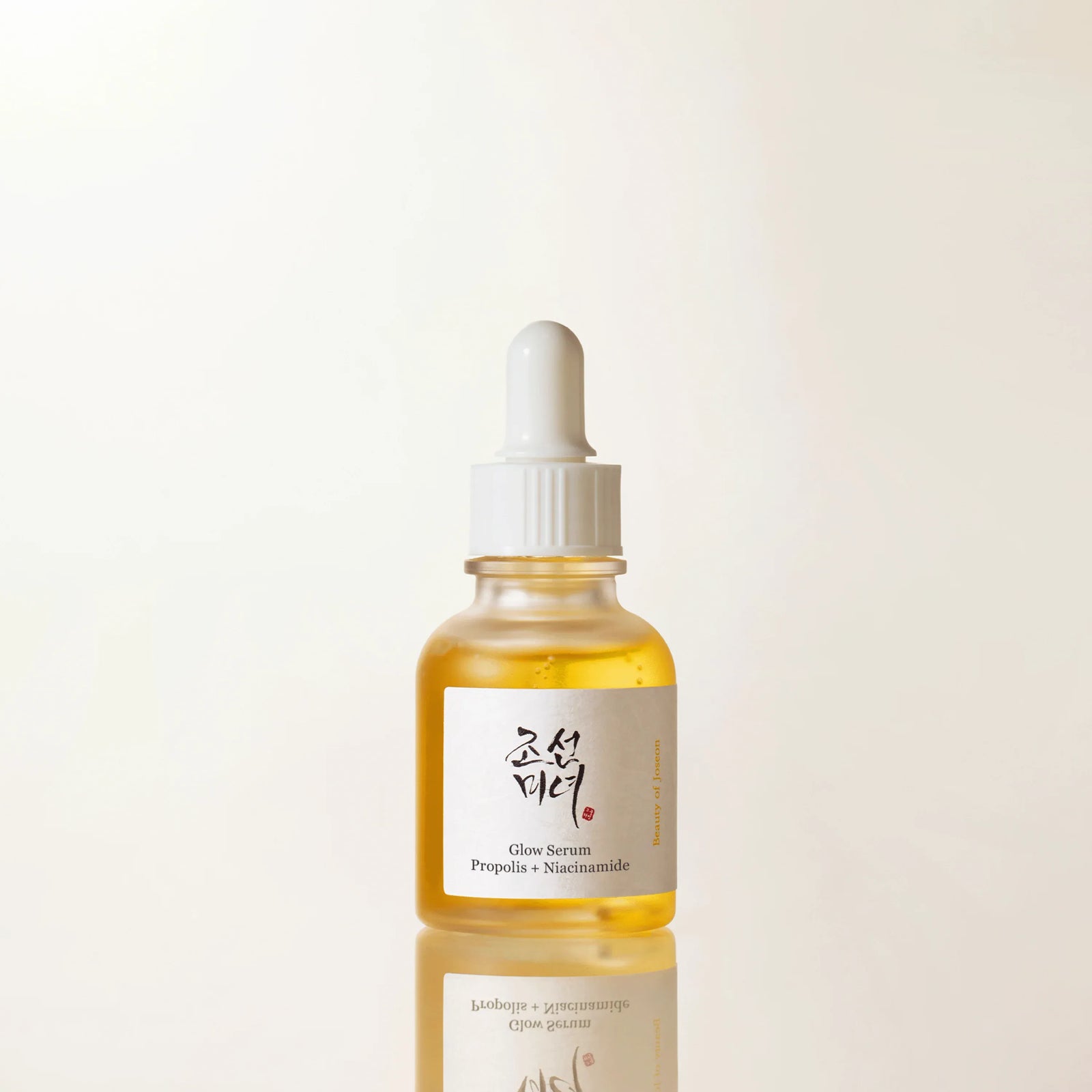
$17 for 30 ml. Propolis extract is fifth on the ingredient list, just ahead of niacinamide, with betaine salicylate, a gentle relative of salicylic acid, right behind them.
The propolis is the reason to buy it.
Propolis is a resin honeybees produce to seal their hives. It's antibacterial in a way that translates to skin. A 2025 randomized controlled trial tested a propolis and aloe cream as an addition to 5% benzoyl peroxide against benzoyl peroxide alone in 72 patients with Grade II or III acne, and the propolis arm showed larger drops in C. acnes bacterial load and inflammatory biomarkers over 8 weeks. That's not the same claim as propolis clears acne on its own. It's the claim that propolis has real, measured anti Cutibacterium activity, and that's what you're buying with the Glow Serum.
It's the closest thing this brand makes to a just buy it for acne prone skin. See also our writeup of why some niacinamide serums hide their real percentage, which explains why the Glow Serum's soft label is a good sign, not a bad one.
Runner up: Relief Sun: Rice + Probiotics, SPF 50+ PA++++
$18 for 50 ml. The single most cited Beauty of Joseon product on TikTok, and for once the hype is close to earned. It's a chemical sunscreen built on newer filters such as Uvinul A Plus and Tinosorb M, with rice extract and niacinamide in the base.
One thing worth knowing before you buy: like any sunscreen film, it sits on the skin all day, and under a chin strap or mask that matters for acne mechanica. If you're shopping sunscreen for acne prone skin more broadly, we compared Korean and Japanese SPFs here.
Is the Radiance Cleansing Balm safe for acne prone skin?
$19 for 100 ml. A balm built on rice bran oil and sea buckthorn oil with emulsifiers so it rinses off, and Beauty of Joseon labels it fragrance free. It won't clear existing filaments; for that we ranked the three oil cleansers that actually break down sebaceous filaments. Treat the Radiance Balm as a good, plain first step in a double cleanse. Nothing more.
Is the Green Plum Cleanser good for acne?
$13 for 100 ml. A gel cleanser built on green plum water, with mung bean extract and citric acid. It's one of the cleansers the brand features in its own Breakouts collection, and it works as the water phase after the Radiance Balm.
The occasional mask: Red Bean Refreshing Mask
$20 for 140 ml. Ground adzuki bean powder with kaolin and hectorite clays. Ten minute clay treatment, twice a week max. There is no salicylic acid in it.
It's a plain clay mask.
If you want an acid in your mask, our shortlist of charcoal masks for acne prone skin includes a salicylic acid option. This one earns its slot when the problem is congestion, not active nodules.
Which toner should you start with?
$18 for 150 ml of the Glow Replenishing Rice Milk. Rice extract is on the list along with panthenol, ceramide NP, and a little kaolin. Not an exfoliating toner. Not a treatment. It's a hydration prep step, and it costs little per use. This is the bottle to reach for if you want to try the line and can't spend more than $20.
Is Beauty of Joseon Dynasty Cream good for acne prone skin?
For most people with active acne, it is not the place to start.
Try it last, if at all.
The Dynasty Cream is the flagship of the Ginseng line, $24 for 50 ml, and it's a rich moisturizer built around ginseng root water, niacinamide, adenosine, and squalane. Adenosine and ginseng aren't the concern. The rich base is: hydrogenated polydecene, squalane, safflower oil, and hydrogenated coconut oil. Beauty of Joseon labels it non comedogenic, and that label has no standard test behind it.
If you're oily and breaking out, keep it off the friction zone at the very least. Whatever sits under a chin strap should be as thin as possible; even a well loved cream works against you there. For a broader read on when to switch to real acne actives, see our guide to PanOxyl for cystic acne.
The lineup, side by side
| Product | Price | Key actives | Best for |
|---|---|---|---|
| Glow Serum | $17 | Propolis, niacinamide, betaine salicylate | Active inflammation, redness |
| Relief Sun: Rice + Probiotics | $18 | Uvinul and Tinosorb filters, niacinamide | Daily SPF, non mechanica users |
| Radiance Cleansing Balm | $19 | Rice bran oil, sea buckthorn oil | First cleanse, SPF removal |
| Green Plum Refreshing Cleanser | $13 | Green plum water, mung bean, citric acid | Second cleanse, daily use |
| Red Bean Refreshing Mask | $20 | Adzuki, kaolin, hectorite | Weekly pore prep |
| Glow Replenishing Rice Milk | $18 | Rice extract, panthenol, ceramide NP | Budget entry, prep step |
| Dynasty Cream | $24 | Ginseng root water, niacinamide, adenosine, squalane | Dry, mature skin (not acne prone) |
What should an acne mechanica shopper actually buy?
Because acne mechanica is driven by mechanical trauma and heat trapping rather than clogged pores alone, the shopping rule flips. You want everything in your friction zone to be watery, non occlusive, and simple. Anything that reads as a cushion or cream or balm belongs elsewhere on the face, not under the strap.
The Beauty of Joseon subset that fits that brief cleanly is a small one: the Glow Serum, the Glow Replenishing Rice Milk, the Relief Sun Aqua Fresh, and the Green Plum Cleanser. That's the whole shelf for a mechanica shopper. Keep the Dynasty Cream and other rich creams off the parts of the face that touch a strap, a phone, or a mask edge.
The honest downside
Comedones can lag by a month, so judge any new product over several weeks, not days. If your baseline is Cetaphil and a Neutrogena moisturizer, expect an adjustment window on any of these.
Propolis is a bee product. It's a small but real allergen risk. If you have a beeswax or honey reaction, patch test the Glow Serum on the inner arm for three nights before it goes on your face. Nothing here treats hormonal cystic acne. If you're getting deep painful nodules along the jawline that leave dark marks, none of these are a substitute for a real prescription; that's a dermatologist conversation. Photograph any Beauty of Joseon bottle and Skinventry shows its published ingredient list, who makes it, and who owns the brand, each linked to its source.
