e.l.f. Whoa Glow at $15 matches Supergoop Unseen on the filters that do the real UVA work, and it adds niacinamide and sodium hyaluronate the $38 original does not. Unseen still wins on SPF math at 50 versus 30. Under apply and the dupe loses; measure two fingers and it is close enough.
Can a $15 e.l.f. tube really stand in for the $38 Supergoop? This comparison works from what can be checked: the published filter lists, the inactive ingredients, the prices, and the research on how much sunscreen people actually apply. The short answer is yes, with caveats. The longer answer turns on dose: how much sunscreen actually goes on.
The setup: why mature skin changes the comparison
Most dupe posts assume your skin is 22 and oily and that a sunscreen's only job is to not pill under foundation. After 40 the job list changes. You're protecting elastin you can't get back, you're patching a moisture barrier that measurably thins in the years on either side of menopause, and you're trying not to add white cast to skin that already looks a little tired by Wednesday. So a fair comparison has to look at filters, finish, and the absolute amount of product you can comfortably wear, every day, for years.
Dose is the buried fact in every dupe comparison. The 2002 letter in the BMJ that introduced the two finger rule did not invent a beauty trick. It tried to fix the gap between the 2 mg/cm² dose labs use to measure SPF and the 0.5 mg/cm² most adults actually rub on. At half application your SPF 40 behaves like an SPF 6.3, your SPF 30 like an SPF 5.5. Both of those are bad.
That is why this comparison treats both products at the dose their SPF was tested at and compares the formulas, not anyone's application habits. A 4.5 year randomized trial in the 2013 Annals of Internal Medicine found that daily sunscreen users showed 24% less photoaging than the control group at the proper dose. The dose is the boring part of the story. It's also the only part that decides whether either of these tubes pays off after a decade.
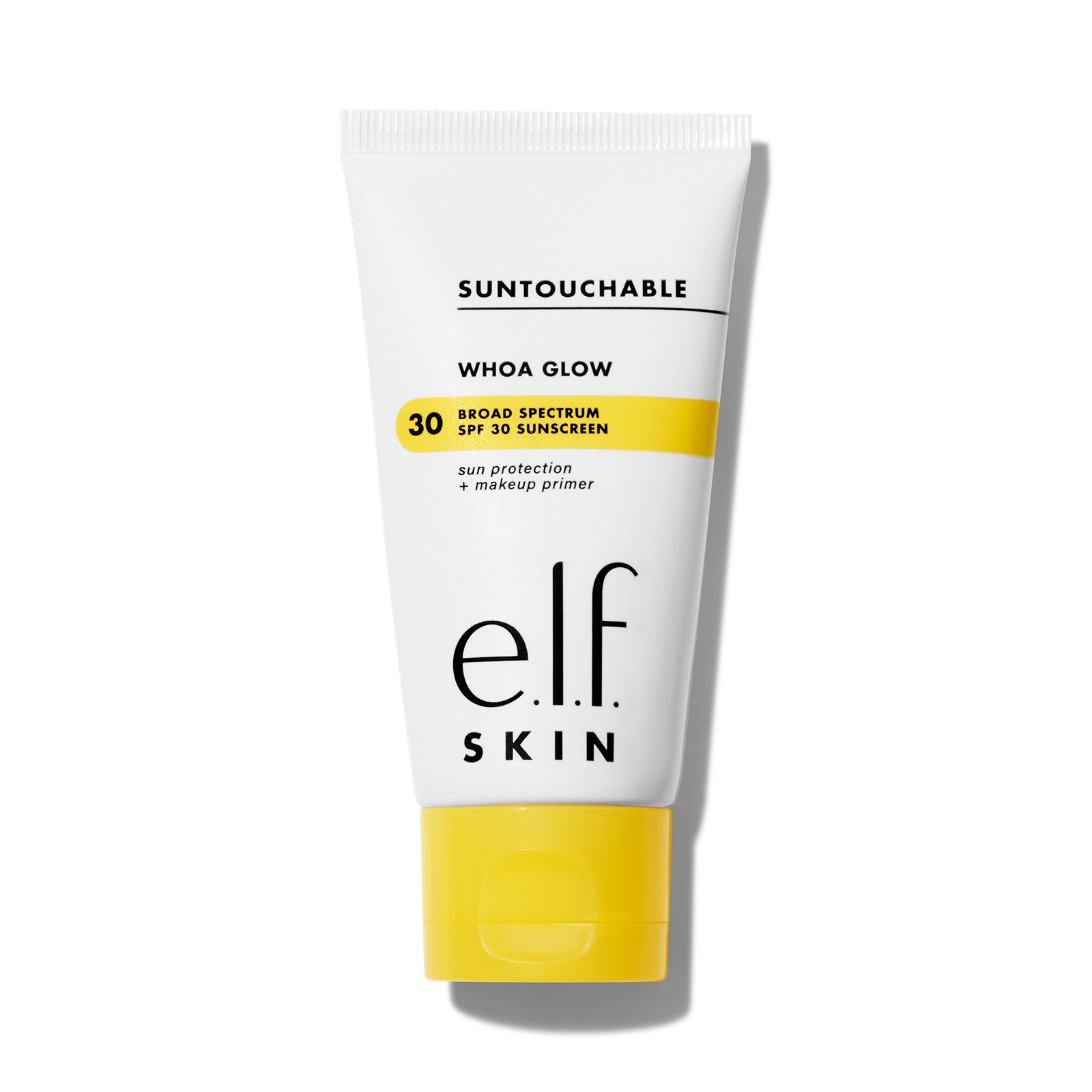
Is Whoa Glow a dupe for Glowscreen or Unseen?
Straight answer: the comparison you're looking for is Glowscreen, not Unseen. Every reviewer lineup I found puts Whoa Glow against Supergoop Glowscreen, and the products themselves make the case, right down to the shade names. Glowscreen comes in Sunrise, Dawn, Golden Hour, and Sunset; Whoa Glow comes in Sunbeam, Sunlight, and Sunburst. Both are tinted, glow first primers, Glowscreen with light reflecting pearls at SPF 40, Whoa Glow with its shimmer at SPF 30. Unseen is a different product entirely: a totally clear, scentless gel with no tint and no glow, and Supergoop has since bumped the formula from SPF 40 to SPF 50. This comparison sets Whoa Glow against Unseen because both brands sell them as daily face sunscreens that double as primers, but if you typed a dupe query to get here, Glowscreen is the tube you mean.
The price math: Glowscreen is $38 for 1.7 oz. Whoa Glow lists at $15 for 1.69 oz. Same glow idea at well under half the price, with the labeled SPF dropping from 40 to 30.
Who should buy which: if you want the tinted glow under makeup and the budget matters, buy the Whoa Glow; its carrier is humectant heavy, with glycerin second on the ingredient list. If you want the higher SPF number, a fourth shade option, and the pearl finish over shimmer, pay for Glowscreen. And if you hate glow entirely, skip both, because an invisible gel is exactly the job Unseen was built for, and the rest of this comparison covers it.
Round 1: which filter math actually wins?
Both products run a nearly identical organic filter stack. Supergoop Unseen, now sold as SPF 50, lists avobenzone 3%, homosalate 7%, octisalate 5%, and octocrylene 9% on the brand's label. e.l.f. Whoa Glow lists avobenzone 3.0%, homosalate 9.0%, octisalate 5.0%, and octocrylene 7.0% per its official ingredient page. Avobenzone is the only UVA filter doing real work in either tube, and the dosage is identical. The filter totals match too, 24% in each tube, yet the labels read SPF 50 and SPF 30, because SPF is measured on each finished formula rather than predicted from the filter list.
Round 2: which carrier suits creased, drier skin?
This is where the two products separate. Supergoop Unseen reads silicone first: isododecane and four dimethicone based ingredients lead its inactive list, which is where that velvet primer feel comes from. There is no glycerin, panthenol, or hyaluronic acid on that list.
e.l.f. Whoa Glow goes the other direction. Its inactive list reads like a moisturizer: water and glycerin at the top, then niacinamide, panthenol, sodium hyaluronate, squalane, and aloe. The trade is the shimmer. e.l.f. sells every shade as a shimmer finish, and the only pearlescent pigment on the list is bismuth oxychloride, fourth from the top. If you hate shimmer, this one is not for you.
The AAD's standing advice is that the best sunscreen is the one you will use again and again, as long as it is broad spectrum, water resistant, and SPF 30 or higher. For drier, creased skin, that makes finish a real factor, not a vanity one.
The reason matters. Stratum corneum lipid content drops measurably in the years on either side of menopause, and the barrier holds less water for longer between applications. A sunscreen whose finish is built around silicone elastomers can sit on top of that drier surface and emphasize it. A sunscreen whose carrier is heavy on glycerin and panthenol can pull water in the other direction. Near identical filter lists on paper. Very different skin under the protection.
Round 3: which one is more likely to break you out?
Neither product contains oxybenzone or octinoxate, the two organic filters with the deepest endocrine and reef toxicity files. Both run avobenzone, which is photo unstable on its own but stabilized in both tubes by octocrylene.
Supergoop describes Unseen as scentless, and e.l.f. labels Whoa Glow fragrance free; neither lists added fragrance. If you have reacted to fragranced sunscreens in the past, that is one worry neither label raises.
On breakouts, the labels say less than the marketing. Supergoop now calls the SPF 50 formula non acnegenic for acne prone and sensitive skin, which is a brand claim, not an independent result. Comedogenicity ratings on raw ingredients don't predict how a finished formula behaves on real skin, so if you congest easily, patch test either tube along the jaw before committing.
Round 4: who is each sunscreen actually for?
Use this table as the short version.
| Criterion | Supergoop Unseen SPF 50 | e.l.f. Whoa Glow SPF 30 |
|---|---|---|
| Price (1.7 oz) | ~$38 | ~$15 |
| UVA filter | Avobenzone 3% | Avobenzone 3.0% |
| UVB load | Homosalate 7% / Octisalate 5% / Octocrylene 9% | Homosalate 9.0% / Octisalate 5.0% / Octocrylene 7.0% |
| Labeled SPF | 50 | 30 |
| Finish | Velvet, primer like | Sheer shimmer glow |
| Hydrators | Shea butter, meadowfoam estolide (emollients) | Glycerin, niacinamide, hyaluronic, squalane |
| Best for | Makeup days, anyone who wants no tint or glow | Mature, dry, no makeup or light base |
| Worst for | Anyone who wants humectants in the SPF step | Anyone who hates visible shimmer |
The thing the table can't show is how often you'll actually reach for the tube. Mature skin does not want to wear a sunscreen that makes it look more textured. Frequency of use beats label SPF in real human results, which is why the Hughes trial found such a strong photoaging effect at moderate SPF when people actually wore it every day. A $15 tube you use seven mornings a week protects you better than a $38 tube you use four.
The honest caveat (what the dupe loses on)
Two places the dupe loses outright. The first is high UV days. If you're outdoors in May or June at a latitude under 35, an SPF 30 at the dose the average person actually applies is leaving meaningful UV on the table. On those days a higher SPF product is the better call. The second is sweat. Unseen's Drug Facts tell you to reapply after 40 minutes of swimming or sweating, which is water resistant labeling; e.l.f. makes no water resistance claim for Whoa Glow on its product page. Daily indoor wear is the dupe's territory. Outdoor sport days are not.
The verdict
On the published labels, the e.l.f. Whoa Glow is the better daily face sunscreen for dry, mature skin, paired with a real outdoor SPF 50 for hike and pool days. That split costs $15 plus whatever the outdoor tube costs. The Supergoop Unseen earns its $38 for a different reader: someone who wants an invisible, primer like base under foundation and no glow at all.
The dupe is not a clone. It's a better daily sunscreen for one specific reader: dry, mature skin that wants humectants in its sunscreen. The most expensive sunscreen in your cabinet is the one you skipped because you didn't like the finish.
If you want to see what your current shelf actually delivers at the dose you use, our deeper SPF cluster covers the rest: why the SPF on the label is almost never the SPF you get, how to read the PA rating that actually predicts photoaging, and how the spray and mist categories compare on the same two finger test.
What no label can tell you is whether either tube holds its labeled SPF at the amount a real adult face actually gets. A scale can tell you what you applied; only an in vivo SPF test tells you what your skin received. Photograph either tube and Skinventry shows its published ingredient list, who makes it, and who owns the brand, each linked to its source. If your derm has a different read on the silicone versus humectant tradeoff in midlife skin, write back. The Supergoop versus e.l.f. story is not over. It is just the part of it the two brands are willing to tell.
