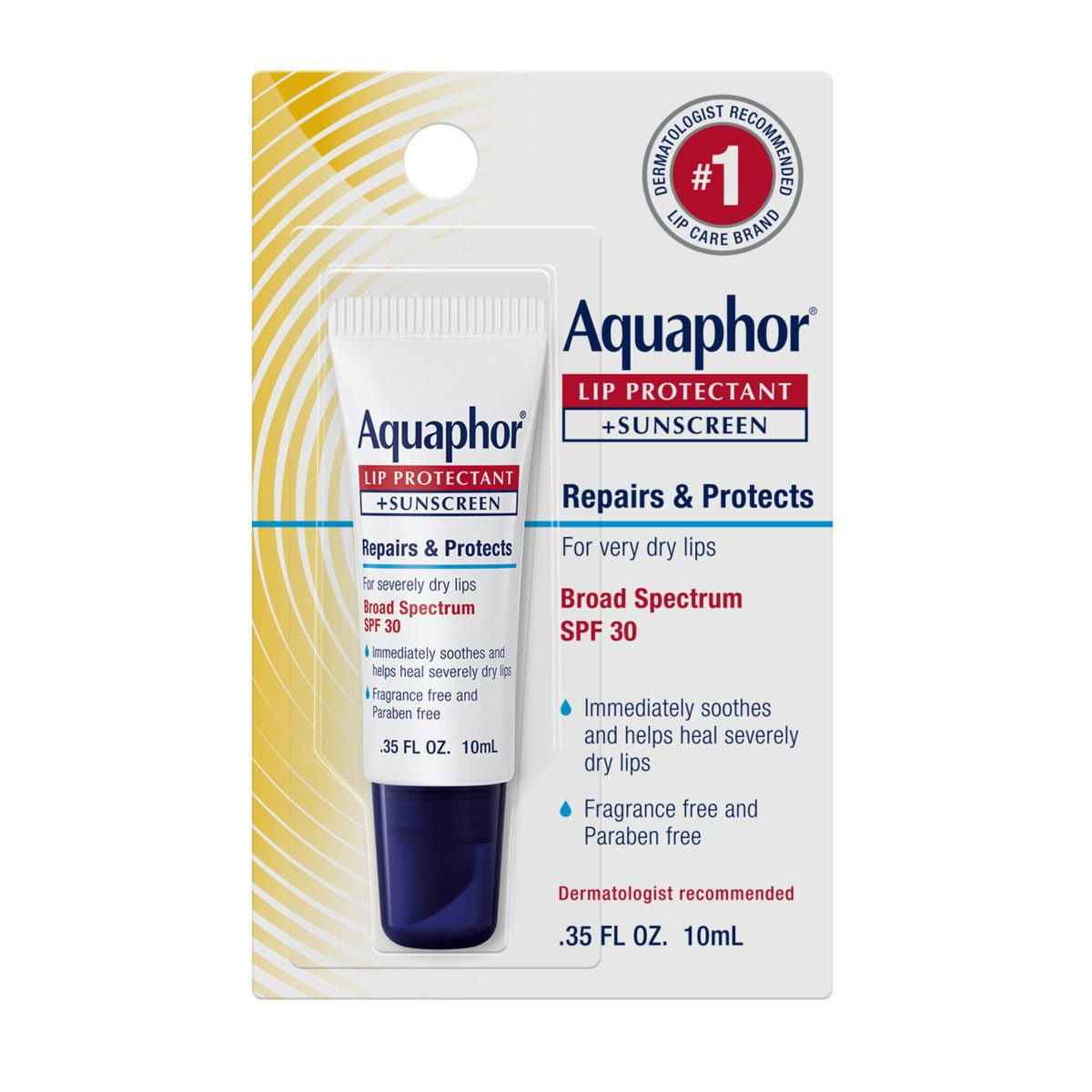
Aquaphor Lip Protectant + Sunscreen SPF 30 wins on the things that matter for cracked lips: hydration, durability, and price. Supergoop Lip Shield SPF 40 wins on cosmetics, finish, and the FDA's 80 minute water resistance test. If your lips split open every winter, you want the Aquaphor.
Lip cancer is small in absolute terms, about 0.1% lifetime risk in this country, but it's one of the few cancers where ultraviolet exposure is a primary modifiable cause, per the NIH SEER registry, with new cases running about 0.5 per 100,000 a year and skewing heavily toward older men with sustained outdoor exposure. And yet roughly 30% of Americans only sunscreen their face, according to the 2025 AAD survey of 1,000 adults. That gap is why the SPF lip balm aisle exists. It's also why two products own it.
What follows compares the two on what the Drug Facts label on each tube tells anyone willing to flip it over, on price, and on what independent reviewers have published about both.
What's actually on the Drug Facts side
Aquaphor Lip Protectant + Sunscreen SPF 30 is a lotion. Its actives, per the FDA's DailyMed listing, are petrolatum 31%, avobenzone 3%, octinoxate 6.75%, octisalate 4.5%, octocrylene 2%, and oxybenzone 5.4%. The petrolatum is the moisturizer; the rest is the sun filter cocktail.
Supergoop's Play Lip Shield SPF 40 leans on avobenzone 3%, homosalate 8%, octisalate 5%, and octocrylene 3%. No oxybenzone. Its base is coconut oil, shea butter, jojoba, and avocado oil. The format is a stick, not a lotion, and the FDA cleared it for 80 minute water resistance.
That's the whole science of the comparison. Same UVA workhorse in both (avobenzone), different UVB blends, different bases, different formats. Everything that follows is downstream of those four facts.
Why this matchup is the one people actually search
Supergoop's label carries an 80 minute water resistance claim. Aquaphor's does not. The same search keeps surfacing on Reddit and TikTok because shoppers want to know if the cheap drugstore stick really matches the boutique stick they saw on a creator's shelf. Both use avobenzone as the UVA filter. Both are reformulated within the last three years. Both have published Drug Facts labels you can verify yourself on DailyMed. The comparison is fair because the chemistry is genuinely close. The verdict turns on what you ask the tube to do all day.
Round 1: which costs more per real use?
Aquaphor sells the lip tube for about $5.99 at most US drugstores. Supergoop's Play Lip Shield retails at $13 for a comparable volume of product. That puts Aquaphor at roughly one third the price for the same job.
If you actually reapply, this matters. The FDA monograph for sunscreen calls for reapplication every two hours, or after eating, drinking, swimming, or sweating, which is a standard that practically nobody outside a dermatology trial meets in real life but that the agency holds as the floor for the SPF claim on the front. A daily user goes through a tube of lip balm in three to four weeks. Across a year that's roughly $72 of Aquaphor versus $156 of Supergoop, a delta that gets larger the more honest you are about how often you reapply.
Aquaphor wins this round on flat dollars. The honest caveat: Supergoop wraps in shea butter and avocado oil, which arguably matter to people whose lips don't crack. Aquaphor leans on paraffin and petrolatum, which arguably matter to people whose lips do.
| Spec | Aquaphor Lip Protectant SPF 30 | Supergoop Play Lip Shield SPF 40 |
|---|---|---|
| List price | $5.99 for 0.35 oz | $13 for 0.25 oz |
| SPF | 30 | 40 |
| UVA filter | Avobenzone 3% | Avobenzone 3% |
| UVB filters | Octinoxate, octisalate, octocrylene, oxybenzone | Homosalate, octisalate, octocrylene |
| Skin protectant | Petrolatum 31% | None listed |
| Water resistant | Not labeled | 80 minutes |
| Format | Lotion in a tube | Stick |
| Finish | Matte, slightly greasy | Sheer, slight sheen |
Round 2: which one's protection lasts longer?
SPF is a ratio measured under perfect laboratory conditions: 2 milligrams per square centimeter of skin, no rubbing, no licking, no melting. Real lips do all three within roughly twenty minutes of application, which is why what survives on your mouth has very little to do with the number printed on the box.
Two things govern in vivo durability. The first is whether the filter system breaks down in sunlight. Avobenzone, the only non mineral filter the FDA permits with meaningful UVA coverage, can lose meaningful protection within an hour unless paired with a stabilizing partner, per the JAAD 2006 photostability work that still anchors current labeling. Both products fix this. Aquaphor pairs avobenzone with octocrylene, the canonical stabilizer. Supergoop uses octocrylene plus homosalate, which is a slightly belt and braces approach because homosalate also absorbs some UVB and doesn't decompose under UV the way some of the older partners did.
The second is whether the product physically stays on your lips long enough to matter. Treeline Review tested SPF lip balms in 2026 and reported that the Aquaphor stick was the only one that survived two days locked in a 90 degree car without melting, according to their testing notes. The Supergoop stick softened. That's worth knowing if you leave lip balm in a sunny car all summer, which most people who buy lip SPF do.
On the other side: Supergoop is the only one of the two with FDA cleared 80 minute water resistance. If you swim, run, or sweat through a workout, the Supergoop earned that claim. The Aquaphor lotion has not been tested for it and the brand makes no such claim on label.
I split the field. Aquaphor wins for daily indoor and outdoor use where the threat is wind and rubbing. Supergoop wins for water and sustained sweat.
Round 3: which one survives cracked lips?
This is where the comparison gets uncomfortable.
Lip skin is thinner than facial skin, runs about three to five cell layers versus more than fifteen on the cheek, and produces no sebum of its own. A cracked lip is essentially a wound, and a wound under sunscreen feels whatever the formula is putting on it. The wrong base on a chapped mouth doesn't just fail to heal, it actively stings, and once it stings most people stop reapplying for the rest of the day. That is the cascading failure that turns a $13 lip SPF into a $13 lip ornament.
Aquaphor's base is petrolatum, the same molecule the FDA recognizes as a skin protectant in its own OTC monograph. It occludes. It seals microfissures. It doesn't sting on broken skin. The AAD's own dry skin guidance calls out petrolatum specifically for cracked tissue, which is part of why it has owned the post procedure aftercare aisle for decades.
Supergoop's Play Lip Shield uses plant oils and waxes. Shea butter is a sound emollient. Coconut oil seals less reliably than petrolatum and can sting on broken skin, and the lauric acid component in particular has a reputation in the literature for irritating compromised barrier tissue. In comparative testing by NBC News Select, Aquaphor was the landslide favorite, beating Supergoop, Sun Bum, and Banana Boat across nearly every tester.
Aquaphor wins this round on first principles. The honest caveat: a small subset of people develop a contact reaction to oxybenzone, and the Aquaphor lotion contains it (the Aquaphor Lip Repair Stick variant skips oxybenzone, per its own DailyMed listing). If your face reacts to chemical sunscreen, treat the chemistry the same way on your mouth. The Lip Repair Stick is the better option in that case.
Round 4: who should reach for which
Some of this depends on how you spend your day.
If you wear lipstick or a colored gloss, Supergoop disappears under product. Aquaphor films. If you're shooting a portrait in good light, Supergoop wins. If you're in the back of a truck on a wind battered highway, Aquaphor wins.
If you swim laps or run outside in the heat, Supergoop's 80 minute water resistance is the only real claim either tube makes. Aquaphor's lotion washes off your mouth about as fast as your face sunscreen washes off your shoulders. Supergoop does not.
If your lips bleed in February, you want the petrolatum. Aquaphor.
If you can only carry one tube and you don't know what your week looks like, the answer is also Aquaphor. It does more of the job for more of the people more of the time, and the price is forgiving when you lose one or pass it to a kid or watch it go through the wash.
One more label line is worth reading before checkout: water resistance. Supergoop's tube claims 80 minutes. Aquaphor's makes no water resistance claim. Not every SPF lip stick is sweat proof, and that single label disclosure is the cleanest way to tell what you're really paying for at checkout. Photograph either tube and Skinventry shows its published ingredient list, checks the label's claims against it, and names the company that owns the brand, each with its source.
The verdict
I'd rather have the Aquaphor in my pocket. The price is fair, the petrolatum base is built for broken skin, and the independent testing cited above points the same way. The exception is the swimmer, the trail runner, the parent at the pool from ten in the morning until three in the afternoon. Those people should be carrying the Supergoop. Or, more honestly, both tubes, because the right answer for a real life is rarely one product.
As Dr. Whitney Bowe, board certified dermatologist at Mount Sinai, has put it on her own readers' guide: "Lips are skin too, and they take more direct sun than you think. I keep an SPF lip balm in every bag."
If you want the next layer down, we walked through why the SPF number on the front isn't what you actually get on your skin, and our breakdown of what mineral filters really do on contact applies to lips just as much as cheeks. For the rest of the face, our Korean mist versus Japanese spray breakdown is the next read. And if you came in looking for the Supergoop, our take on Supergoop Unseen versus a much cheaper alternative is the natural follow up.
What I'd still want to know: whether a person who uses the Aquaphor lotion only at night, and the Supergoop stick only when they leave the house, gets the best of both. If you've run that experiment on your own lips, tell us how it landed.
