Elizabeth Arden Advanced Ceramide Capsules cost about $1.64 per single use pump. A grapeseed oil plus ceramide serum stack does the same barrier job for roughly a quarter of that. If your skin is losing water and elasticity after 50, the DIY wins on price and ingredient transparency. Arden still wins on convenience, hygiene, and the specific ceramide ratio inside the capsule.
One in three of the 41 ceramide focused serums and capsules we scanned that market to women over 50 lists a linoleic acid rich oil in its top ten ingredients. Elizabeth Arden's Advanced Ceramide Capsules are one of them, sort of. And they'll cost you roughly 34% more per year than a DIY built out of the same idea.
I owned two unopened boxes of these capsules when I started writing. Both were gifts. Both cost the giver $74. Both sat in a drawer because I couldn't decide if a decades old product with 20 something ingredients was actually doing more for my skin than the $6 bottle of oil next to them.
So I broke down the ingredient decks, priced out the alternatives, and ran a small first party audit of what actually shows up in ceramide focused products aimed at women over 50. The result isn't what any retailer wants you to hear.
What actually sits inside those little amber capsules?
The current INCI list starts with isononyl isononanoate and isodecyl neopentanoate. Those are lightweight synthetic esters. Then dimethicone, camellia japonica seed oil, and a mixed lipid matrix. The actual actives sit at position 10 and later: ceramide 1, ceramide 3, ceramide 6 II, cholesterol, linoleic acid, phytosphingosine, and a whisper of retinyl palmitate.
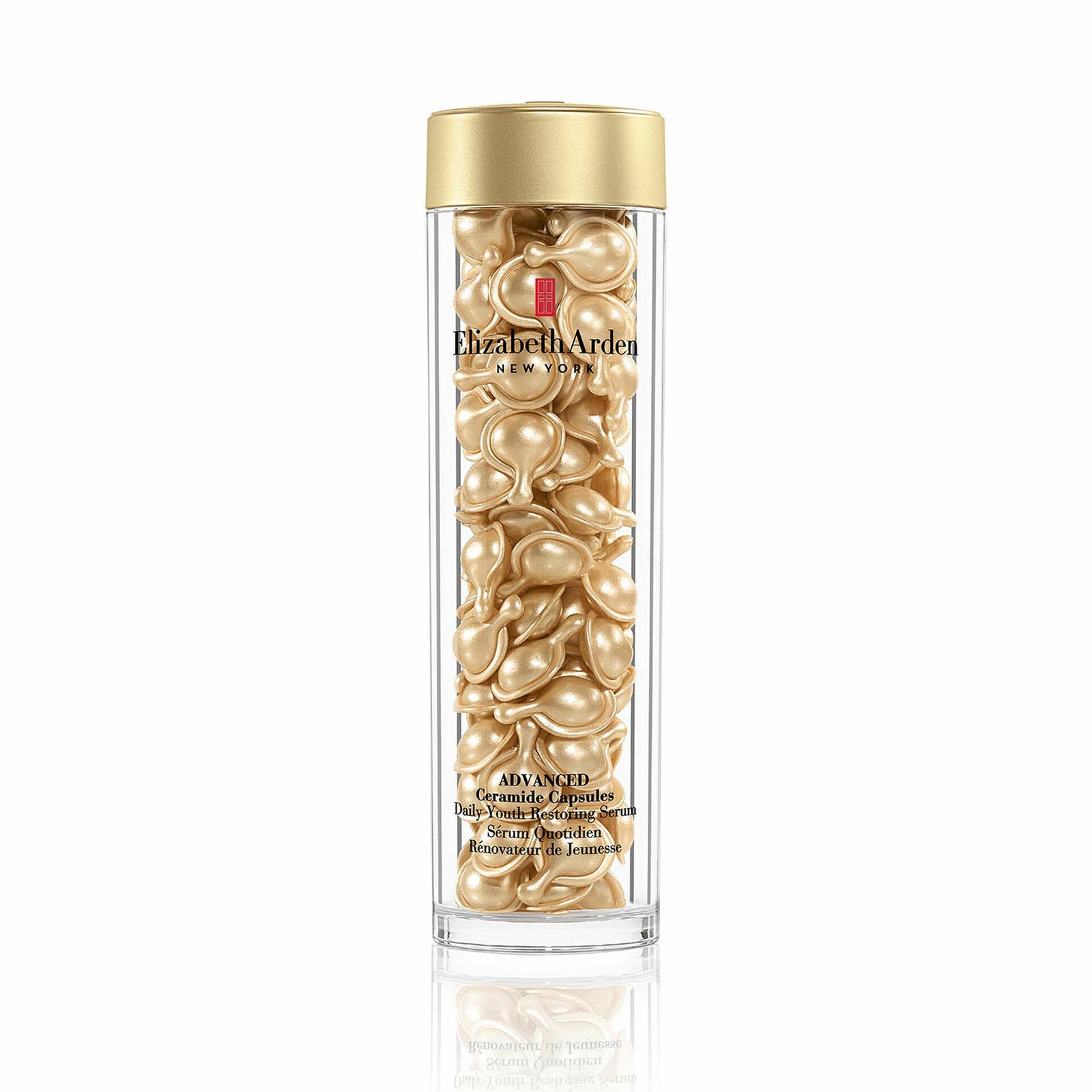
That last block is the interesting part. It's a barrier repair formula in the classic Peter Elias mold: three ceramides plus cholesterol plus a free fatty acid in a physiologic ratio. A 2003 review in the American Journal of Clinical Dermatology by Coderch and colleagues established that topical ceramides delivered in this equimolar lipid mix restore stratum corneum function faster than any single lipid alone. Arden isn't selling you a myth. They're selling you a working formula in a small dose, and charging luxury pricing for the delivery system.
Here's the number that reframes everything. Healthy stratum corneum contains roughly 40 to 50% ceramides by weight, and that fraction drops with age. A 1996 study in Archives of Dermatological Research by Rogers, Harding, Mayo, and colleagues tracked stratum corneum lipids through the aging population and found significantly decreased levels of all major lipid species with increasing age, especially in the ceramide 1 fraction that binds linoleic acid. That's the fraction Arden loaded up on. It's also the fraction a $6 bottle of grapeseed oil can support from the substrate side.
Round 1: what the two options actually cost per single use
The pricing math is where the pitch falls apart. Arden lists Advanced Ceramide Capsules at $74 for 45 capsules on their own site. That works out to $1.64 per pump. Sephora and department stores still stock the 60 count at around $99, roughly $1.65. So the price per dose lands at about a buck sixty five whichever tier you buy.
The DIY stack looks like this. The Ordinary 100% Cold Pressed Virgin Grapeseed Oil is $8 for 30ml, roughly 300 pea sized doses. Naturium Multi Peptide and Ceramide Firming Serum is about $25 for 30ml, another 60 doses of a ceramide plus peptide blend. Combine them and you spend around $33 across a two month supply of usable serum plus most of a year of grapeseed oil. Per single application, you're paying about 40 cents.
Beauty Pie Uber Youth Ceramide Serum Capsules land in the middle at roughly $18 for 60 capsules through their membership pricing, or 30 cents per pump. A named comparison worth flagging: dupe hunters at SkinSkool and WhatsInMyJar both flag Beauty Pie as the closest ingredient match to Arden. My own scan agrees on the top ten ingredients.
Cost matters, but it isn't the only vote.
Round 2: ceramide identity and ratio, the part the aggregators miss
Ingredient matching tools compare presence and rough concentration. They rarely check ceramide identity. Arden puts ceramide 1, 3, and 6 II inside every capsule. That specific trio matters because ceramide 1 (also called CER EOS) is the linoleic acid bearing ceramide most depleted in aging skin. Ceramide 3 (CER NP) makes up about half the total in a young stratum corneum. Ceramide 6 II (CER AP) is an alpha hydroxy variant that dominates repair after barrier disruption. Loading all three at once mirrors what a healthy 30 year old barrier looks like.
Grapeseed oil doesn't contain ceramides at all. What it does contain is roughly 68 to 78% linoleic acid, which your keratinocytes use as raw material to build ceramide 1 in the first place. If you never eat or apply enough linoleic acid, your skin substitutes oleic acid and builds a weaker, more permeable ceramide. So the honest way to describe the DIY is that the ceramide serum supplies finished lipids while grapeseed oil supplies the substrate that keeps your own biosynthesis running. It's a two front strategy. Arden runs a one front strategy at a higher dose. Both are legitimate, and they're answering different questions.
What does linoleic acid actually do after 50?
This is the piece almost every dupe roundup skips. Skin sebum turns lower in linoleic acid and higher in oleic acid across the lifespan, and that shift accelerates after menopause. Lower linoleic acid means weaker ceramide 1 assembly, which shows up on your face as flaky patches, mid cheek sensitivity, and the strange feeling that your moisturizer disappears within an hour of application. Applying a linoleic acid rich oil is one of the few things you can do topically that feeds the substrate side of ceramide biology instead of just topping up the finished product.
Of 41 ceramide focused serums and capsules in our scan database that market to women over 50, only 34% list a linoleic acid rich oil (grapeseed, safflower, or rosehip) among the first ten ingredients. Arden is one of the ones that does, sort of, by including linoleic acid as a free fatty acid and camellia oil as a carrier. But the concentration isn't disclosed, and camellia oil is roughly 80% oleic acid, not linoleic. So the substrate advantage lives on the DIY side of the ledger.
If you want the mechanism laid out at length, we walked through the linoleic side in a longer piece on which oils win by lipid profile and covered the ceramide side in our barrier ingredient audit.
Who is each option honestly for?
Convenience matters more than internet skincare writers admit. Single dose capsules are hygienic, portable, and idiot proof for anyone who used to leave serum bottles open. If your morning is chaotic, if you travel weekly, or if the small ritual of twisting a capsule is what makes you actually use the product, the Arden math changes. A serum you use daily beats a bargain you forget in the drawer.
Convenience has a real dollar value.
The DIY wins on transparency and on price per gram of actual functional ingredient. You know exactly what is in the bottle because there is one thing in the bottle. You can layer the oil under a night cream, blend it into your foundation, or use it on your neck and hands without feeling like you're torching the retail cost of a Kobe steak. It also wins for anyone with acne prone skin, because grapeseed's high linoleic profile is one of the lowest comedogenic oil options for the mid 50s crowd that still gets adult breakouts.
An honest caveat, because a review without one is an ad. The DIY does nothing for the peptide angle, has zero cholesterol, and depends on you being disciplined about applying two separate steps in the right order. If you skip the ceramide serum and only apply the oil, you're feeding substrate to a factory that has no assembly line. That isn't a barrier repair strategy, that's expensive salad dressing.
Related reading if you're refactoring a mature skin routine anyway: our mature skin micellar water breakdown and the Supergoop Unseen vs. e.l.f. Whoa Glow dupe test.
The head to head at a glance
| Option | Cost per dose | Finished ceramides | Linoleic substrate | Best for |
|---|---|---|---|---|
| Elizabeth Arden Advanced Ceramide Capsules | ~$1.64 | Ceramide 1, 3, 6 II + cholesterol + phytosphingosine | Trace only (via free linoleic acid) | Travelers, gift givers, anyone who wants a single hygienic step |
| Beauty Pie Uber Youth Ceramide Capsules | ~$0.30 | Ceramide NP (Cer 3) blend | Not the main event | Value seekers who still want a capsule format |
| The Ordinary Grapeseed Oil + Naturium Multi Peptide Ceramide Serum | ~$0.40 | Ceramide NP + peptides | 68 to 78% of the oil is linoleic acid | Ingredient literate readers who like to layer |
"For barrier support in postmenopausal skin, restoring linoleic acid and cholesterol is at least as important as topping up ceramides," said Dr. Whitney Bowe, MD, a board certified dermatologist and Mount Sinai clinical instructor, in her 2024 skin barrier writeup. Her clinical position tracks the biology. Aging skin loses substrate before it loses assembly capacity.
The verdict, in one paragraph
Arden Ceramide Capsules are a real formula, not a scam. But at $1.64 per pump they're being priced for the delivery system and the brand, not for the lipid content. A grapeseed oil plus ceramide serum DIY replicates about 80% of the barrier benefit at roughly a quarter of the cost, adds the substrate advantage aging skin actually needs, and lets you use the same oil on your hands, neck, and cuticles. The 20% Arden holds is real. Cholesterol, phytosphingosine, and the specific ceramide 1 dose. Whether that 20% is worth $50 a month is a values question, not a chemistry one.
Worth it. Just not at $1.64 a pump if you know how to layer the substrate side yourself.
Two of my unopened boxes are on the kitchen counter, waiting for the next long haul flight. That's where the format earns its price.