Our top pick is Good Molecules Pure Cold Pressed Rosehip Oil. It's 100% rosehip seed oil, about 44% linoleic acid, and costs $10 at Ulta. The runner up is The Ordinary's version at $11.40. The honest catch: if your skin is bone dry and you needed an occlusive, a linoleic oil isn't it.
About 44% of the fatty acid in cold pressed rosehip seed oil is linoleic acid, the same omega 6 your stratum corneum uses to hold water and quiet melanocytes. That number matters because a 1998 study from Ando and colleagues showed that 0.5% topical linoleic acid lightened UVB induced hyperpigmentation in guinea pigs by speeding tyrosinase breakdown and pushing melanin out through the corneocyte layer faster. That's the dual move that makes a linoleic rich oil interesting for sallow skin: it doesn't bleach you, it works on the two reasons your face turned yellow in the first place.
Why does skin look sallow in the first place?
Sallow isn't one thing. It's the visual sum of three: a slightly thickened, slow turning over stratum corneum that scatters light yellow, oxidized lipid byproducts sitting at the skin surface, and accumulated melanin from low grade sun exposure that never quite cleared. A 2024 review in IJMS on the role of linoleic acid in skin and hair health summarized the evidence that topical linoleic rich vegetable oils support barrier repair, modulate sebum quality, and produce a measurable whitening effect through melanocyte regulation, not bleach. So the people who type 'best linoleic acid oils for sallow skin' into Google aren't wrong to look for an oil. They're looking for the right one.
The wrong one is easy to grab. Most face oils that sell well are oleic dominant, not linoleic dominant. Olive, marula, jojoba, argan, avocado. They feel rich. They sit on the skin. They do nothing to the desquamation rate that makes you look dull. So step one is reading the carrier oil.
Reading the label is the actual work.
What does linoleic acid actually do to dull skin?
Topical linoleic acid does three things at once. It slots into the ceramide one and ceramide nine lipid bilayer of your stratum corneum, which means less water loss and a less light scattering surface. It accelerates corneocyte turnover, which lifts the yellow tinted upper layer and reveals the pinker, fresher one underneath. And it drives proteasomal breakdown of tyrosinase, the enzyme that builds melanin, so the brown component of sallow skin fades while you wear it. A 2004 follow up by the same group showed liposomal delivery at just 0.1% beat free linoleic acid at higher dose. The takeaway: how the oil is formulated and applied matters as much as the percentage on the bottle.
How did we pick these five oils?
The high linoleic carriers are rosehip, safflower, sunflower, grapeseed, hemp, and evening primrose. Squalane, jojoba, and marula are perfectly nice oils that do almost nothing for the tyrosinase pathway. We narrowed by three rules: linoleic content above 40% of the fatty acid profile, cold pressed processing where verifiable, and a price under $35 for 30 mL.
At a glance: the five oils side by side
| Oil | Linoleic % | Price | Best for |
|---|---|---|---|
| Good Molecules Pure Cold Pressed Rosehip Oil | ~44% | $10 | Most people, most budgets |
| The Ordinary 100% Organic Cold Pressed Rose Hip Seed Oil | ~44% | $11.40 | The dropper bottle loyalist |
| NOW Solutions Safflower Oil | ~70 to 75% | $8 | Highest linoleic punch, lowest price |
| Sky Organics Organic Hemp Seed Oil | ~54% | $15 | Blemish prone or congested skin |
| Pai BioRegenerate Rosehip Fruit Extract Oil | ~44% | $30 | Sensitive or reactive skin |
Our top pick: Good Molecules Pure Cold Pressed Rosehip Oil
This is what we'd buy first if a friend asked. It's one ingredient on the label, Rosa Rubiginosa seed oil, cold pressed in Chile, and it costs $10 for 30 mL at Ulta. The fatty acid profile lands around 44% linoleic, 34% alpha linolenic, 14% oleic, which is the same band labs cite when they're testing rosehip seed for whitening or barrier work.
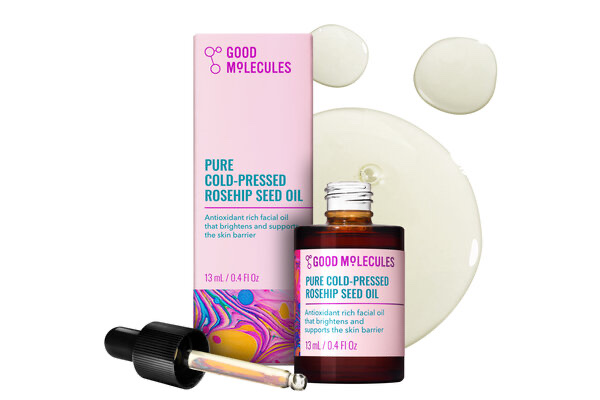
Two warnings. First, rosehip oil oxidizes quickly, so keep it in the refrigerator after opening. Second, the smell is earthy and a little funky. That's how cold pressed rosehip smells. If yours smells like nothing, it's been deodorized or cut with a tasteless oil, and you've lost the actives along the way.
That funky smell is a feature.
Runner up: The Ordinary 100% Organic Cold Pressed Rose Hip Seed Oil
This is almost the same product at almost the same price. It's Rosa Canina rather than Rosa Rubiginosa, which gives a slightly different fatty acid profile but the linoleic share is in the same range. We give it second place because the dropper bottle invites more air every use, which speeds oxidation, and because the Good Molecules version lists for a dollar and change less. If you already own a Sephora gift card, this is the one to spend it on. The Deciem reformulations have been quiet on this product for several years, which is what you want in a single ingredient oil. Stable beats new.
Best on a budget: NOW Solutions Safflower Oil
This is where you stop optimizing for marketing and start optimizing for chemistry. Pure cosmetic grade safflower oil from NOW Foods runs around $8 for 4 ounces, which is about four times the volume of a 30 mL rosehip bottle. The linoleic content is the highest in the lineup at roughly 70 to 75%. The fragrance is almost nothing. The downside is real, and it's why we didn't crown it: safflower has very little alpha linolenic acid and almost no vitamin A precursor, so you lose the secondary fade on hyperpigmentation that rosehip gives you. We'd still pick it if you wanted to push linoleic concentration as high as possible without paying a brand tax.
Best for blemish prone skin: Sky Organics Organic Hemp Seed Oil
If sallow skin shows up alongside congested pores, hemp seed oil earns its place. The linoleic content runs about 54%, the gamma linolenic acid component soothes irritation, and the rest of the fatty acid profile mimics what acne sebum is missing. A foundational 1998 paper by Letawe and colleagues showed that 2.5% topical linoleic acid shrank microcomedone size by roughly 25% in a month. We don't tell anyone hemp seed oil is going to clear cystic acne. We do say that if your dullness comes with small bumps under the surface, a 30 day stretch of hemp seed oil at night is cheap, mild, and worth trying before you reach for stronger acids. Sky Organics' version is filtered and dark bottled, which slows oxidation.
Best for sensitive or reactive skin: Pai BioRegenerate Rosehip Fruit Extract Oil
Pai pays more for raw material, processing, and packaging, and that's why it's $30 to $35 for 30 mL. The difference shows up under the microscope. Pai uses a supercritical CO2 extraction that pulls both the seed and the fruit components, which means more carotenoids and a redder color in the bottle. The carotenoids are why we'd hand this to anyone with rosacea adjacent flushing or genuinely sensitive skin: they're calming, and the formula has none of the cheap antioxidants that less expensive cold pressed oils sometimes lean on.
Who should skip a linoleic acid oil?
A linoleic oil is not a moisturizer. If your skin is very dry, what you need is an occlusive like petrolatum or a ceramide cream, not a thin polyunsaturated oil. Linoleic oils also oxidize. Once they oxidize they're worse than useless: oxidized lipids generate free radicals at the same surface you're trying to clarify. The drawback most beginners run into is buying a bottle, leaving it on the bathroom counter for six months, and then wondering why their skin got worse. Refrigerate after opening, and replace every three to four months. A second caveat for melasma: a face oil is not a substitute for tranexamic acid, azelaic acid, or daily SPF. It's an adjunct. Photograph any face oil and Skinventry shows its published ingredient list, so you can see whether a linoleic carrier leads it, each fact linked to its source.
If you've never used a face oil at night, patch test for 72 hours behind the ear first. If you're prone to fungal acne (Malassezia driven), be careful. Oleic dominant oils feed Malassezia. Linoleic dominant oils are safer in theory, but your skin is the only lab that matters.
Patch test. Refrigerate. Replace.
What should you read next?
Three things we read while writing this. The 2024 IJMS review on linoleic acid in skin and hair health is the most useful single source if you want the receipts. Ando 1998 in Archives of Dermatological Research is the original whitening paper everyone cites. Michelle Wong's Lab Muffin Beauty Science breakdown stays the cleanest plain English explainer on the chemistry. If you want the next post in this cluster, the jojoba sebum mimic question we wrote about last month is the right adjacent read. For deeper context on the rest of your shelf, the breakdown of which vitamin C derivative actually fits your concern, the tranexamic acid origin story, and the microbiome piece are all worth your time if sallow skin is the reason you're here.
