Not every dark dot on your nose is a blackhead. DermNet's comedonal acne page says the black is surface melanin, not dirt or oxidized oil. Cleveland Clinic calls sebaceous filaments normal structures with no plug, which is why a squeeze refills within thirty days. A close photo can show color and location, but it can't tell which is which at the follicle.
What's the difference between a blackhead and a sebaceous filament, when both appear as dots on the same nose? The short answer is that one is an acne lesion with a plug of keratin and sebum at the surface, and the other is a normal thread of oil doing its job. The longer answer is where most popular advice gets it wrong, and where a phone photo stops being useful. A 2023 study of smartphone skin photos found that camera distance and angle alone shift the recorded color of the skin on the same face, which is the physical reason the two look the same in a selfie even when they aren't.
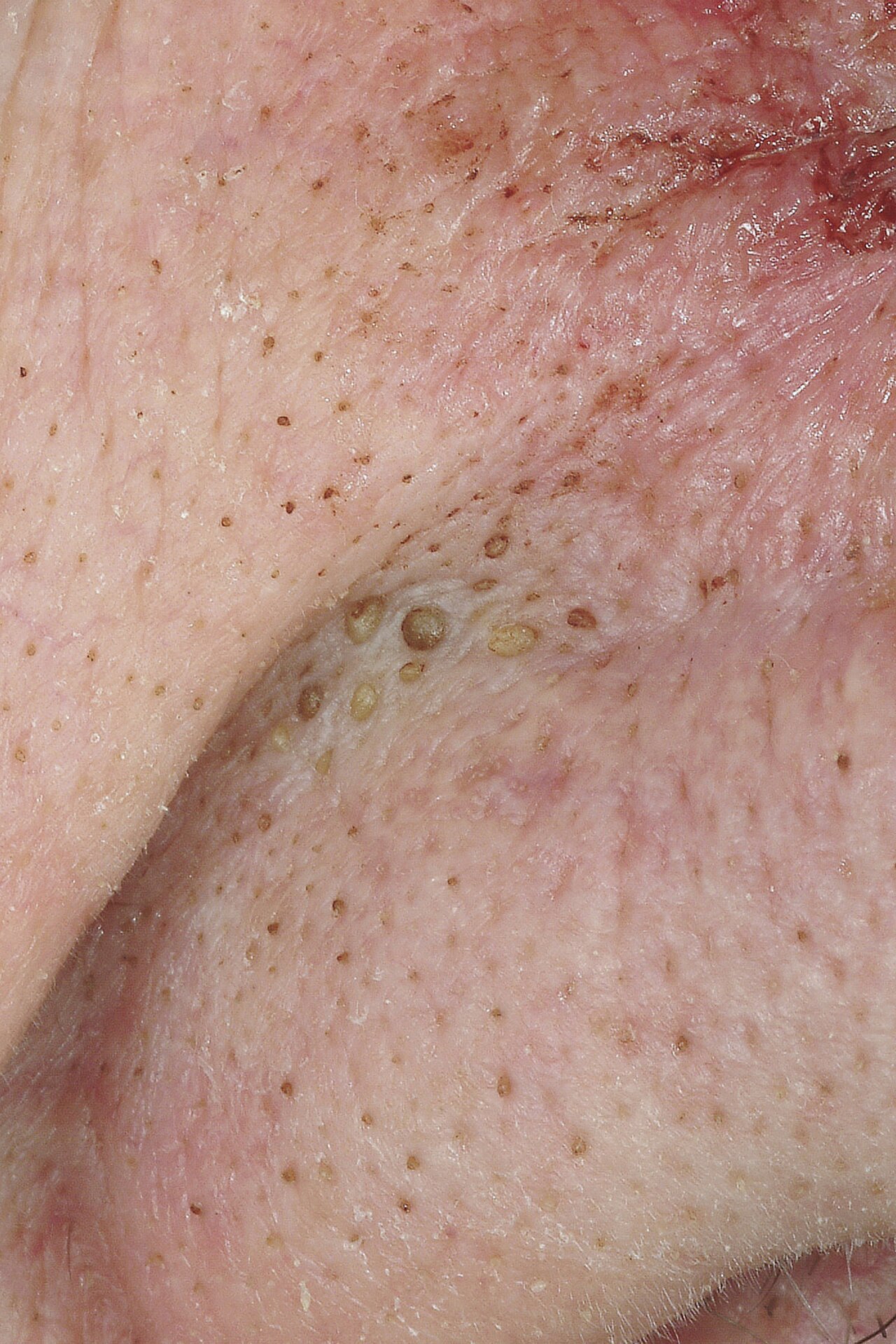
What are those dots on your nose really made of?
A sebaceous filament is a thread that lines the duct of an oil gland. It carries sebum from the gland to the surface of the skin. Cleveland Clinic calls it "a normal, healthy element of your skin," most noticeable on the nose, forehead, chin and cheeks. These dots show up on almost every adult face. They aren't acne.
A blackhead is something else. It's an open comedo. The DermNet page on comedonal acne says cells lining the sebaceous duct multiply, sebum production rises, and debris blocks the duct and hair follicle. The plug sits at the top of the open pore. That plug is what looks dark from the outside.
We opened both pages on November 24, 2026, and we checked DermNet for a standalone topic page on sebaceous filaments. It returned a 404. The oldest medical reference we found is Plewig and Wolff's 1976 paper, which first described these threads as their own structure.
The color story: why the black is melanin, not dirt
This is the sentence most people have never read. On that same comedonal acne page, DermNet writes: "Open comedones are blackheads; black because of surface pigment (melanin), rather than dirt." The black is a color the skin makes itself, in the plug at the top of an open follicle. It isn't oxidized oil. It isn't trapped dirt you can scrub off. It's pigment, in a plug.
So what makes a sebaceous filament look darker than the skin around it? Sebum carries cell debris and a little melanin as it moves toward the surface, and the thread holding it does the same. The PMC case report on sebaceous filaments describes them as yellowish to off white accumulations of sebum and dead cells. In most nose photos you see a tan or gray dot, not a true black one.
For the bigger myth under this one, see the full breakdown of why pores don't truly open or close. Cold water and hot steam shift nothing about the follicle, and that's the same reason squeezing a sebaceous filament refills it within a month: the thread is still producing sebum the next day, and the opening it sits in hasn't changed.
Why can't a close photo tell them apart?
Here is the harder part. A phone photo can show you the color, the symmetry and the rough size of a dot on your nose. It can't see down into the follicle, where the real difference lives. The plug of a blackhead is a solid piece sitting at the top of the opening. A sebaceous filament has no plug. On a photo, those two read as the same little dot.
The photo has other limits, too. A 2023 study of camera distance and angle in smartphone skin images found that each of them shifts the recorded color of the skin, enough to change readings between phones and between sessions on the same phone. A 2017 analysis of consensus standards for clinical skin imaging in JAMA Dermatology lists five separate rules about lighting alone, from the color temperature of the bulb to how far behind the camera it should sit. A 1996 study of acne lesion counting found the same rater agreed with their own reading 0.81 to 0.97 of the time, but different raters only 0.61: even trained dermatologists don't line up perfectly on what they see.
Shadows at the edge of the nose can read as dots that aren't there. A warm indoor bulb can lift the brown of a sebaceous filament toward something that looks closer to the black of a true blackhead. Phone cameras smooth skin more aggressively when the light is low, which erases the pale halo that often marks a filament.
That halo is the tell, and it vanishes first.
That's why a scan that calls every dark dot on a nose a blackhead is almost always wrong. An honest reading of the same photo says: we see small dark marks in this area, we can't tell at this resolution whether each one is an open comedo or a filament, and most of these are the normal ones. It's the same honesty we want from any AI skin analysis that starts from a selfie.
What do dermatology sources list for each?
Cleveland Clinic says filaments can't be removed. You can make them less noticeable with exfoliation, over the counter salicylic acid, or retinoids. That same page advises against squeezing, because the pore refills within thirty days, and it warns that pore strips can dry the skin. The AAD page on treating large facial pores says the same thing in plainer words: "Never scrub, rub, pick at, or squeeze the skin on your face."
For blackheads, the DermNet comedonal acne page lists comedolytic topicals used long term: benzoyl peroxide, azelaic acid, salicylic acid, glycolic acid or retinoids. It notes that persistent comedones may be removed in office by cryotherapy, electrosurgery or microdermabrasion. Those office options belong with a dermatologist, not a drugstore aisle.
The honest overlap here is salicylic acid. Both pages name it. If you're already using it and the dots on your nose look smaller or softer than they did a month ago, that's the expected result. If nothing has moved after a few weeks, nothing has moved. Most of the posts in the filaments cluster land on the same ingredient, which is why our shelf read of face washes for sebaceous filaments and our three oil cleanser label readings both come back to salicylic acid and oil based removal.
Retinoids and benzoyl peroxide carry their own trade offs that salicylic acid often doesn't. Retinoids need ramp up to avoid flaking, and the AAD's acne myths page says it's normal for benzoyl peroxide to bleach fabric even at drugstore strengths. Neither is a reason to avoid them.
It's a reason to read the label before you buy.
When to see a dermatologist
The Cleveland Clinic page says to see a dermatologist when filaments appear alongside severe acne, or when you're not sure which of the two you're looking at. The AAD's treating large pores page says a board certified dermatologist can examine your skin and recommend what to do next. Neither page tells you to decide this alone from a photo, and neither do we.
One more line, because it matters. A face scan does not read moles. If one of the dark spots on your face is changing in size, shape or color, it isn't the subject of this post. The AAD's ABCDEs of melanoma page is the one you want for that, and an in person dermatologist is the one who reads it. An app can mark a dot. It can't tell you whether that dot is cancer.
What we still don't know: how many of the people clicking on the sebaceous filament posts already have a confident reading of which dots are which, and how many walked in thinking all of them were blackheads. If you've gone back and forth on it, write us. The adjacent family of bumps that are neither comedones nor filaments lives in the piece on milia at home, which explains why no cream from a drugstore shelf reaches them at all.
Photograph your face and Skinventry marks the dots it sees by zone, says how sure the reading is, and tells you plainly when a dot is too small or too close to the edge of the nose to call. It doesn't diagnose. The free face scan lives at the face scan page, and the rule stands: a scan does not read moles.

