Pick 0.3%. In the only 12 week head to head of 0.3% and 0.5% retinol, the lower strength matched the higher one on wrinkles, dark spots and hydration, and the 0.5% side had significantly more irritation. Europe reached the same answer in 2024 and capped face retinol at 0.3%. We read 4 US labels to find which bottles land where.
I own a 0.5% retinol. The research says I probably shouldn't have bought it.
On November 21, 2026 we read the labels of four retinol products on their brands' own pages. Two were 0.3%. Two were 0.5%. Each page returned a 200 status and showed the strength on the bottle itself. Then we checked what the trials say about those two strengths and what Europe concluded when it looked at the same data.
Here's what we found. In a split face trial published in Skin Pharmacology and Physiology in 2020, 37 women used 0.3% retinol on one side of the face and 0.5% retinol on the other for 12 weeks. Both sides improved on hyperpigmentation, wrinkles and hydration. The 0.3% side did better on elasticity. More side effects showed up on the 0.5% side, and the difference was statistically significant.
Which Retinol Strength Actually Works Better?
The question people type into Google is simple. If a stronger retinol works better, why not just buy 0.5%, or 1%, or the 2% bottles some brands sell. The answer the trials keep giving is that retinol's dose response is flat earlier than most shoppers assume.
Think of the 2020 Zasada split face trial as the direct test. 37 women. Mean age 46. Each side of the face got one strength. The team used a liquid crystal serum base that was held constant, so only the retinol number changed. At week 12, the two sides had the same improvement on hyperpigmentation, wrinkles and hydration. Elasticity improved significantly only on the 0.3% side. Side effects, mostly stinging and redness, were significantly more frequent on the 0.5% side, with the authors writing that symptoms were graded as mild to moderate but turned up often enough on the 0.5% side that the paper's own summary singles the contrast out. They called 0.3% the strength that delivered the benefit with less cost.
The ceiling shows up again at 1%. A 2022 paper in the International Journal of Cosmetic Science (free on PubMed Central) ran a six week home use study on 218 women, with Mellody and co authors splitting the group so one cohort used 0.3% retinol and the other used 1%. In the 0.3% group, 69.6% reported no reactions. In the 1% group, that figure was 39.8%. The difference in tolerance was statistically significant at p less than 0.001, and only four women dropped out of the 0.3% arm against twenty three in the 1% arm. In a separate patch test on photoaged skin biopsied at day 12, the team's work showed that 0.3% and 1% produced similar stepwise effects on keratinocyte turnover and on fibrillin, the microfibril that holds the elastic network together.
Two independent teams. Two formats. Same answer.
A face product gets most of what retinol can deliver by 0.3%, and it pays the irritation tax if you push higher. A reader who wants the full dose response can read our post on which retinoid is right for your skin concern. The quick version: prescription tretinoin at 0.025% is already stronger than any over the counter retinol, because tretinoin is the active form the skin converts retinol into. If the ceiling matters to you, that's the exit ramp.
How Was the 12 Week Head to Head Run?
This is the trial the shopping question turns on, so it's worth reading how it was run. Malwina Zasada and two co authors at the Medical University of Lodz enrolled 37 healthy women with a mean age of 46, each with mild to moderate photoageing, and asked them to use one strength of retinol on the left side of the face and the other strength on the right for 12 weeks of nightly application, which is roughly how long most shoppers wait before deciding whether a serum is working. The design was split face. One side of each volunteer's face got 0.3% retinol. The other side got 0.5% retinol. The bases were identical liquid crystal serums. Volunteers used each side once a night.
The team measured hydration with a Corneometer, elasticity with a Cutometer, hyperpigmentation and overall tone with a Visioscan, and wrinkles with image analysis. They scored side effects on a graded scale at every visit. The result reads clean. Hyperpigmentation, wrinkles and hydration improved on both sides. Elasticity improved significantly only on the 0.3% side. Side effects were significantly more frequent on the 0.5% side.
The authors own the patented formula they tested, and the sample was small, so the read isn't definitive. It's still the only published trial that compares those two strengths on the same face for a shopping length of time. Nothing on page 1 of Google answers the question with a trial that did the test. This one did.
The 4 Retinol Labels We Read
On November 21, 2026 we pulled each label from the brand's own page in the US. Each URL returned a 200 status. Here's what the bottles actually say.
| Product | Strength | Format | Size | US price | Ingredient list |
|---|---|---|---|---|---|
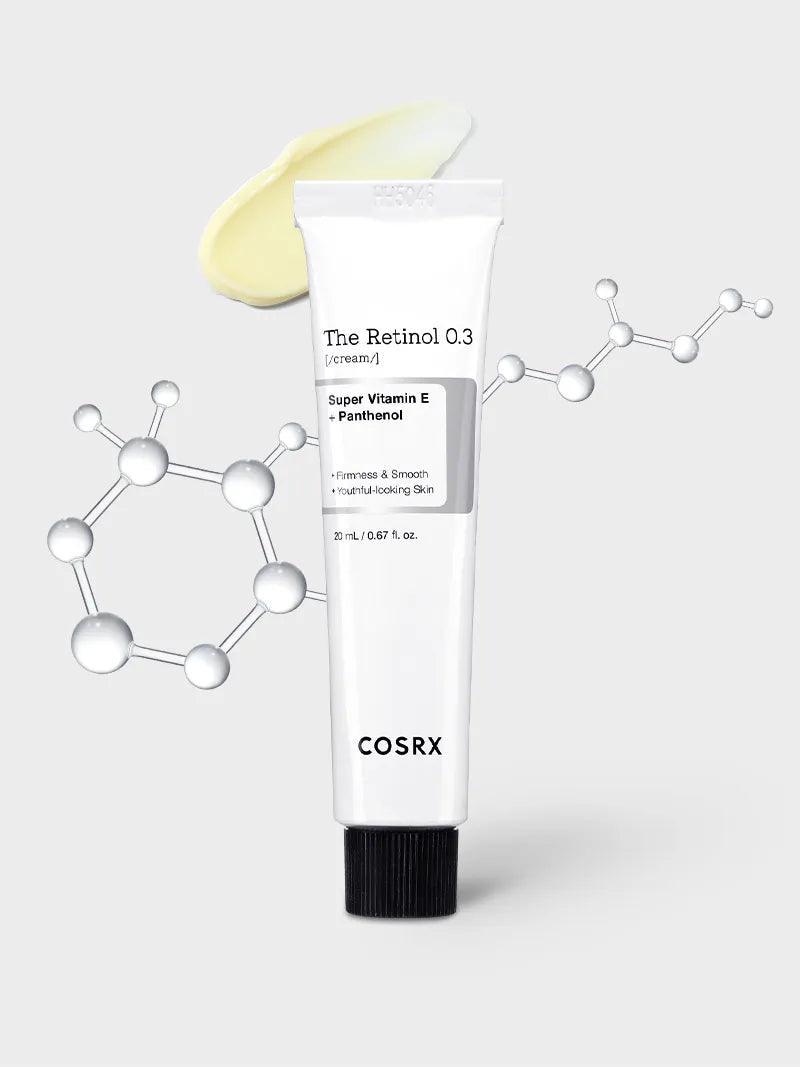
| Cosrx The Retinol 0.3 Cream | 0.3% | Cream | 20 mL | $29 | Short, water based cream |
| SkinCeuticals Retinol 0.3 | 0.3% | Encapsulated night cream | 30 mL | $88 | 22 items |
| The Ordinary Retinol 0.5% in Squalane | 0.5% | Anhydrous squalane solution | 30 mL | $11.20 | 8 items |
| Cosrx The Retinol 0.5 Oil | 0.5% | Anhydrous oil | 20 mL | $27 | 10 items |
Two things jump out. First, the 0.3% and 0.5% strengths cross price tiers. A $29 cream and an $11.20 serum sit in the same strength band as an $88 encapsulated night cream. If the trial data is right, the strength band is what matters. Everything above it is base, carrier, delivery and finish.
Second, the four labels split in half on format. Two are anhydrous. The two 0.5% products are both oil based, with squalane as the first item. Anhydrous bases are kinder to raw retinol because water drives its breakdown, and you get a bottle that smells like plant oil, not fragrance. The two 0.3% products aren't anhydrous. Cosrx's cream mixes retinol into a water based moisturizer. SkinCeuticals wraps retinol in hydrogenated lecithin plus an allyl methacrylates crosspolymer, a technique the brand calls encapsulation, and the long INCI list is largely the protection and release system (phenoxyethanol, caprylyl glycol, bisabolol and propyl gallate all show up). For a sense of how long any of these will actually last once opened, our post on how long retinol takes to work covers the usable life of these formulas and why bottles sitting in a hot bathroom lose potency before the stated shelf life.
How Do You Pick Between 0.3 and 0.5?
Start at 0.3% if any of this is you. You've never used retinol before. Your skin flushes, stings or peels on actives. You get rosacea or seborrheic dermatitis flares. You're already using another irritant like glycolic acid or benzoyl peroxide in the same routine. You live somewhere with winter dry skin. You want results without a month of visible purge and flake. 0.3% is the strength the Zasada trial says gets you the same wrinkle, pigment and hydration gains as 0.5% without the significant jump in side effects. If you're a Skinventry reader who already photographed your retinoid and compared it to our guide to where retinol sits on the ingredient list, this is the band to favor.
Pick 0.5% only if two things are true.
First, you've run at least 12 weeks on 0.3% without a problem. Second, you still see room to improve on wrinkles or tone. The split face trial is a reminder that 0.5% isn't the next step up the ladder for a beginner. It's the same rung, with more friction. Users who switched to 0.5% in the Zasada trial reported mild to moderate stinging and redness more often than at 0.3%, enough that the authors singled it out in the paper's summary. If your 0.3% bottle is nearly done and your skin didn't flake once in 12 weeks, moving up is reasonable, but the gains past this point get smaller and smaller as the strength number goes up, and the Mellody paper shows that by 1% you've traded a lot of tolerance for almost nothing extra on the skin.
Skip retinol over 0.5% unless a dermatologist is directing it. 1% and 2% bottles are legal to sell in the US because FDA doesn't restrict retinol in cosmetics. They aren't more effective in print. At 1%, the Manchester study found tolerance crashed and twenty three of 103 volunteers stopped the product before the study ended. The published dose response doesn't reward the number on the front.
An honest caveat. Retinol strength is one lever. Delivery is another. The SkinCeuticals formula puts the molecule inside a lipid bilayer that releases over time, and some dermatologists prefer that pattern for sensitive skin. The Cosrx 0.3 cream offloads moisture at the same time as the active, which blunts dryness. The two 0.5% oils give you retinol with no water, which keeps the molecule stable longer but can feel heavy on oily or acne prone skin. Match the base to your face before you argue about the percentage.
Why Did Europe Cap Retinol at 0.3%?
Europe looked at the same trial data and wrote it into law. Commission Regulation (EU) 2024/996 was published on April 4, 2024. It added retinol, retinyl acetate and retinyl palmitate (the three forms the rule groups as vitamin A) to Annex III of the EU Cosmetics Regulation. The limits: 0.3% retinol equivalent in leave on and rinse off face products, and 0.05% retinol equivalent in body lotions. From November 1, 2025, no product above those lines can be placed on the EU market. From May 1, 2027, all non compliant stock has to come off EU shelves. Products that contain any of those three forms must carry one new warning on the label: Contains vitamin A. Consider your daily intake before use.
The reason Europe gave isn't skin irritation. The scientific committee on consumer safety, in its October 2022 opinion, concluded cosmetic vitamin A was safe at 0.3% in face products and 0.05% in body. Above those lines, people who already get a lot of vitamin A from food or supplements could cross the tolerable daily intake. So the rule caps cosmetic exposure for the 5% of Europeans who are already over on vitamin A. It has nothing to say about the skin of the other 95%, which is where the Zasada and Mellody trials come back in to say the lower strength is also the better buy for most faces.
There's no equivalent rule in the US. FDA's cosmetics restricted ingredients list, cited above, doesn't mention retinol. A brand can sell 0.3%, 0.5%, 1% or 2% in the US and label it however it wants. Which is why The Ordinary still ships a 1% version to American shoppers from the same product family that stops at 0.5% in Europe.
You don't need the EU rule to pick a strength. You can treat it as a tiebreaker. If two bottles perform the same in a trial, and one is now the legal strength everywhere in the world's second biggest cosmetics market, that's a signal.
How Do You Start Retinol?
Apply retinol at night. Wait for your skin to be dry (this is the two minute pause the brands like to skip over). Use a pea sized amount for the whole face. Put sunscreen on in the morning. Expect the first four weeks to be a tolerance ramp. Expect visible texture and tone change at eight to twelve weeks. Nothing on this list changes with strength.
Pair retinol only with actives that have a track record of working with it. Niacinamide is fine. Hyaluronic acid is fine. Azelaic acid is fine for most people, and our post on using azelaic acid and niacinamide together covers the pH and timing. Skip benzoyl peroxide in the same routine (it breaks retinol down). Skip glycolic acid on the same night unless your skin has run both for months.
Pregnancy is the one hard stop.
If you're pregnant or trying to be, don't use topical retinoids. That guidance isn't changed by the strength debate.
Frequently Asked Questions
Is 0.3% retinol strong enough for wrinkles?
Yes, inside the dose range cosmetics actually operate in. The 12 week Zasada split face trial found 0.3% matched 0.5% on wrinkle improvement, and the 2022 Mellody study found 0.3% matched 1% on biomarkers of retinol activity in the skin. Prescription tretinoin is more potent than any retinol, because tretinoin is the form the skin converts retinol into.
Does 0.5% retinol work twice as fast as 0.3%?
No. Retinol activates the same cell receptors at both strengths, and the receptor response saturates well below 0.5%. The dose response in published trials is flat on efficacy and uphill only on side effects. Faster results come from consistency, as in five nights a week for 12 weeks, not from doubling the number on the front.
Can I switch from 0.3% to 0.5% after a few weeks?
You can, but you don't need to. If 0.3% is working, there's no trial evidence that climbing to 0.5% delivers more. If 0.3% isn't working after 12 to 16 weeks of nightly use, the fix isn't a higher strength first. Check that the bottle is fresh and stored out of light, that you're using a pea sized amount, and that nothing else in the routine is breaking retinol down.
Why do some brands sell 1% or 2% retinol in the US?
Because US law doesn't stop them. FDA regulates cosmetic ingredients that are tested as drugs, and retinol hasn't been put on the agency's restricted list. Europe chose 0.3% based on vitamin A total intake math, not on skin safety. In the US, the number on the front is a marketing choice.
So What Should Go in Your Cabinet?
0.3%.
That's the answer the one head to head trial gives, the answer the 1% trial repeats, and the answer Europe wrote down. Keep whatever base suits your face, and ignore the number on the front after 0.3%.
Photograph the jar and Skinventry lists the ingredient order, the strength the label prints, who makes the brand, who owns the company and the public record, each with its own source.
