A 2025 review of 41 trials named one topical with over 50 percent efficacy on freckles, and it's prescription only: mequinol 2 percent with tretinoin 0.01 percent. Four store bought serums carry the next best actives, and the one each bottle leads with isn't always what the label says is inside.
You'll see it everywhere on a freckle search: a serum promising to fade them in six weeks. A 2025 systematic review in the Journal of Cosmetic Dermatology pulled 41 clinical trials, 3,234 patients, and asked which topicals actually did it. One combination cleared over half of lesions in most studies: prescription mequinol 2 percent with tretinoin 0.01 percent. That's the honest ceiling. Every active below it, including the ones on the label of the serum you're about to buy, works less often, more slowly, and with weaker evidence.
The good news is you don't need the top of the chart to get something.
Are freckles the same as dark spots?
The question of which serum works for you starts with which spot you actually have. DermNet NZ's own reference page is the clearest split. True freckles, the ones dermatologists call ephelides, are small, flat, light brown spots that appear on sun exposed skin in the summer and fade considerably in winter. They are genetic, more common on fair skin, and they will keep coming back as long as the sun does. Solar lentigines, which most people also call freckles, are the larger, more defined brown spots that arrive in midlife on the face and hands. They do not fade in winter. They're the spots the 2025 review was studying.
Post inflammatory hyperpigmentation, left behind by a pimple or a scratch, is a third thing. Melasma, driven by hormones and sun together, is a fourth. A serum that helps one of those may do little for another, because the melanin sits at a different depth and the trigger is different. If what you want is help with the brown spots that bloom on your cheeks every July and softly fade by November, you've got ephelides, and the honest answer is that no over the counter serum reliably keeps them away. A serum helps most on the summer sun spots that stay. For the broader category of brown spots, we also compared five serums for freckles and dark spots on their actives and price.
So the first question is which kind you have.
The only topical with over 50 percent efficacy is a prescription
The 2025 review graded every topical in the literature on how many patients cleared. Mequinol 2 percent combined with tretinoin 0.01 percent, a prescription combination originally sold in the US as Solagé, reached a 52.6 to over 80 percent efficacy range in the included trials, mostly on facial lesions. Intense pulsed light, a clinic procedure, ran 74.6 to 90 percent in the same analysis. Picosecond laser went up to 93 percent. Cryotherapy, trichloroacetic acid peels, and cosmeceutical creams clustered lower. Every over the counter active people search by name tranexamic acid, alpha arbutin, azelaic acid, niacinamide, vitamin C sits below that top line. None of them is a prescription combination; none of them, run alone, has matched that top number in a comparable trial.
So read the headline like this. The best serum for freckles you can buy without a visit to a dermatologist is a weaker treatment than the best one you can't. If you want the top result, you need a prescription, or a clinic chair with a laser. If you want the top result that fits in a shopping cart, you're picking from a tier below, and you should know which active on that tier has the strongest case.
Here's what each tier buys you.
What the over the counter actives actually do
Four actives carry the next best case on the shelf. Each one slows the enzyme or the pathway that makes melanin, and each one has small to midsize trials behind it.
Tranexamic acid is a blood clotting drug that turned out, in dermatology, to quiet the signal that tells melanocytes to make pigment. Topically at 2 to 5 percent it has the most trial support of the four, mostly in melasma, with some carryover to other sun driven pigmentation. We covered its history in our post on why a bleeding drug ended up in a dark spot serum.
Alpha arbutin is a tyrosinase inhibitor, which means it slows the first step of melanin production. Trial evidence is thinner than tranexamic acid and the usual use level is 2 percent. It's the gentler option for sensitive skin.
Niacinamide does not block tyrosinase. It blocks the transfer of melanin from the cell that makes it to the cell above. At 2 to 5 percent it has the broadest safety record of the four. The evidence on its own is modest, which is why it usually shares a bottle with something else. It's the quiet workhorse of this category.
Vitamin C and its derivatives (L ascorbic acid, ascorbyl glucoside, sodium ascorbyl phosphate) help even skin tone and work with sunscreen rather than replacing it. The derivative you pick matters, because they absorb and convert differently.
Azelaic acid, cysteamine, and kojic acid also have trial support. Azelaic acid at 15 to 20 percent is prescription in the US at the top of its range. We ran the research on cysteamine in our 12 week read on cysteamine 5 percent for melasma. Kojic acid shows up in creams at 1 to 2 percent and has a mixed sensitivity profile.
The four serums, read on their labels
We read the published INCI lists of four serums widely sold in the US for freckles and dark spots on Incidecoder on November 22, 2026. The point of this table is where each active sits on the label, because ingredient order follows concentration down to 1 percent in a US cosmetic. An active at position 2 is roughly the strongest. An active at position 10 is probably below 1 percent. The headline on the bottle is not always what the label says is inside.
| Serum | Price (USD) | Active it leads on the label | Position on INCI | What is in the bottle besides |
|---|---|---|---|---|
| The Ordinary Alpha Arbutin 2% + HA | $10.40 for 30 ml | Alpha arbutin | Position 2 (after water) | Hydrolyzed sodium hyaluronate, propanediol, lactic acid. Short list, 12 ingredients. |
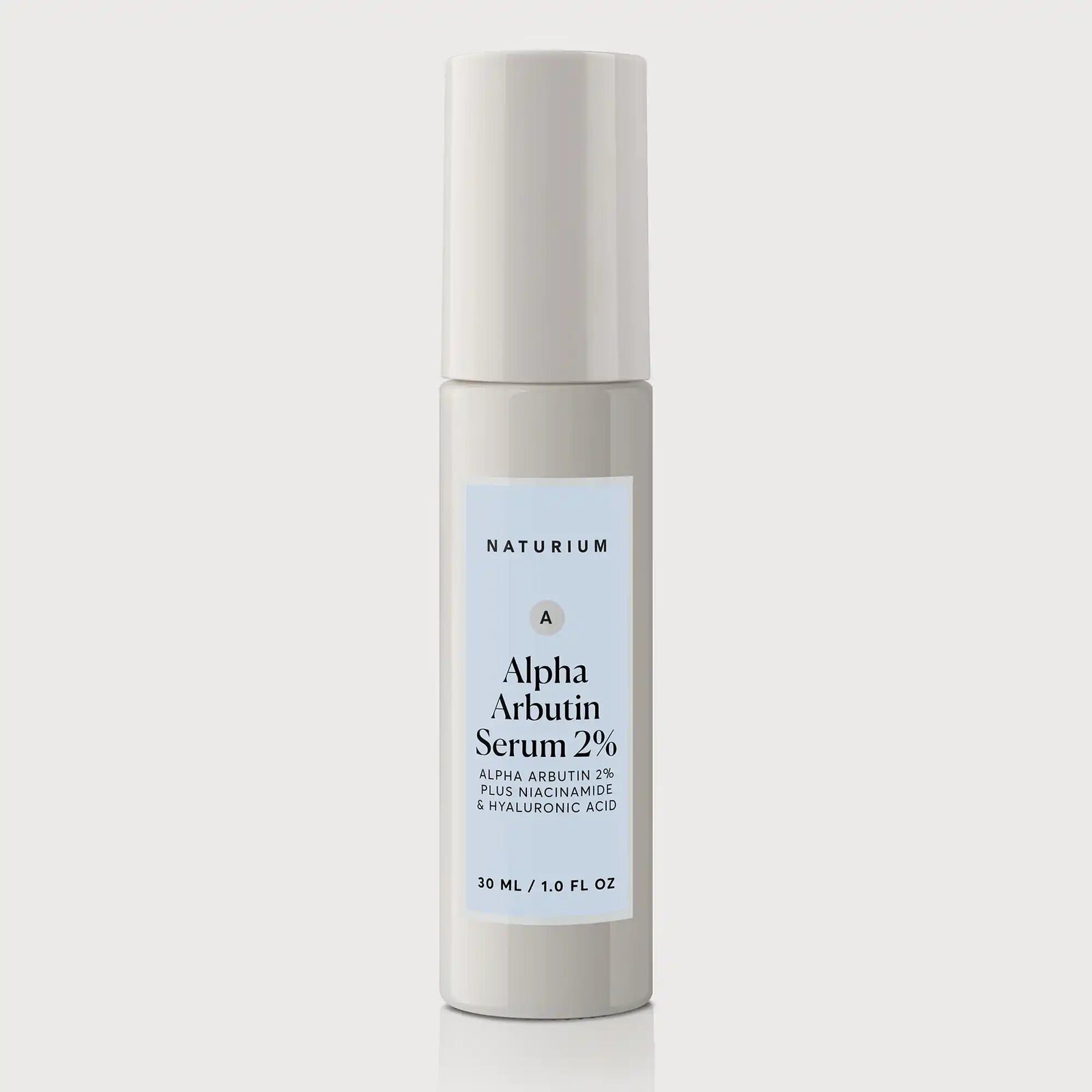
| Naturium Alpha Arbutin Serum 2% | $20.00 for 30 ml | Alpha arbutin, then niacinamide | Position 3 and 4 | Sodium hyaluronate, lemon fruit extract, panthenol, tremella fuciformis. Around 20 ingredients. |
| The INKEY List Tranexamic Acid Night Treatment | $19.00 for 30 ml | Tranexamic acid on the box, ascorbyl glucoside and tranexamic acid on the label | Ascorbyl glucoside at position 4, tranexamic acid at position 5 | Acai fruit extract, 1 methylhydantoin 2 imide, squalane, lactobacillus ferment. |
| Allies of Skin Tranexamic & Arbutin Advanced Brightening Serum | $101.00 for 30 ml | Tranexamic acid, alpha arbutin, niacinamide | All three in the top third of the INCI | Mushroom complex, peptide blend. The full stack, at full price. |
The read: Naturium at $20 is the closest match between front and back labels. Its two headline actives both fall in the top four ingredients, which is as close to a disclosed 2 percent as a cosmetic reaches on an open INCI. The Ordinary at $10.40 is the cheapest honest bottle: alpha arbutin at position 2, nothing else pretending. The INKEY List is the interesting label read. It is sold as a tranexamic acid treatment, and the bottle does carry tranexamic acid, but ascorbyl glucoside, a vitamin C derivative, sits one position above it. That is not a failure; it is a formula choice, and it does give you a brightener. It just means you are also buying a vitamin C serum when you buy this. The Allies of Skin bottle has the full stack. At $101 for 30 ml, it is for the shopper who has already tried the others.
What does no freckle serum beat?
The partner that does more work than any of these serums is the sunscreen you actually wear. Freckles are a photobiology problem. UV reaches the melanocyte, the melanocyte makes pigment, the pigment shows up at the surface. A tyrosinase inhibitor or a signal quieter can slow that chain by a bit. A broad spectrum SPF stops it at the top. The 2025 review ends on exactly that note: continued careful sun protection is essential, because the pigmentation is likely to recur the next summer. Which it will, whether you spent $10 or $101 on the serum. What the FDA requires on a sunscreen label, and how long a bottle actually lasts once opened, we walked through on four real labels.
Sunscreen isn't the sexy answer. It's the one that works.
So the shopping math is simple. If you're not already using a daily SPF 30 or 50 broad spectrum on your face, buy that first and skip the serum for a season. If you are, then a 2 to 3 percent alpha arbutin or tranexamic acid serum is a reasonable addition at night, with the expectation that you'll see a soft fade over months, not weeks, and the freckles will come back next July unless the sunscreen stays on.
When is a spot not a freckle?
Here is the honest caveat. Freckles do not need treatment. They are not a disease and there is nothing medically wrong with having them. A spot that needs attention is one that is new in middle age, changing shape, changing color, growing, itching or bleeding, or standing out as different from every other spot on that part of your body. Those get a dermatologist, not a serum. DermNet's own guidance is to have a spot that changes checked, because the overlap between benign pigmentation and the kinds of skin changes that are not benign is not always obvious at a glance. No serum sold at a drugstore is the answer to that question.
If I were starting over on my own freckles today, I would skip the serum rotation for the first six months, spend that money on a tinted mineral SPF 50 I actually wear every day, and only then add a 2 percent alpha arbutin serum at night, cheap enough to run through a bottle without regret. The serum is the accessory. The sunscreen is the treatment. Photograph the bottle you are thinking about and Skinventry reads the label, shows the actives, the brand's owner and anything on the record, with a source for each line, so you can see whether the 2 percent on the front matches the position on the back before you pay for it.
