FDA says a sunscreen without a printed expiration date should be treated as expired three years after purchase, and discarded whenever you do not know how old it is. A 2017 study found avobenzone fell to 94.68% after one day of simulated sun.
What happens inside a sunscreen bottle after the date on the back? FDA has one answer in plain words. A 2017 Pharmaceutics study has a sharper one, and it lands well before the label says the product is done. In a 2017 study, Briasco and colleagues found that avobenzone in a UV filter sunscreen fell to 94.68% of untreated content after a single day of simulated sun. That is before any printed date. That is day one.
What does the FDA actually say about sunscreen expiration?
FDA regulates sunscreen as a nonprescription drug. Under the agency's drug rules, every bottle needs an expiration date unless the manufacturer's own stability testing has proved the product still meets its label claim for at least three years. The sunscreen page on fda.gov puts it this way: a sunscreen product that does not have an expiration date should be considered expired three years after purchase. The same page tells you what to do if you can't remember how old a bottle is. Discard it. The rule says nothing about how hot the car got, how often the lid was left open, or whether the bottle lived on a bright shelf. Three years is a ceiling the manufacturer vouched for in testing. FDA tells you to treat anything older than that as done.
What happens to the filters when sunscreen sits?
Sunscreen going off is really the filters breaking down. Avobenzone is the single UVA filter in most US chemical sunscreens, and it degrades under light on contact with air. In the 2017 Pharmaceutics paper, Briasco and colleagues ran finished sunscreens in HDPE and LDPE bottles through one day of simulated solar irradiation and then through three alternating cycles at 20 and 45 degrees Celsius. In the formulation with free UV filters, avobenzone content fell to 98.92%. In the formulation with encapsulated filters, avobenzone fell to 94.68%, just below the paper's own acceptable range of 90 to 110% of untreated content. The authors said the plastic packaging by itself was a poor match for sunscreens.
That is one day of light.
A bottle that spent summer in a car trunk or a beach bag got many more. In a separate 2011 study in the International Journal of Pharmaceutics, Couteau and colleagues tested 15 marketed products with the same labeled SPF under natural sunlight and found that 8 of them lost stability in the UVA1 band between 340 and 400 nanometers. UVA1 is the deepest part of UV that reaches the ground. A filter that fails there is still printed on the front of the bottle, but it isn't protecting you from the wavelength most tied to photoaging.
So two things are happening inside the bottle at the same time, in slow motion: the carrier gets older (water, oils and emulsifiers start to separate), and the UV filters lose a little performance every time they meet light. The printed exp date is the manufacturer's best guess at when those two curves stop crossing cleanly. It assumes the bottle was handled the way a lab handles a bottle.
How much does heat really change things?
Heat accelerates what UV starts. A separate 2014 analysis of marketed sunscreens stored for 90 days at 45 degrees Celsius found that formulations rated as acceptably stable in a cool cabinet lost significant SPF when run through accelerated aging. The bottle that lives in your car is doing accelerated aging on itself, every afternoon the thermometer passes 90 Fahrenheit.
That is why the visible signs on a bottle matter. If the lotion has separated, changed color, taken on an odd smell or dried into flakes around the cap, the filters inside the carrier fluid are no longer where the formulator put them. Reapplying at two hours will not give you the label SPF. Toss it. The three expiration systems on a skincare label apply here too. Sunscreen is the one place the FDA date is the strict one, because sunscreen is the one place in your bathroom that is regulated as a drug.
How do four common US sunscreens print their dates?
We read the Drug Facts active ingredient list for four of the most searched US sunscreens on DailyMed, FDA's database of structured drug labels, on November 10, 2026. All four are regulated as nonprescription drugs. All four must carry an expiration date on the pack under 21 CFR 352. What is on the label and how fast the actives degrade are formula dependent.
| Sunscreen | Filter type | Actives on the Drug Facts | How fast the actives degrade under sun and heat |
|---|---|---|---|
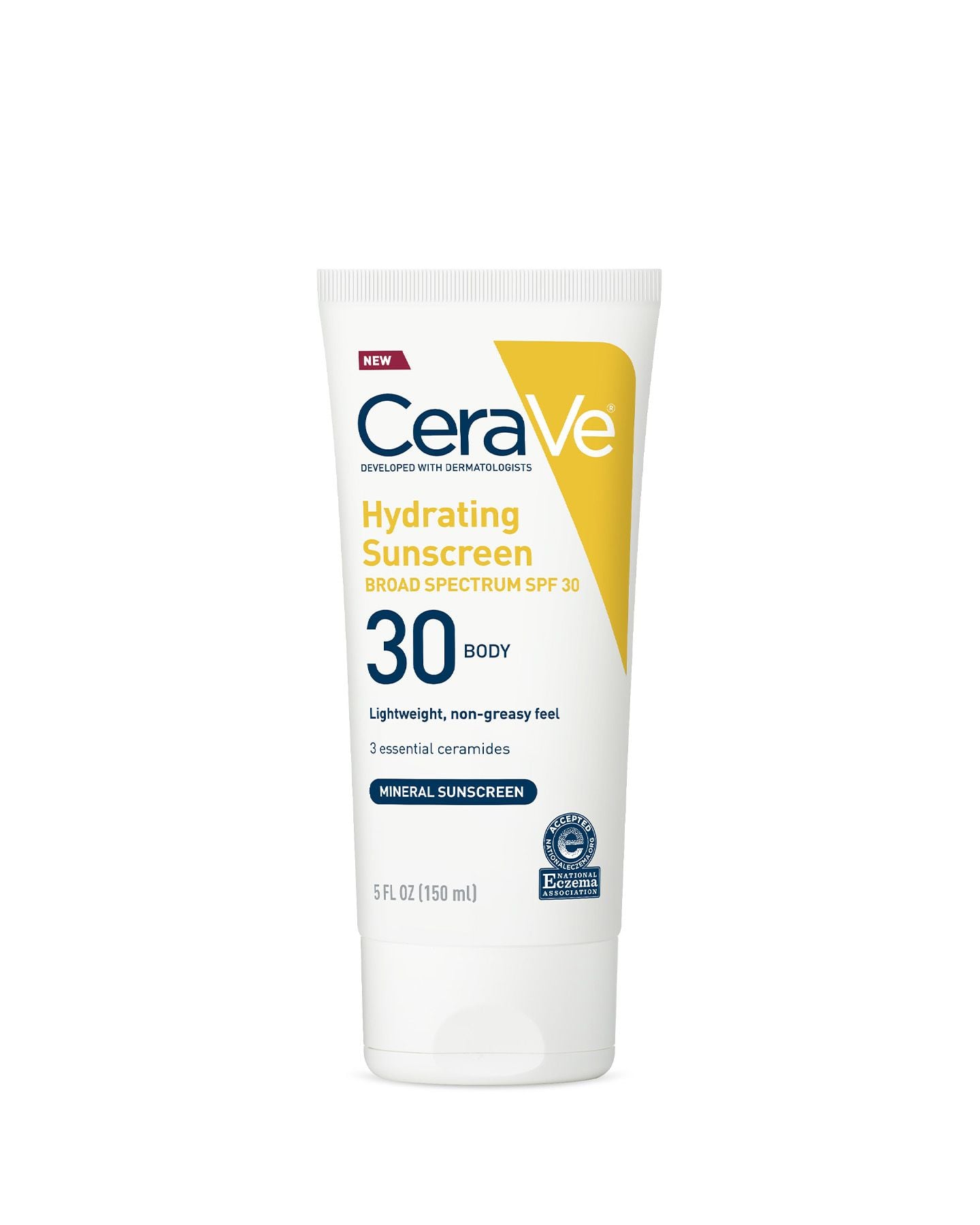
| CeraVe Hydrating Mineral Sunscreen Body Lotion SPF 30 | Mineral | Titanium dioxide, zinc oxide | Slowest. Mineral filters are oxides. They barely photo degrade. |
| La Roche Posay Anthelios Melt in Milk SPF 60 | Chemical | Avobenzone 3%, homosalate 10%, octisalate 5%, octocrylene 7% | Stabilized. Octocrylene is in the formula because it slows avobenzone's decay in light. |
| EltaMD UV Clear SPF 46 | Hybrid | Zinc oxide, octinoxate | Octinoxate is heat sensitive. Zinc oxide half of the pair is stable. |
| Neutrogena Ultra Sheer Dry Touch Max SPF 100+ | Chemical | Avobenzone, homosalate, octisalate, octocrylene | Same stabilizer pair as the Anthelios. SPF 100 is the lab figure at the label dose. |
The practical read on this table is simple.
The mineral CeraVe is the least sensitive to time and handling, because its oxides don't change meaningfully in sunlight. That doesn't make it a free pass; the carrier still ages, and zinc oxide can settle in a bottle that hasn't been shaken. But a 2024 label stored in a bathroom cabinet behaves roughly how the manufacturer promised.
The two avobenzone and octocrylene combinations (the Anthelios Melt in Milk and the Neutrogena Ultra Sheer Max) are formulated to buy themselves time. Octocrylene absorbs the energy that would otherwise break avobenzone apart, which is why both labels carry it. That's not the same as being immortal. The clock still runs on the avobenzone; it just runs slower.
The EltaMD UV Clear pairs a stable mineral filter with octinoxate, which is the one US filter the European Union has restricted most recently (the EU Scientific Committee on Consumer Safety reopened its review of octinoxate in 2020 and finalized new concentration guidance in 2023). The zinc oxide half of EltaMD's label is still solid at a year in. The octinoxate half isn't.
For why the SPF on any of these bottles is already optimistic before any aging, see our breakdown of why you get a fraction of the SPF printed on the bottle.
What should you replace first?
Sort the bottles in your house by heat exposure, not by age.
The ones to throw out first are the bottles in your bag, your car, and the shelf next to the shower. Any of those three have run through more heat and more light than a bottle on the back of a bathroom cabinet of the same age. The small PAO symbol on the back of the pack reads 12M or 24M: twelve or twenty four months after opening. For a chemical sunscreen that has already been opened, the PAO is usually tighter than the printed exp date, and it is the number you should trust.
Watch for the three visible signs the FDA page mentions: separation, color change, and a different smell. Any one of them is enough to retire the bottle. If you want a second opinion, the single FDA sunscreen recall this cycle was triggered by a different stability problem, and the testing pathway is the same. A filter under spec is a filter you don't want on vacation.
When in doubt, FDA's own answer is the cleanest. If you don't know how old a bottle is, discard it. That is the line the sunscreen guidance page gives. That is the line professional dermatology groups adopt.
What I would replace today
If I had to pick one bottle in my own bathroom to replace today, it would be the one that lives in the car, whatever the date on the back says. Three thermal cycles in a 2017 paper were already enough to push encapsulated avobenzone below the stability study's own acceptable floor. A real summer does more.
The second one I'd toss is the bottle on the pool shelf. It's been opened the longest and handled the roughest. A mineral formula like the CeraVe is forgiving; a high SPF avobenzone formula like the Neutrogena is not. I'd replace it on principle.
Photograph any of the four sunscreens above with Skinventry and the app lists the Drug Facts actives, the full inactive ingredient list, the labeler on file with FDA, and the owner above the labeler, each line with its source, so you can see at a glance whether the bottle you're about to toss is the chemical one with the fast aging actives or the mineral one with the slow ones. That is the second half of the label the printed exp date does not tell you about.
