Why sunscreen burns your eyes almost never comes down to whether the UV filter is mineral or chemical. The sting is written in the inactive ingredients that sit below the Drug Facts panel: fragrance, denatured alcohol, surfactant emulsifiers, and certain preservatives. We read four DailyMed labels on October 27, 2026. The pattern held across the whole set.
Your tear film is three impossibly thin layers stacked on your eye. Oil on top, salt water in the middle, mucus pinned to the cornea at the bottom. The whole stack is thinner than a sheet of paper, and the oil layer at the top is what keeps the salt water from evaporating in the open air. When a detergent reaches that oil, it collapses. The salt water underneath hits the cornea's nerves, and that is the burn you feel the second a drop of sweaty sunscreen slides past your lower lid.
So the real question is not whether your sunscreen is mineral or chemical. It's what's in the bottle that acts like a detergent on your tear film the moment it migrates. The American Academy of Ophthalmology's 2024 EyeWiki entry on periocular dermatitis puts a hard number on the stakes: allergic contact dermatitis causes 31% to 72% of cases, with eye area products a common trigger. That is a wide band because the field is thin on head to head data, but the floor alone is one in three.
The FDA already knows the migration part. Every single sunscreen sold in the United States, mineral and chemical and anything in between, carries the exact same warning line in its Drug Facts panel: "When using this product keep out of eyes. Rinse with water to remove," a line the FDA's over the counter sunscreen monograph (21 CFR Part 352) made mandatory for every product sold in this category.
That line is not a warning the brand wrote.
Why does every US sunscreen carry the same eye warning?
We pulled the Drug Facts labels for four sunscreens on DailyMed on October 27, 2026. These are the four that come up most often when a dermatologist tells someone with sensitive eyes what to buy. We picked four very different filter systems on purpose. One identical warning line sat on all four:
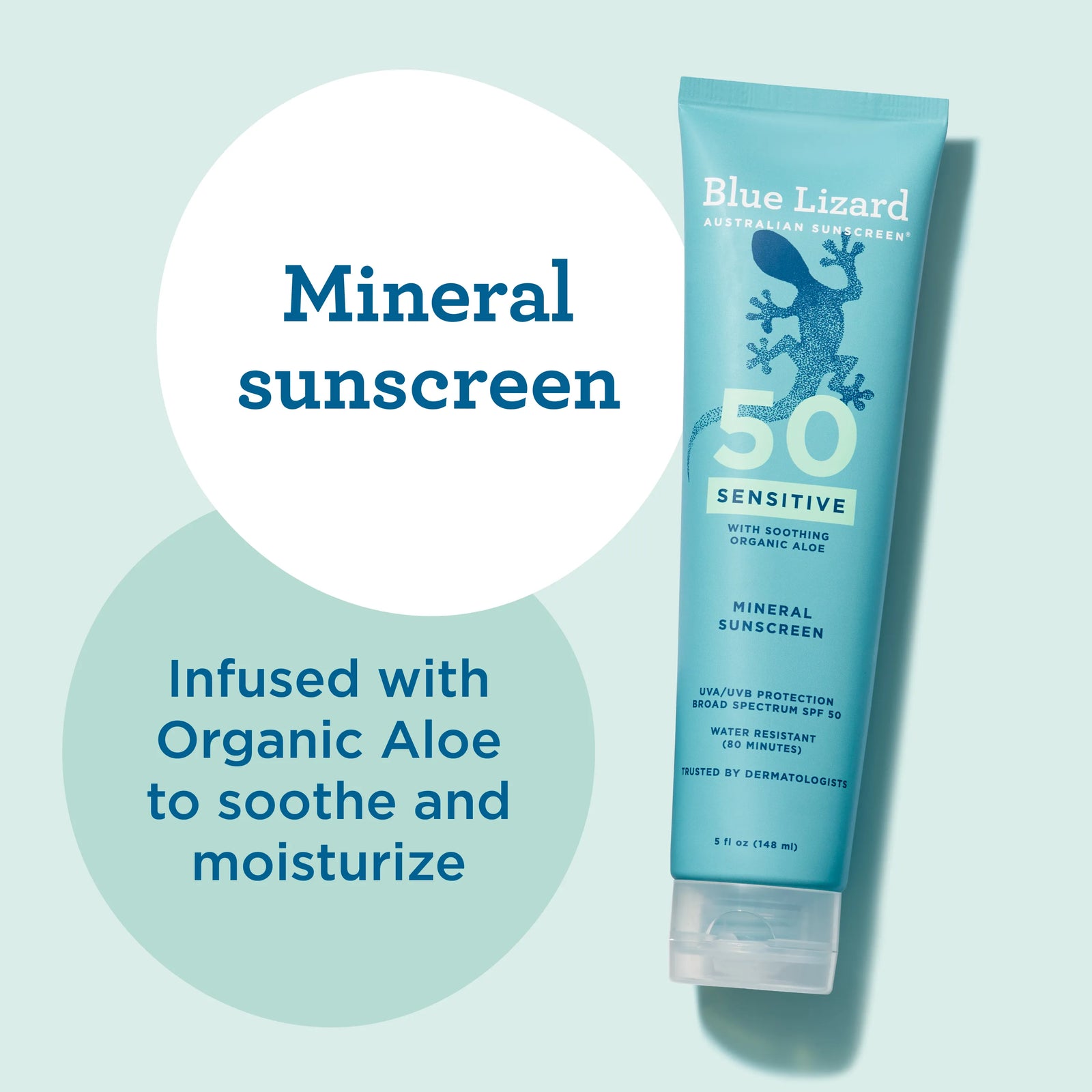
Blue Lizard Sensitive Mineral SPF 50 Lotion: Keep out of eyes. Rinse with water to remove.
EltaMD UV Clear SPF 46: Keep out of eyes. Rinse with water to remove.
La Roche Posay Anthelios UV Clear SPF 50: Keep out of eyes. Rinse with water to remove.
Vanicream Facial Moisturizer SPF 30: Keep out of eyes. Rinse with water to remove.
That line is a federal requirement. The sunscreen monograph treats the risk as a given across the whole category, because the agency knows every topical that goes on a face can and will travel. Sweat moves it. Water moves it. Rubbing your eyes with the back of a sunscreen slicked hand moves it. The question has never been whether sunscreen will reach your eye. It's what the sunscreen does when it gets there.
Why 'switch to mineral' is right by accident
The derm answer most readers see is to switch to a mineral sunscreen. Dr. Mona Gohara, an associate professor of dermatology at Yale School of Medicine quoted by Today in 2025, says mineral formulas are the least likely to irritate the skin and inflame the eyes. Dr. Lauren Penzi, in the same piece, points to a wider culprit list: not just the UV filters, but the preservatives, alcohols, and fragrances alongside them.
Penzi's version is closer to the chemistry. Here's why. A UV filter does not touch your eye on its own. It arrives dissolved in a vehicle: water, oils, silicones, emulsifiers, fragrance molecules, preservatives, humectants. That vehicle is the detergent problem. Pure zinc oxide and pure avobenzone, both filters, do not emulsify tear film oil. The surfactants carrying them do.
The dermatology recommendation to switch to mineral works most of the time because the products marketed to sensitive skin tend to skip fragrance, skip denatured alcohol, and use milder surfactants. The filter class is a proxy for a cleaner vehicle. It is not the lever itself. That's why Blue Lizard Sensitive stings less than a mineral stick cut with denatured alcohol, and why La Roche Posay's Anthelios UV Clear, an all chemical formula, is one of the standard eye safe picks on dermatology office shelves. The vehicle, not the filter, carried both products across that line.
What do four Drug Facts labels actually show?
Here is what the actual labels look like, pulled verbatim from the FDA's DailyMed database on October 27, 2026. The actives sit at the top. Everything we care about sits below them.
| Product | Actives (Drug Facts) | Fragrance? | Alcohol denat? | Notable inactives |
|---|---|---|---|---|
| Blue Lizard Sensitive Mineral SPF 50 Lotion | Titanium dioxide 5%, zinc oxide 10% | No | No | Beeswax, dimethicone, polyglyceryl 4 isostearate, phenoxyethanol |
| EltaMD UV Clear SPF 46 | Zinc oxide 9%, octinoxate 7.5% | No | No | Niacinamide 5%, sodium hyaluronate, phenoxyethanol, iodopropynyl butylcarbamate |
| La Roche Posay Anthelios UV Clear SPF 50 | Avobenzone 3%, homosalate 7%, octisalate 5%, octocrylene 7% | No | No | Azelaic acid, glycerin, propanediol, cetearyl alcohol (a waxy emollient, not drying alcohol) |
| Vanicream Facial Moisturizer SPF 30 | Zinc oxide 19.5% | No | No | Squalane, ceramides, dimethicone, 1,2 hexanediol |
None of the four lists fragrance. None lists denatured alcohol. Three of the four skip the surfactant systems you would find in a water resistant beach formula. The pattern is simple: the product people actually recommend across the mineral and chemical divide is a product that happens to lack the stuff that stings. The filter is the headline. The inactives are the story. We built this table so the clean set is sitting side by side with its own Drug Facts actives line, because that is the comparison the brand pages never make for you. Read the right column, not the second one.
The sting is almost always a vehicle problem
If you want to predict which sunscreen will burn your eyes, you can mostly ignore the actives line and read the one below it. These are the usual suspects, in rough order of how often they show up on bottles people say sting.
Fragrance and parfum. Fragrance is a catchall term that can hide dozens of individual aromatic chemicals, many of them volatile. On the lid of the eye, where the skin is thinner than anywhere else on the face, fragrance is a top driver of allergic contact dermatitis. The American Academy of Ophthalmology's EyeWiki entry on periocular dermatitis is blunt about it: allergic contact dermatitis accounts for 31 to 72 percent of periocular dermatitis cases, with eye area products a common trigger. On a sunscreen that bakes into your skin for hours and then runs with sweat, that risk compounds. If you sting easily, scan the whole inactive list for the words fragrance, parfum, or any name ending in essential oil. We dug further into why "unscented" is not the same as fragrance free in our piece on how unscented moisturizers can still carry fragrance.
Denatured alcohol. On a label it shows up as alcohol denat, SD alcohol, or ethyl alcohol. In a sunscreen stick the ethanol flashes off quickly, which is why sticks sting less than their ingredient lists suggest. In a lotion or spray, it stays wet long enough to spread into the oil layer of your tear film and dissolve it. A tear film with a thinner oil layer evaporates faster. A faster evaporating tear film is a stinging tear film. Even people without allergy will feel it.
Harsh surfactants and emulsifier systems. These are what make sunscreens emulsify at all. Mild ones (polyglyceryl 4 isostearate, sorbitan oleate, the ones Blue Lizard uses) sit heavy on skin and don't travel. Lighter, more sprayable systems (certain PEGs, polysorbates, laureth sulfates) travel more easily, and when they reach your tear film, they strip oil off it the same way dish soap strips grease off a plate. Dr. Lauren Penzi named this bluntly in the Today 2025 piece: "additives such as preservatives, alcohols, fragrances, other botanical ingredients" drive the burn as much as the UV filter itself.
Preservatives at a high enough load. Phenoxyethanol is on three of our four labels and is well tolerated by most people. Iodopropynyl butylcarbamate (on the EltaMD label) is a sensitizer in a non trivial minority of patch tested patients. Methylisothiazolinone, which thankfully is not on any of these four, is the one most strongly linked to allergic contact dermatitis around the eye in the dermatology literature. Scan for the long ones.
Alpha hydroxy and salicylic acids inside the sunscreen. Occasional, but it happens. If a sunscreen also doubles as a chemical exfoliant, read it twice. Those acids can sit at a pH that irritates skin on their own, and the eye margin is far less forgiving.
The sting is a vehicle problem, not a filter problem.
What should you look for on a label that will not sting?
Think of this as a four line check you can run on any sunscreen in a drugstore aisle. The actives line matters least. The inactive list matters most.
First: no "fragrance" and no "parfum." If the label says fragrance free, read the whole list anyway, because sometimes an essential oil sneaks in under its botanical name. The Skinventry rundown on buzzwords the FDA has never defined goes through which claims on this list are enforced and which are not.
Second: no "alcohol denat" or "SD alcohol" near the top of the inactive list. Fatty alcohols like cetearyl alcohol are not the same thing; they are waxy emollients and they do not sting. The grain alcohol is the one you don't want sitting on your orbital rim.
Third: if you sweat a lot, consider a stick. Sticks are solid at room temperature, so the sunscreen doesn't melt down into your eye the way a thin lotion will. The Skin Cancer Foundation makes this recommendation in exactly those terms: a mineral stick, dabbed on and worked in, won't melt and make application less messy.
Fourth: for the eye orbit specifically, apply with a fingertip to the brow bone and the cheekbone, not the lid itself. The lid is where the Drug Facts warning is pointing. The orbital bones are a safe landing zone, and the natural creasing of the skin will carry the product toward (not into) your eye.
If you want the chemistry explained, we wrote a longer piece on what mineral filters actually do (they don't reflect UV the way the marketing says), and a sibling post on why the SPF number on the bottle isn't the SPF you get.
What derms get right and what they skip
Dermatologists are right that mineral sunscreens sting less on average. They are right that the skin around the eye is thin and reactive. They are right that if you want to stop a burn fast, you flush with cool water and resist rubbing. All of that still holds.
What the headline advice skips is the mechanism. "Switch to mineral" is a product category recommendation. It won't help you buy well inside a product category, and it won't tell you why the Vanicream and the Anthelios UV Clear, which don't share a single UV filter in common, both come up on sensitive eye lists.
Read the second half of the label.
That is where the sting lives. If a bottle is fragrance free, has no denatured alcohol, uses mild surfactants, and skips the sharpest preservatives, it will almost certainly leave your eyes alone, whether the active is zinc oxide or avobenzone. If any of those four things is wrong, the bottle will sting even if it has mineral written across the front in friendly letters.
Photograph any of these four sunscreens and Skinventry shows you the Drug Facts actives, the full inactive list and the labeler for the product, each with a source, and flags the fragrance and denatured alcohol a sensitive eye reader asked to see. That's the second half of the label the Drug Facts warning is really pointing to, and it is where the sting lives.
