Of four salicylic acid body washes most back acne lists rank first, only three are acne drugs on the label. The one at the top of most lists, CeraVe SA Body Wash for Rough and Bumpy Skin, isn't. It's a cosmetic cleanser with salicylic acid below the FDA acne drug range. If the acne is real, pick a drug.
Google the exact phrase a dermatologist would type, salicylic acid body wash for back acne, and the first page is a wall of sponsored listicles. The Tampa Bay Times. NBC Shop. A junk affiliate called Smytten that calls Paula's Choice a benzoyl peroxide product, which it isn't. Three of the top five rank CeraVe's SA Body Wash first. That bottle is on half the shelves in America. It also isn't an acne drug.
We spent a Saturday reading the actual labels. There are 4 bottles. 3 are OTC acne drugs. 1 is a cosmetic. And the one that works best isn't a wash at all.
Why you should trust us
Skinventry's lab desk writes about what's really in beauty products, down to the Drug Facts panel. We don't test on skin. We read labels against the primary record: brand pages, FDA's DailyMed, and the FDA rule that sets the active ingredient limits. On October 31, 2026, we pulled the published labels of four salicylic acid body wash candidates for back acne. We recorded the active ingredient percentage, the directions, and whether the product carries the OTC Drug Facts panel that lets a product claim to treat acne under FDA's 2023 Final Administrative Order OTC000013_M006. Three of the four sit on DailyMed. One doesn't.
Who is this guide for?
Adults with persistent breakouts on the back, chest, or shoulders. If the acne is severe, cystic, or scarring, see a board certified dermatologist. Nothing in a shower kills cystic acne on its own, and the AAD's 2024 acne guidelines name oral and prescription options for anything that doesn't yield to OTC care in 8 to 12 weeks. Everything that follows is for the version of back acne the AAD calls mild to moderate: closed and open comedones, papules, small pustules, no deep nodules.
How did we pick these four?
We started with the four products that keep showing up on page 1 of Google for the target query and asked one question: does the label actually say the product treats acne? That's not pedantry. In the United States, treats acne is a drug claim, and only an OTC monograph compliant product with a Drug Facts panel and an active ingredient at the right percentage can carry it. Everything else is a cosmetic cleanser that happens to contain salicylic acid at an undisclosed level. You can use it, and it will clean you, but if it worked on acne by law the box would say so.
Three products pass that bar. One doesn't. We ranked the three on how closely their directions match the one variable that matters for a wash off acne drug: how long the active actually touches skin.
What do the four labels actually say?
Here are the four, side by side, pulled on October 31, 2026 from DailyMed and the brand's own site.
| Product | Salicylic acid | Drug Facts panel | Treats acne (label claim) | Form |
|---|---|---|---|---|
| PanOxyl Acne Banishing Body Spray | 2% | Yes | Yes | Leave on spray, not a wash |
| PanOxyl Acne Gel Wash with 2% Salicylic Acid | 2% | Yes | Yes | Rinse off wash |
| Neutrogena Body Clear Body Wash | 2% | Yes | Yes | Rinse off wash |
| CeraVe SA Body Wash for Rough and Bumpy Skin | Undisclosed, cosmetic strength | No | No, marketed for rough and bumpy skin | Rinse off wash |
The pattern is simple. If the label carries a Drug Facts panel with salicylic acid as the active and the use line says treats acne, FDA sees it as an acne drug. That's the three top rows. CeraVe's SA Body Wash, the bestseller, carries none of that. It's a cleanser.
Our pick: PanOxyl Acne Banishing Body Spray
Not a wash. That's the point.
Every rinse off acne product has the same problem. Salicylic acid is a slow actor on skin, and the 2023 Clinical, Cosmetic and Investigational Dermatology trial that is the single best piece of truncal acne evidence used daily application over 84 days to show a 56.3 percent drop in total lesion counts. The spray sidesteps the entire contact time question by not asking you to rinse. You soap up with any body wash. You dry off. You spray the 2 percent salicylic acid onto your back, chest, or shoulders, and you leave it. One to three times a day, per the Drug Facts panel.
If what you have is back acne and you can only buy one thing, this is the one.
Runner up: PanOxyl Acne Gel Wash with 2% Salicylic Acid
Same brand, same active, same percentage, different form. The Gel Wash is PanOxyl's rinse off counterpart, with Drug Facts directions that say to cover the affected area with a thin layer morning and night, then rinse. It's a face product used on the body, which is fine. It outperforms the Neutrogena on one small thing: the directions actually ask you to apply a thin layer, which keeps the active on skin a few seconds longer than a lather up and rinse. If the spray dries you out or you want a cleaner that doubles as treatment, this is the move.
Also great: Neutrogena Body Clear Body Wash
Also 2 percent salicylic acid, also a DailyMed listed OTC drug product. The directions are the loosest of the three: use daily in the shower or bath, massage over wet skin with a washcloth or body puff, concentrating on areas prone to breakouts, rinse well. No contact time. A shopper reading those directions will spend about 20 seconds lathering and rinsing, and the active will have about that long to do anything. It's cheaper and easier to find than PanOxyl, and if that's what gets you to use it every day, it's a reasonable choice. Just know what you're buying.
Is CeraVe SA Body Wash actually a salicylic acid acne wash?
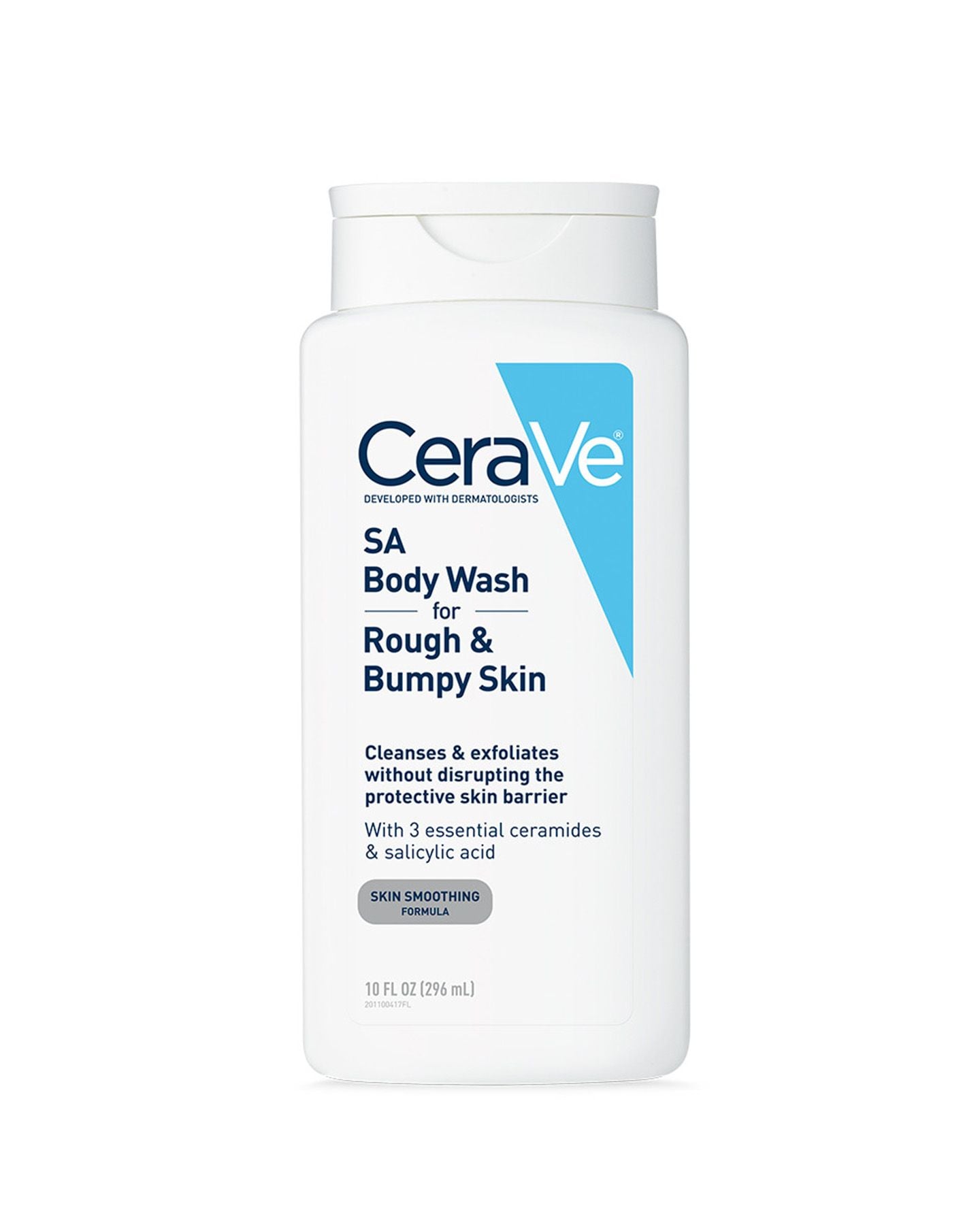
This is the one almost every listicle leads with. It's cheap, about 13.99 for 10 fluid ounces. The bottle is the familiar CeraVe white and blue. It contains salicylic acid. All of that is true. None of it makes it an acne drug.
Read the label. The front says cleanses and exfoliates without disrupting the protective skin barrier. It does not say treat acne. Flip to the back and there's no Drug Facts panel, no Active ingredient line, no Use line. On the INCI, salicylic acid lands after sodium chloride and calcium gluconate, both of which sit at well under 1 percent in a surfactant cleanser. That puts the salicylic acid under the 0.5 percent floor that FDA's 2023 Final Administrative Order OTC000013_M006 set as the lowest allowable concentration for an OTC acne drug product. The product is marketed as a keratosis pilaris cleanser. For that, it's fine. For back acne specifically, you're using a cosmetic that nods at the active ingredient.
What should you look for on any back acne body wash label?
Flip to the back of the bottle. Three questions.
One. Is there a Drug Facts panel? That rectangular black and white box with Active ingredient, Use, Directions, and Warnings. If not, the product is a cosmetic. It isn't legally allowed to say it treats acne, and the active, if there is one, isn't declared at a drug level percentage.
Two. If there is a panel, does the Active ingredient line say salicylic acid, and what's the percentage? FDA allows 0.5 to 2 percent. For back acne, 2 percent is the ceiling and the one most of the real acne washes use.
Three. Do the Directions say leave on, or rinse? Everything about contact time flows from this answer. A wash gets about 20 seconds of skin contact. A leave on gets hours. For a slow actor like salicylic acid, the difference is the whole product.
If you want the deeper mechanics of why a wash off acid doesn't work the way the bottle implies, the contact time piece on face acids walks through the same math on the face. We've also looked at what PanOxyl's benzoyl peroxide bar wash is really doing, since PanOxyl runs both actives in the same brand. For chest and shoulder specifics, the pimple patch piece on chest acne covers what to do between treatments. The skincare buzzwords the FDA has never defined post explains why the words on the front of a bottle so often don't line up with the Drug Facts panel.
Care, maintenance, and when to stop
Give any of these 8 to 12 weeks of daily use before judging it. That's the window the AAD's 2024 acne guidelines set for OTC monotherapy. If after 12 weeks the back is clearer, you're done searching. If it isn't, you've learned something: your acne wants a stronger regimen, probably one with benzoyl peroxide and sometimes a prescription retinoid or oral medication.
And one honest caveat on the leave on spray. People with sensitive skin, open scratches, or a known salicylate sensitivity may find the 2 percent spray stings or dries the back more than a wash does, because leaving an active acid on skin for hours asks more of your barrier than lathering it off in a shower ever will. If that's you, start with the Gel Wash two or three nights a week, build up to daily, then add the spray only if the washes stall. The product that works best in theory isn't always the product your skin tolerates. Patch a small area for a few days first.
Dryness after a few weeks is normal. Peeling, redness, or a stinging rash means stop.
What I'd do differently
If I were walking down the aisle again today and had to pick one bottle for a friend's back acne, I'd skip the whole wash shelf and pick the PanOxyl Banishing Body Spray. For 15 or 20 dollars, you get a leave on dose of the active that doesn't hinge on how carefully you lathered. The CeraVe SA Body Wash I'd leave for someone with keratosis pilaris, which is actually the problem it was made for and the one the label was written for.
Photograph any one of these bottles and Skinventry shows what the Drug Facts panel declares, who makes it, who owns the brand, and the public record on the active, each with a source. The app does the label reading we just did, so you can do it in the aisle instead of a Saturday.
Sources
- FDA Final Administrative Order OTC000013_M006, Topical Acne Drug Products for OTC Human Use, 2023.
- Chamusca Nunes et al., The Benefit of a Deep Cleansing Gel in the Management of Mild to Moderate Truncal Acne. Clin Cosmet Investig Dermatol, 2023. NCT05584150.
- Neutrogena Body Clear Body Wash, DailyMed OTC label.
- PanOxyl Acne Gel Wash with 2% Salicylic Acid, DailyMed OTC label.
- PanOxyl Acne Banishing Body Spray, DailyMed OTC label.
- CeraVe SA Body Wash for Rough and Bumpy Skin, product page.
- American Academy of Dermatology, Guidelines of care for the management of acne vulgaris, 2024.
