In the one big head to head trial, Stiller 1996 in Archives of Dermatology, 8% lactic matched 8% glycolic on faces over 22 weeks and beat vehicle on more endpoints. Glycolic goes deeper, lactic also feeds ceramides. We read four leave on acid labels so you can pick.
You'll see it everywhere: glycolic acid is the stronger one, lactic acid is the gentler cousin. That shorthand came from brand copy, not from the trial that compared them. When Stiller and colleagues ran 8% L lactic cream against 8% glycolic cream against vehicle for 22 weeks on the face and forearms of volunteers at the University of Michigan, the two acids landed close on the face. 76% of glycolic users and 71% of lactic users improved at least one grade on a nine point scale. Lactic actually beat vehicle on more endpoints on the forearm. Both at modest concentrations. Both well tolerated. That's the ceiling of the honest comparison.
So the question in a cart isn't which one works.
It's which one fits what your skin keeps asking for.
The setup: same family, two sizes
Glycolic and lactic are both alpha hydroxy acids. They loosen the bonds between the dead corneocytes at the surface so the stratum corneum sheds faster. The molecular biology is nearly identical. The physics is not. Glycolic weighs 76 grams per mole. Lactic weighs 90. That 15 gram per mole gap sounds small on paper and is the whole story at the shelf: the smaller molecule slips between corneocytes faster, which is why glycolic is the acid that most often shows up in a clinic peel.
Smaller and faster isn't stronger. It's just deeper, and faster. The published head to head says the two acids land close on photodamage endpoints when they're at the same concentration and the same pH. What changes is tolerance, hydration, and what the molecule does on the way back out of your skin.
That's the first thing we always try to pull out of the comparison.
Round 1: which actually goes deeper?
Glycolic. The smaller molecule, at a pH low enough to keep the acid in its undissociated form, moves through the stratum corneum faster. That is why clinical peels at 30% and above are usually glycolic rather than lactic. It is also why glycolic burns more at the same strength. At 7% in a toner, like The Ordinary's Glycolic Acid 7% Toning Solution, the burn is a tingle. At 20% leave on and 30% peel strengths, it is sharper and faster.
Lactic is bigger, which does two things at once. It gets less of itself into the skin, so irritation's softer at the same concentration. And it holds water. Lactate is a natural moisturizing factor your own corneocytes already carry, which is why dry patches tend to drink in a lactic serum and only sting in the ones that are formulated low pH and high percent.
Round 2: what does lactic actually do that glycolic does not?
This is the paragraph the comparison posts skip. In 1996 Rawlings and colleagues showed in Archives of Dermatological Research that L lactic acid, but not its mirror image D lactic acid, is incorporated as a substrate into keratinocyte ceramide synthesis, raising ceramide levels in the stratum corneum and improving barrier function. Translated: a well formulated L lactic serum, used over weeks, builds more of the lipid cement that keeps water in your face. Glycolic hasn't been shown to do that. It's the exfoliator; lactic is the exfoliator that also feeds the brick wall.
This is why dermatologists keep calling lactic the dry skin pick, not the gentle version of glycolic. “Lactic acid also has a larger molecular size than glycolic acid, so it doesn't penetrate as deeply and is less likely to cause irritation,” said Dr. Ashley Magovern, a board certified dermatologist, to Dermstore. She calls lactic a safer choice for sensitive and reactive skin, and pairs it with a daily moisturizer. The humectant quality is why.
Round 3: what the labels actually say
We read the published ingredient lists and marketing specs of four leave on acid serums on the brands' own US pages on November 3, 2026. The point wasn't to rank them. It was to see what the two acids look like on the shelf when the price band and the dropper and the pH story all change around them.
| Product | Acid, strength | Format | Price | What else is in it |
|---|---|---|---|---|
| The Ordinary Glycolic Acid 7% Exfoliating Toning Solution | 7% glycolic acid | Rinse on, leave on, pH about 3.6 | $10 for 240ml | Tasmannia lanceolata (pepperberry) ferment, panthenol, aloe, aminomethyl propanol as the pH buffer |
| The Ordinary Lactic Acid 10% + HA | 10% lactic acid | Leave on serum, pH about 3.8 | $9.60 for 30ml | Sodium hyaluronate, Tasmannia lanceolata ferment, acacia senegal gum, trisodium ethylenediamine disuccinate |
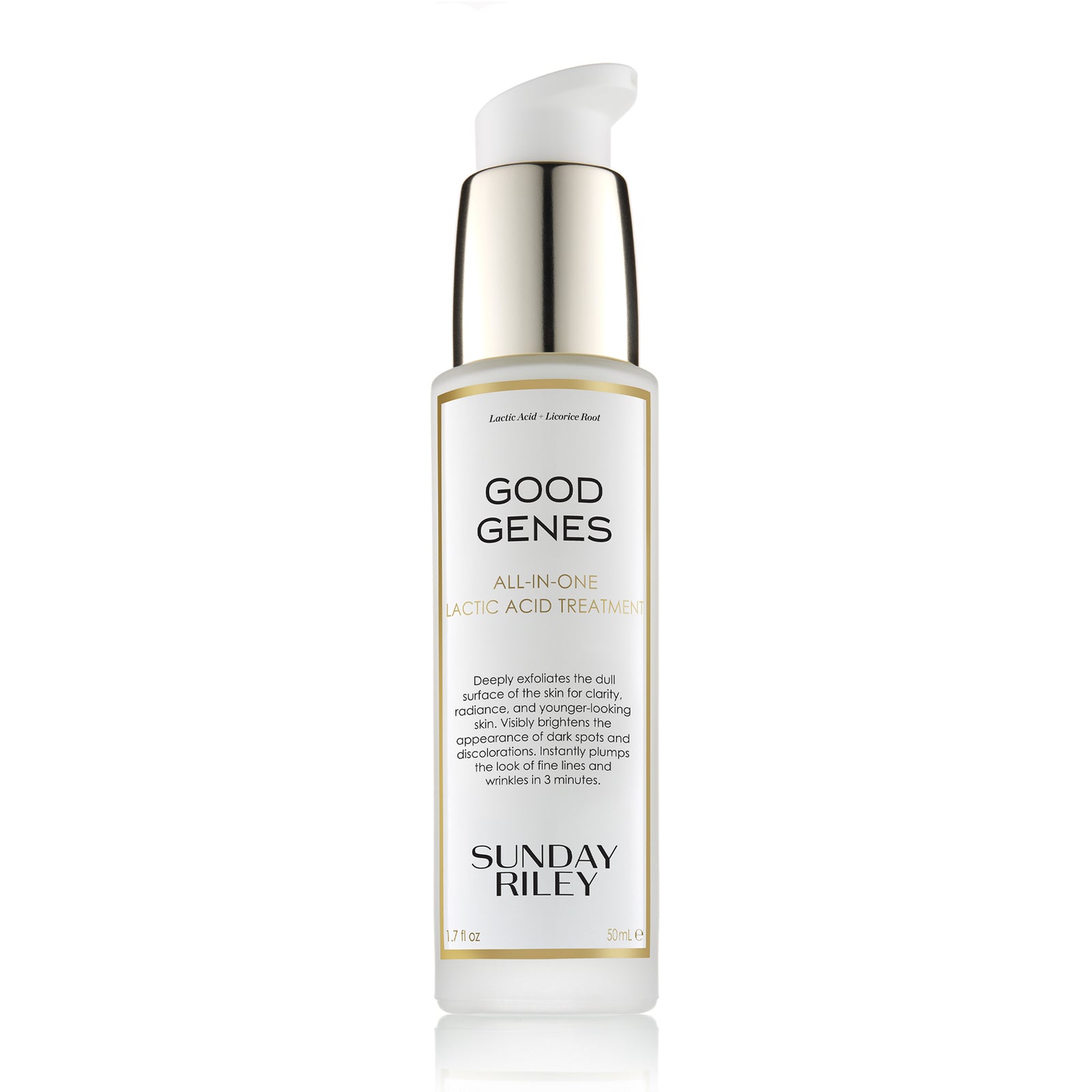
| Sunday Riley Good Genes Lactic Acid Treatment | Purified grade L lactic acid (percentage not disclosed on the brand page) | Leave on treatment, licorice and prickly pear | $85 for 30ml | Licorice root for pigment, prickly pear, lemongrass, aloe, arnica. Fragrance free. |
| Sunday Riley Good Genes Glycolic Acid Treatment | Ultra pure glycolic acid (percentage not disclosed) | Leave on treatment, same serum family as the lactic version | $85 for 30ml | Licorice root, prickly pear, lemongrass, aloe. Formaldehyde free glycolic grade, per the brand. |
A few things jump out when I line them up. The Ordinary quietly puts the biggest acid load (10% lactic) in its cheapest bottle, and does it at a pH close enough to the glycolic toner that the real difference between the two is the molecule, not the number on the label. Sunday Riley sells essentially the same formula framework at the same price in both acids, and does not print an exact percentage on either product page. If you have ever wondered which Good Genes to buy, the honest answer is that both are purified grade acid treatments at an opaque dose, and the acid name is the only lever that changes.
Round 4: which is for which skin
Short version. Pick glycolic if your main complaint is bumpy texture, dullness, blackheads on an oily T zone, or keratosis pilaris on the body. The deeper penetration is doing work in a layer lactic can't reach. Pick lactic if your main complaint is a dry, sensitive, or compromised barrier that still looks dull. The humectant pull and the ceramide feeding keep the exfoliation from pulling you below the barrier you already lost.
In our own label reads on this run, two of the four products we checked only name a maximum strength on the carton, not what's actually in the dropper, so the honest spec for the price band is sometimes thinner than the serum photograph suggests.
If you have rosacea, perioral dermatitis, or any skin that reacts to active ingredients within a day, start on lactic at a lower strength (The Ordinary's lactic also comes in a 5% version) and apply it to completely dry skin. Dr. Magovern specifically notes that damp skin lets acids penetrate deeper and tip into irritation. Patch test for three days behind an ear or on the jaw before you take either acid across the full face.
And whichever you pick, both carry the same FDA Sunburn Alert. In the agency's own studies, four weeks of AHA use raised volunteers' sensitivity to UV reddening by 18 percent, and sensitivity to UV induced cellular damage roughly doubled at some sites. FDA's final 2005 guidance recommends every AHA cosmetic carry a label telling you to wear sunscreen and limit sun exposure for a week after you stop. If your sunscreen habit is already shaky, resolve that first. The acid works harder when the UV is not pulling in the other direction.
Round 5: can you use them together?
Technically yes, in the right geometry. Most derms recommend one acid, one night, not stacked in the same application. If you do want both in a routine, keep them on separate nights, and keep a bland moisturizer between them and anything else that stings. Our own post on leave on versus rinse off acids walks through the timing. The barrier arithmetic cares about total daily exfoliation, not which molecule got there.
What you should not do: stack a glycolic peel with a retinoid on the same night, especially if that retinoid is tretinoin or The Ordinary's 1% retinol at the top of the shelf. And if you have already pushed too far, we've written about how long over exfoliated skin takes to repair: longer than most people wait before they try to fix it with another acid.
The honest caveat: what neither acid will do
Here is the limit, in plain words. Neither acid is going to erase deep wrinkles, pigment that sits in the dermis, or scarring from old acne. The Stiller team called the facial improvements modest, and the trial ran at 8%, not 20%, and still took 22 weeks. Over the counter AHA serums are a slow, steady exfoliation that improves texture and surface dullness. They aren't a prescription retinoid, they aren't a professional peel, and they aren't a laser. If a product promise sounds bigger than that, the molecule can't cash it.
And there's the sun warning. Both acids thin the dead cell layer that was partly shielding you from UV, and in FDA's own studies that showed up as an 18% rise in UV reddening after four weeks. If you can't commit to daily sunscreen through the fall and winter you'll undo the slow gain, and might make hyperpigmentation worse.
The verdict
The internet gets this comparison wrong because it's reading brand copy. The 1996 trial that actually put the two acids on faces for 22 weeks says they land close. The 1996 paper that followed says lactic's got a second job your barrier appreciates. So the picks are mechanical, not moral.
If your skin is thick, oily, resilient, textured, or sun damaged in the familiar ways, the smaller molecule earns its tingle. The Ordinary's 7% glycolic toner is the cheapest honest entry; Sunday Riley's Good Genes glycolic is the premium version of the same choice. If my skin reads dry, sensitive, or over exfoliated already, the bigger molecule that feeds ceramide synthesis is the one that treats and repairs on the same stroke. The Ordinary's Lactic 10% + HA packs the biggest documented dose for the money, and Sunday Riley's Good Genes lactic is the purified grade treatment you're paying for the brand and the texture on. If your main concern is keratosis pilaris or body texture, we tracked a separate La Roche Posay body line for KP that reads differently again.
And one more time, in plain words: wear the sunscreen. Both acids make the next afternoon's UV worse. The FDA wrote the warning on the bottle for a reason.
Photograph any of these four serums with Skinventry and the app shows the ingredient list, the maker behind the name on the dropper, the parent company that owns the brand, and the public record for each one, with a source attached to every line.
How we got these numbers: we read the published ingredient lists and marketing specs of four leave on acid serums on the brands' own US pages on November 3, 2026 (The Ordinary Glycolic Acid 7% Toning Solution and Lactic Acid 10% + HA on theordinary.com; Sunday Riley Good Genes in both acid versions on sundayriley.com). pH values are the brand's own published figures. The 1996 trial numbers come from Stiller et al., Archives of Dermatology 1996 (PubMed 8651713) and the ceramide finding from Rawlings et al., Archives of Dermatological Research 1996 (PubMed 8818186). The Sunburn Alert text and the 18 percent UV sensitivity figure are from FDA's Alpha Hydroxy Acids consumer page and its 2005 Final Guidance for Industry on AHA labeling, both accessed the same day.
