In the US, an antiperspirant is a drug. The only way to legally use that word is with an aluminum salt from FDA's list. So an aluminum free antiperspirant can't exist. If a stick is aluminum free, it's a deodorant: it fights odor, but it doesn't reduce sweat.
You'll see it on shelves: a white stick marked aluminum free antiperspirant, as if the two words sit together naturally. They don't. FDA's own rule, 21 CFR Part 350, lists exactly which active ingredients a stick can use and still be called an antiperspirant, and every one of them is an aluminum salt. There's no non aluminum entry. So the choice at the shelf isn't aluminum free antiperspirant versus the regular kind. It's one of two different products wearing one familiar shape.
That rule is the whole receipt.
The rest of this post is how it got there, what the labels really say, and what to look for in five seconds at the store.
What are people worried about with aluminum?
The aluminum worry sits on two old threads. The first is cancer, from a hypothesis that aluminum salts applied near the breast might absorb into tissue and act on receptors there. The National Cancer Institute's own fact sheet walks through the studies on this question. A 2002 case control interviewed 813 women with breast cancer and 793 without; it found no increased risk, including among women who shaved with a blade razor and used antiperspirant. A smaller 2006 study, 54 cases and 50 controls, found no association. The NCI's position has not changed since: no conclusive evidence of a link.
The second thread is Alzheimer's, from decades old findings of aluminum in post mortem brain tissue. A 2017 review in Morphologie looked at the whole case and noted two things. The evidence is mixed, and the skin absorbs very little aluminum, about 0.01 to 0.06 percent of what is applied. Neither the NCI nor FDA has issued a statement that antiperspirants cause either disease, and both have said they are not aware of conclusive evidence.
So the worry has a long tail. But the shopper's question in the aisle isn't really about cancer at all. It's about one word on a label that's doing two different jobs at the same time, and the industry has been happy to let the ambiguity ride.
Why can't an aluminum free product be called an antiperspirant?
Here's the one part of this that isn't a judgment call.
In the US, an antiperspirant is an over the counter drug, not a cosmetic. That's not marketing. That's the legal category. The final FDA monograph, restated as administrative order M019 in 2021, defines what qualifies. Section 350.10 of Part 350 lists the actives you're allowed to use.
Every single entry is an aluminum salt. Aluminum chloride, capped at 15 percent in a water based nonaerosol. Aluminum chlorohydrate, capped at 25 percent. Aluminum chlorohydrex PG, aluminum chlorohydrex PEG, aluminum dichlorohydrate, aluminum sesquichlorohydrate. Aluminum zirconium octachlorohydrex gly, aluminum zirconium tetrachlorohydrex gly, aluminum zirconium pentachlorohydrex gly, aluminum zirconium trichlorohydrex gly, all capped at 20 percent. There is no botanical entry on the list. There is no mineral entry. There is no zinc salt or magnesium salt. There is no plant extract and no essential oil. If a stick doesn't carry one of these aluminum compounds, FDA doesn't consider it an antiperspirant, and the label legally can't say that it is one.
A product calling itself an aluminum free antiperspirant is making a claim the rule doesn't allow.
That's also why the two sticks sit on different shelves of the law, even when they share a shelf at the store. An antiperspirant has a Drug Facts panel: a Purpose line, a Use line, a list of Warnings, directions and inactives, laid out in a format that mirrors a bottle of aspirin. A deodorant is a cosmetic. It carries an ingredients list the way a shampoo does, but no Drug Facts, because the rule treats it the same way it treats a perfume. You can hold both sticks in your hand at the store and the difference is the black boxed panel on one of them.
How did we get here? A short rule history
FDA didn't invent this category overnight. The rulemaking history page walks it in dates. In 1978, FDA proposed to classify most antiperspirant actives in use at the time, and over the following decades it narrowed and reclassified them. The final monograph published on June 9, 2003 (68 Federal Register 34291) is the one that locked the current list down and set the warnings every label still carries. The 2003 preamble is also where FDA addressed the aluminum safety petitions in detail; the agency concluded the record did not support removing the actives.
In 2020, Congress reformed the OTC monograph system in the CARES Act, replacing the old notice and comment process with administrative orders. FDA restated the antiperspirant monograph under the new framework as order M019, with technical amendments, in 2021. The actives on the list didn't change. The format of the rule did. That's why a label today may cite "OTC Monograph Drug M019" where an older can said "21 CFR 350." Both point to the same aluminum list.
How do the two actually work?
The chemistry is the simplest way to see why aluminum earned its spot in the rule. An aluminum salt, dissolved in sweat, forms a soft gel plug in the sweat duct's opening. The plug is temporary. Washing lifts it, new sweat eventually breaks through, and the body reroutes some perspiration elsewhere. But while the plug is there, less sweat comes out of that particular duct. That's a change in a body function, and FDA regulates products that change a body function as drugs.
A deodorant does not plug anything. It either kills the skin bacteria that produce the odor molecules when they feed on fresh sweat (the mechanism for triclosan or farnesol, where used), raises the skin pH enough to slow them (baking soda does this), or absorbs the result and masks it with fragrance (what magnesium hydroxide and most essential oils do). None of those actions change how much sweat you make. They change how it smells.
So the two products aren't two intensities of the same thing. They're solving two different problems. The aluminum salt is a sweat tool. Everything else in a stick labeled aluminum free is an odor tool. Switching from one to the other is a real trade, not a marketing one: you lose the wetness protection, you keep the odor protection, usually with baking soda, magnesium hydroxide, zinc ricinoleate, triethyl citrate or an essential oil.
What do the real labels show?
I opened the Drug Facts panels of two mainstream antiperspirants and the brand pages of two bestselling aluminum free deodorants on Oct 29, 2026, and I checked each one against the Part 350 list.
| Product | Legal category | Active (what the label prints) | Purpose line | Reduces wetness? |
|---|---|---|---|---|
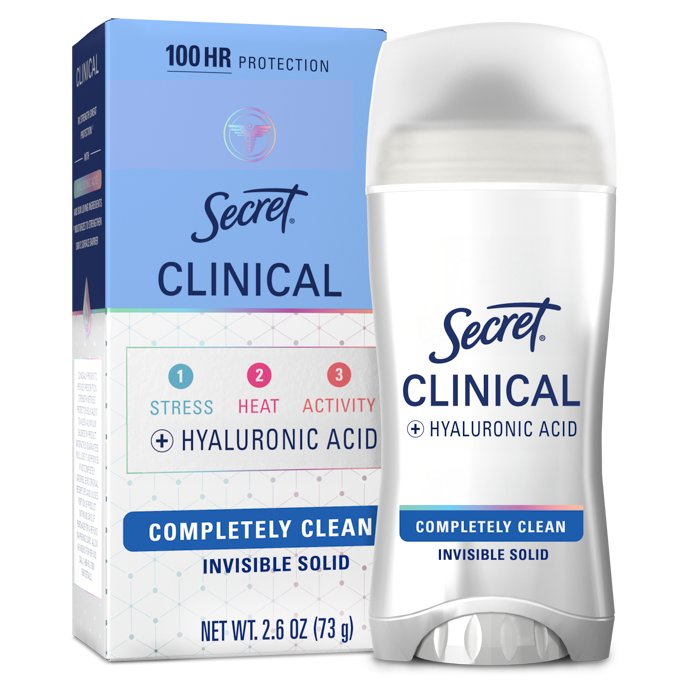
| Secret Clinical Completely Clean Invisible Solid | OTC drug | Aluminum zirconium tetrachlorohydrex gly 20% | Antiperspirant | Yes (the Use line says so) |
| Mitchum Women's Advanced Invisible Solid Clean Control | OTC drug | Aluminum zirconium tetrachlorohydrex gly 20% | Antiperspirant | Yes |
| Dove 0% Aluminum Deodorant Coconut & Pink Jasmine | Cosmetic | None (no Drug Facts panel) | Not applicable | No; the brand page claims 24 hour odor protection only |
| Native Deodorant Stick Coconut & Vanilla | Cosmetic | None (uses sodium bicarbonate and magnesium hydroxide for odor) | Not applicable | No; the brand page uses the word deodorant and never claims to reduce sweat |
The pattern lines up with the rule. Both antiperspirants carry the same aluminum salt. Both at 20 percent. Both on a Drug Facts panel that spells out: reduces underarm wetness. Both aluminum free products are cosmetics, and both honor the line in their copy. Dove's own page is unusually direct: it says the 0% Aluminum version offers 24 hour odor protection, and sends shoppers who want sweat control to a different Dove stick that still contains aluminum. Native does not use the word antiperspirant anywhere on its site and never claims to reduce sweat.
That's four products, four labels, and four answers that match the rule. It doesn't mean every brand on the market stays this honest. The lint check that matters at the shelf is still the back of the pack, not the front.
How do I tell them apart on the shelf, in two lines?
Flip the stick over. If there's a Drug Facts box, it's an antiperspirant. The Active Ingredient line will be an aluminum salt, almost always one of the aluminum zirconium gly compounds at 15 or 20 percent, and the Purpose line will read Antiperspirant. The Use line will say some version of reduces underarm wetness. If there's no Drug Facts box, it's a deodorant. The front of the pack can still shout aluminum free. It won't say antiperspirant anywhere the law can see.
That's the whole shelf test. Five seconds, no chemistry. I ran it on all four of the sticks in this post today and the labels tracked the rule exactly.
A couple of edge cases are worth flagging. A product labeled an antiperspirant deodorant is both a drug and a cosmetic in the same stick: aluminum for sweat, fragrance for scent. The Drug Facts box governs. A clinical strength antiperspirant is still an antiperspirant under the same monograph. Clinical isn't a legal grade of its own. It is a positioning around 20 percent aluminum zirconium with a specific application protocol: apply at night, let dry, then apply again in the morning. FDA doesn't define the word clinical for this category, so a brand's claim to prescription equivalence or 48, 72 or 100 hour protection is a marketing claim, not a monograph claim. The Drug Facts panel is the honest line.
What about kidney disease and sensitive skin?
One warning on every antiperspirant Drug Facts panel reads: Ask a doctor before use if you have kidney disease. That isn't boilerplate. The 2003 monograph requires it for a specific reason. People with impaired kidney function clear less aluminum, and FDA concluded the warning should sit on the label whether or not the applied dose would, by itself, create a problem. If that applies to you, follow the warning on the panel.
A second note belongs here for sensitive skin. Aluminum salts can cause an irritant contact reaction in a small share of users; baking soda, used in a lot of aluminum free sticks, can cause an irritant reaction of its own, especially after shaving. Neither is an allergy in the strict dermatological sense; both are just chemistry meeting skin. If a stick stings or leaves a red stripe, that's a signal to try a different active class, not a verdict on either category. The hypoallergenic label is not a medical term; a product can carry it and still trigger a reaction, because no one defines the word for the shelf.
Then what about the aluminum worry itself?
Here's the honest answer. The research hasn't landed where either side of the aluminum argument wants it to.
The NCI reads the breast cancer studies as negative. The 2017 Morphologie review reads the Alzheimer's work the same way, with the caveat that larger epidemiology would help. FDA has kept the aluminum actives on the Part 350 list through two restatements of the rule and has not moved to pull them. People with kidney disease, who clear less aluminum, get a dedicated warning on the Drug Facts panel itself. For everyone else, the choice sits between a drug that does reduce sweat and a cosmetic that does not, with no proven safety reason to pick one over the other. The reason to switch, if there is one, is comfort, scent, how a product feels on skin, or an irritation reaction, not a verdict the research has delivered.
That matters because the word natural, on the front of a lot of aluminum free sticks, is doing exactly the same job as the word antiperspirant on the back of an aluminum one: it's a positioning word, not a defined one. The whole point of reading the actual label is that the shelf copy is the brand's story, and the Drug Facts panel or the ingredients list is the receipt. Pick the receipt.
One more small thing. The Drug Facts panel's Use line is a tight sentence a brand doesn't get to rewrite. If it says reduces underarm wetness, FDA has reviewed that claim. If a stick's front promises to stop sweat for 100 hours or match prescription strength, the front of pack claim lives outside the monograph. It can be true, it can be puff, it can be a lab test under conditions a user will never match. The monograph language is the one FDA signed off on.
None of this is a reason to hoard aluminum or to fear it. It's a reason to read the back of the pack.
One day Skinventry's app will show you which bucket a stick sits in the second you photograph it, whether the container holds an OTC drug or a cosmetic, which aluminum salt sits at the top of the Drug Facts panel, who makes the stick, who owns the brand, and the public record on the active, each line with its source. Until then, the Drug Facts box on the back of the pack is the whole answer.
How we read these labels
I pulled the Drug Facts panels for the Secret Clinical Completely Clean Invisible Solid and the Mitchum Women's Advanced Invisible Solid Clean Control from DailyMed on Oct 29, 2026, and I fetched the Dove 0% Aluminum Deodorant Coconut and Pink Jasmine and Native Deodorant Stick product pages on the brands' own sites the same day. I cross checked every active on every label against the FDA list in 21 CFR Part 350, read live in eCFR.
The two antiperspirants carry 20 percent aluminum zirconium tetrachlorohydrex gly on the Drug Facts panel. Both labels print the same Purpose line, Antiperspirant, and the same Use line, reduces underarm wetness. Both carry the kidney disease warning the monograph requires. The two aluminum free products carry no OTC active at all. The Dove page explicitly contrasts its 0% version with its aluminum containing antiperspirants. The Native page uses the word deodorant throughout and does not use the word antiperspirant anywhere on the product page I read.
Primary sources: 21 CFR Part 350 on eCFR, FDA's administrative order M019, FDA's rulemaking history, DailyMed labels for Secret Clinical and Mitchum, and the Dove and Native brand pages. The National Cancer Institute's antiperspirant fact sheet and the 2017 Morphologie review on PubMed cover the safety research.
