Whole body deodorants are cosmetics, not drugs. FDA's antiperspirant rule reserves that word for products whose active ingredient is an aluminum salt, and not one whole body brand has one. They can blunt the smell. They can't stop the sweat. We read the ingredient lists of Lume, Dove, Native and Secret on November 14, 2026, and each one reaches for a different chemistry to try.
Walk down the deodorant aisle this fall and half the shelf now says "whole body." None of those packs says "antiperspirant." That's not a design choice. It's the law.
You're not imagining the explosion. Google searches for "whole body deodorant" surged 1,000% between March 2023 and March 2024, per Berlin Packaging's 2024 category review. The whole US deodorant aisle is a $5.3 billion market that grew 9.2% in dollar sales for the 52 weeks ending September 8, 2024, Circana told Beauty Matter, and "whole body" is the line item driving the lift.
If you've typed whole body deodorant does it work into Google, you've found a split answer. The brands say yes, 72 hours of odor protection, for pits, privates and beyond. The American Academy of Dermatology, in guidance last reviewed May 16, 2025, says most people don't need one and that nobody should actually apply one to their whole body. Both can be true. What a whole body deodorant does isn't what its name promises, and the reason sits in one line of a federal rule most shoppers will never read.
So we read the labels.
Four of the best selling whole body products on US shelves, on each brand's own product page, on one date. The chemistry on those labels is the whole story.
The one word the pack can't carry
A deodorant and an antiperspirant are two different kinds of product in US law. FDA's final monograph for over the counter antiperspirants, codified at 21 CFR 350.3, defines an antiperspirant as "a drug product applied topically that reduces the production of perspiration (sweat) at that site." The word drug is doing a lot of work there. Only a drug product can carry the claim, and only certain active ingredients can be in a drug. The monograph's list of accepted actives is almost entirely aluminum salts: aluminum chlorohydrate, aluminum zirconium tetrachlorohydrex gly, aluminum sesquichlorohydrate and a few others, each at a capped concentration, each with a required Drug Facts panel and a required warning about kidney disease on the back of the box.
A deodorant has none of that. It's a cosmetic in FDA's eyes, so it doesn't need Drug Facts, doesn't need a monograph active, doesn't reduce sweat and can't say it does. It can mask or neutralize odor. That's the whole difference, and it was the whole subject of the aluminum free deodorant and antiperspirant post we published two weeks ago.
Here's where whole body changes things, and where we went looking.
Aluminum chlorohydrate works in the underarm. It's tested there, approved there, sold there. There's no monograph for a drug that reduces sweating in the groin, under the breasts or between the thighs. A brand that wanted to sell one would have to pick an active, submit the testing and win an FDA review. Nobody has. So any product that says "whole body" has to be a cosmetic, which means it has no aluminum, which means it doesn't stop sweat. You can prove it on every pack we looked at: no Drug Facts panel, no active ingredient listed above the brand copy, no "ask a doctor if you have kidney disease" warning. The pack sells odor control. It doesn't sell dryness.
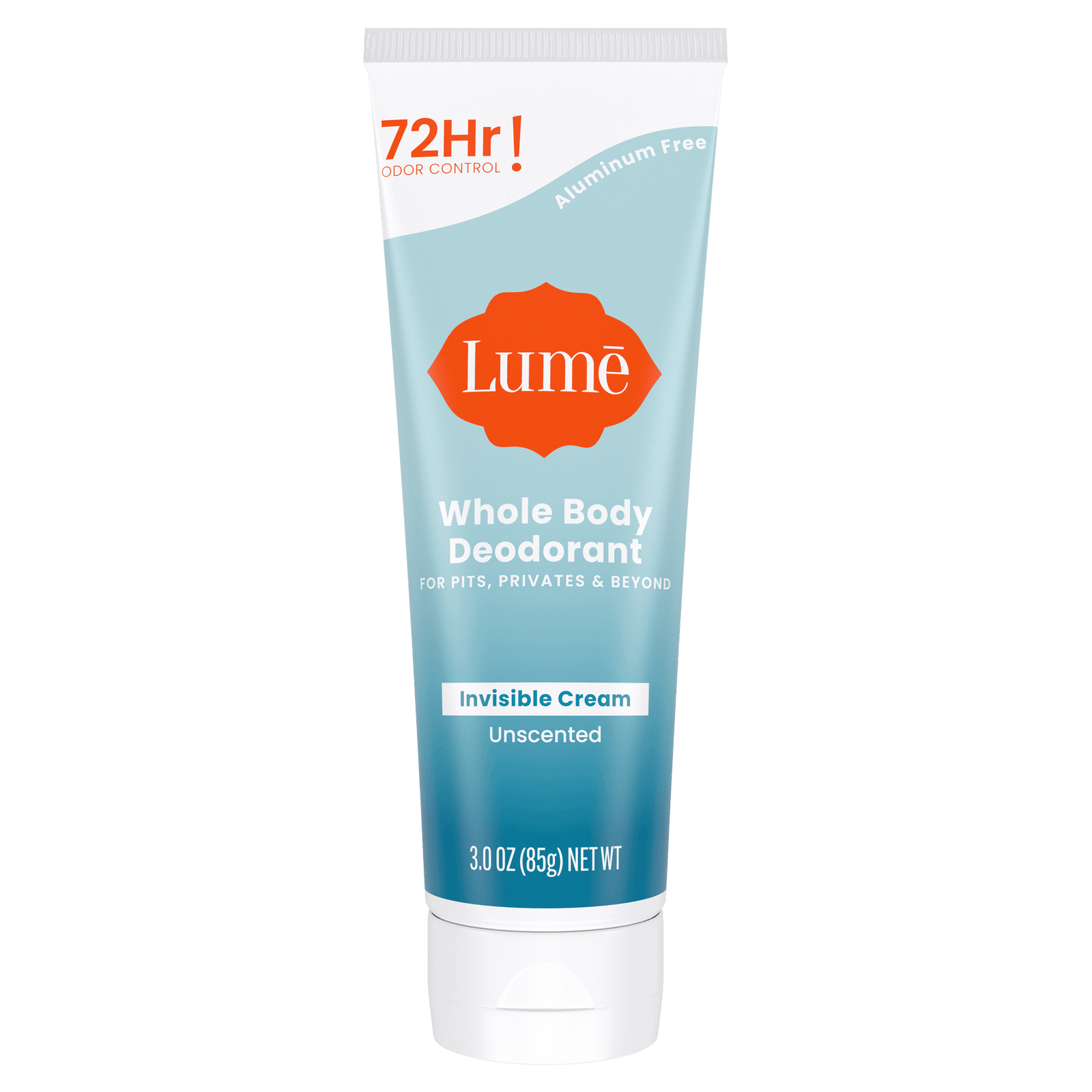
That's why the little "aluminum free" line on the front of a Lume tube isn't a virtue signal. It's a confession. It's what tells you, if you know to look, that the product's a cosmetic. The shoppers who want less sweat are being asked to read for a word the pack is required to leave off.
What's actually in a whole body deodorant tube?
We read the ingredient lists of four of the best selling whole body products on US shelves on November 14, 2026, each on its brand's own product page where we could. I pulled every label myself. Four different brands, four different odor fighters, zero drug actives.
| Product | Odor ingredient | Where it sits on the label | Active drug? |
|---|---|---|---|
| Lume Whole Body Invisible Cream, Unscented | Mandelic Acid (AHA) | Ingredient 2 of 28 | No. No Drug Facts. |
| Dove Whole Body Invisible Cream, Coconut & Vanilla | Lactic Acid (AHA) | Dove's own copy: "lactic acid to neutralize odor before it starts" | No. No Drug Facts. |
| Native Whole Body Stick, Vanilla & Raspberry | Magnesium hydroxide, magnesium carbonate, piroctone olamine | Ingredients 4, 8 and 11 of 14 | No. No Drug Facts. |
| Secret Aluminum Free Whole Body Stick, Unscented | Magnesium hydroxide, magnesium carbonate, piroctone olamine | Ingredients 3, 7 and 8 of 8 | No. No Drug Facts. |
Four brands, three odor strategies.
The Lume approach is to drop the skin's pH with mandelic acid, an alpha hydroxy acid that lowers the environment the odor bacteria like to grow in. That's why the Ulta listing for the Lume cream carries the standard AHA warning, which is required by law on any cosmetic that uses one at a level that affects sun sensitivity: "This product contains an alpha hydroxy acid (AHA) that may increase your skin's sensitivity to the sun." You won't read that on an antiperspirant, because antiperspirants aren't AHAs.
Dove uses the same category, a different acid: Dove's own product page says the cream uses "lactic acid to neutralize odor before it starts." Lactic acid is older in skincare and shows up in acne and body washes; the Dove page doesn't list a percentage, and no Drug Facts panel is present. Native and Secret go the other way. Both skip the acid and reach for a pH buffer plus an antifungal: magnesium hydroxide and magnesium carbonate raise the skin's surface pH slightly, which the brand pages frame as "pH balancing," and piroctone olamine is an antimicrobial you'll recognize from anti dandruff shampoos, where it's used to knock back Malassezia. Patents in the deodorant space describe piroctone olamine as a workable antimicrobial that often doesn't perform well on its own, which is why it's paired with the magnesium compounds here.
None of this is a sweat blocker.
The acids and the antimicrobials go after the bacteria on the skin, not the glands under it. You can still sweat exactly as much as you did yesterday. If the odor is better, it's because the bacteria that break sweat down into the smelly volatile acids didn't multiply the way they usually do.
What does the microbiome research actually say?
Human sweat is mostly water, salt and a little urea; on its own, it doesn't smell. The smell comes from what happens after. Skin bacteria, especially Staphylococcus and Corynebacterium species, break the longer, odorless molecules in sweat into short chain acids and thioalcohols, and those are the volatile compounds your nose picks up. Chris Callewaert at Ghent University is the researcher who mapped much of this, and his 2013 PLoS ONE paper profiled the armpit microbiomes of 53 healthy subjects. Two patterns stood out. The armpits dominated by Staphylococcus produced less odor; the ones dominated by Corynebacterium produced more. And deodorant use had a measurable, roughly linear influence on the species diversity of the armpit microbiome. In other words, a deodorant does change the garden, and the direction of the change matters.
That's why an AHA can make sense as a deodorant. Corynebacterium species don't grow well in a slightly more acidic skin environment, and dropping the local pH is a way to tip the balance toward Staphylococcus, which produces less of the thioalcohols that smell. Mandelic acid has a milder, more lipid soluble profile than glycolic or lactic, which is part of why Lume picked it. None of this is miraculous, and none of it reduces the amount of sweat. It reshapes what the sweat meets on the way out.
The limit of that research is the limit of this post.
The axillary microbiome has real clinical literature. The groin and the under breast skin don't, because almost nobody has studied them at this depth. A product that moves the pH of your underarm has been tested there, in people; a product that moves the pH of your inner thigh hasn't. That's a gap the brands don't advertise.
So does whole body deodorant actually work?
If the question is "will it stop my pits from being wet," no. No whole body deodorant is an antiperspirant, which means not one of them reduces sweat. If you want less sweat under your arms, you want an aluminum salt at a monograph strength, and you want the Drug Facts on the back to say so. You won't get that in a tube that says whole body.
If the question is "will it keep me from smelling," the honest answer's sometimes, in some places, on some people. The AHAs and the magnesium plus piroctone systems have plausible mechanisms. There are clinical trials on whole deodorant formulations claiming 72 hours of odor control; those are company sponsored trials and they're not the same thing as an FDA sweat reduction endorsement. The AAD's own guidance says the products do work as odor control but they aren't necessary for most people, and you should only apply them where the odor actually starts. That's the opposite of whole body.
The dermatology side has been even blunter.
Dr. Karan Lal, a board certified dermatologist, told CBS News in 2024 that whole body deodorants are "not necessary at all" for most people. Dr. Jeanine Downie, in the same reporting, said many of her sensitive skin patients find the whole body versions irritating. The AAD also warns against using fragranced versions in the groin, where it can hide a sign of something a doctor would want to see, like a bacterial infection. None of that is a verdict on the brands. It's a line about where the chemistry fits.
Who is a whole body deodorant actually for?
The honest fit is narrow.
If you have real odor in a place where regular deodorant doesn't go, feet, groin, the fold under a breast, back during summer, a whole body deodorant is a reasonable thing to try. Lume built the category on exactly that case. If you want less sweat, these are the wrong products. You want an aluminum antiperspirant, and you want the one that prints its monograph active on the back.
Three practical things to check on any whole body pack you're holding. One: is there a Drug Facts panel? If no, you're holding a cosmetic. It won't reduce sweat, whatever the ad promises. Two: what's the odor ingredient? An AHA (mandelic, lactic, glycolic) works by lowering skin pH. A magnesium hydroxide system works by buffering it. Both target bacteria, not glands. Three: where's the fragrance? Whole body products are often fragrance heavy, and fragrance is a leading cause of underarm and groin dermatitis. The label hygiene is the same as seven buzzwords FDA has never defined: if a term isn't in a monograph, the brand gets to choose what it means. If you've ever reacted to a scented product, choose the unscented version, and read the label; several "unscented" sticks still contain masking fragrance.
And the 1 percent line. These acids aren't usually listed by percentage, because they're cosmetics. Mandelic sits as the second ingredient in the Lume cream, which in cosmetic labeling is a strong signal of a working level; lactic sits further down in the Dove cream, with the brand copy doing the heavy lifting. Where the active falls on the list isn't a guarantee of how much is in there, but it's the only clue a cosmetic's required to give you.
The verdict in plain words
Yes, it works as a deodorant. No, it isn't an antiperspirant. A whole body pack can reasonably control odor in places a regular stick doesn't reach, and the four brands we read use different chemistry to try. None of them can be called an antiperspirant, because a federal rule reserves that word for drugs that reduce sweat, and the only approved drug actives for that job are aluminum salts you won't find on a whole body label. The AAD doesn't want you to use it on your whole body. Use it where you need it, if you need it, and read the pack for what it quietly leaves out.
If you want to read further
Three things worth your time while writing this. The AAD's "Should I use whole body deodorant?" page is the plain, reviewed guidance from three board certified dermatologists, last updated May 16, 2025. The text of 21 CFR 350.3 is the federal definition of antiperspirant; 350.10 lists the approved actives and 350.50 is the required labeling with the kidney disease warning you won't see on any whole body pack. And Callewaert et al.'s 2013 PLoS ONE paper on the axillary microbiome is the piece of real science under the marketing word "neutralize."
Photograph any of these products and Skinventry shows the published ingredient list, names the maker and the owner, and lists what the label claims, each with its source. For the Lume tube above, that means the mandelic acid near the top of the list, the Harry's Inc. parent company behind the brand, and the "72 hour odor control" claim shown with no "reduces perspiration" wording, because by law a cosmetic can't carry one.
