The word eczema on a US cream is an FDA drug claim earned by colloidal oatmeal, not by ceramides. I read 4 adult eczema creams on DailyMed on November 25, 2026. Only CeraVe Eczema Relief Moisturizing Cream lists all three ceramides of the barrier lipid family. La Roche Posay Lipikar Eczema Cream lists zero. If the ceramide load is what you actually want, CeraVe is the pick.
Of 4 eczema relief creams I pulled on DailyMed on November 25, 2026, every one carries the same active ingredient: colloidal oatmeal 1 percent. The actives are identical. The inactives are not.
That is the first thing to know if you came looking for the best eczema cream with ceramides. The word eczema is not a marketing claim on a US cream. It is an FDA drug claim, finalized in 2003 and effective June 4, 2004, and the way a cream earns it is by containing an approved skin protectant like colloidal oatmeal, allantoin, white petrolatum, dimethicone or glycerin. Ceramides are not on that list. So the cream that calls itself an eczema cream is really an oatmeal cream. The ceramides are a bonus, not the reason the box uses the word.
That's what we were looking for when we read the labels.
What makes a cream an eczema cream in the first place?
Under the FDA's 2003 review that became 21 CFR part 347, a short list of ingredients can carry the skin protectant drug claim. Colloidal oatmeal is one of them. If it sits in a cream at 0.007% to 1.5%, the label can say the cream temporarily protects and helps relieve minor skin irritation and itching due to eczema. The claim stops there. It doesn't say the cream treats atopic dermatitis as a disease. The American Academy of Dermatology puts moisturizers in the first row of care, and prescription treatment with a board certified dermatologist in the next row when moisturizers are not enough.
Every one of the 4 creams I read runs oatmeal at exactly 1 percent. That's the top of the monograph's allowed range. It's what buys them the right to print the word eczema.
Ceramides do a different job. They are the lipid matrix the outer skin uses to hold water in and irritants out, built into the structure as the skin layer forms. In a 1996 study that still anchors the field, Man, Feingold, Thornfeldt and Elias at UCSF reported that applying any single lipid alone actually delayed barrier recovery, and that only a mixture of all three lipid families at a roughly equal molar ratio restored the barrier at full speed. It takes ceramides, cholesterol and free fatty acids together, in a roughly equal ratio, to get the fastest recovery. A cream with one ceramide isn't the same as a cream with three.
What we checked, and how
Of the 4 labels we read on DailyMed on November 25, 2026, every one is a US OTC drug product under the FDA skin protectant monograph. We pulled the Drug Facts panel and the full inactive ingredient list for each cream on DailyMed, the US National Library of Medicine's labeling database. For each label we counted how many ceramides were listed, in which positions, and whether the cream carried the National Eczema Association Seal of Acceptance. We verified the Seal status against the NEA's product directory, which currently lists more than 300 accepted skincare products. We compared what the box advertises to what the ingredient list actually proves. No cream was tested on anyone's skin. The labels are the whole evidence here.
Which ceramides are on each label?
This is where the four come apart.
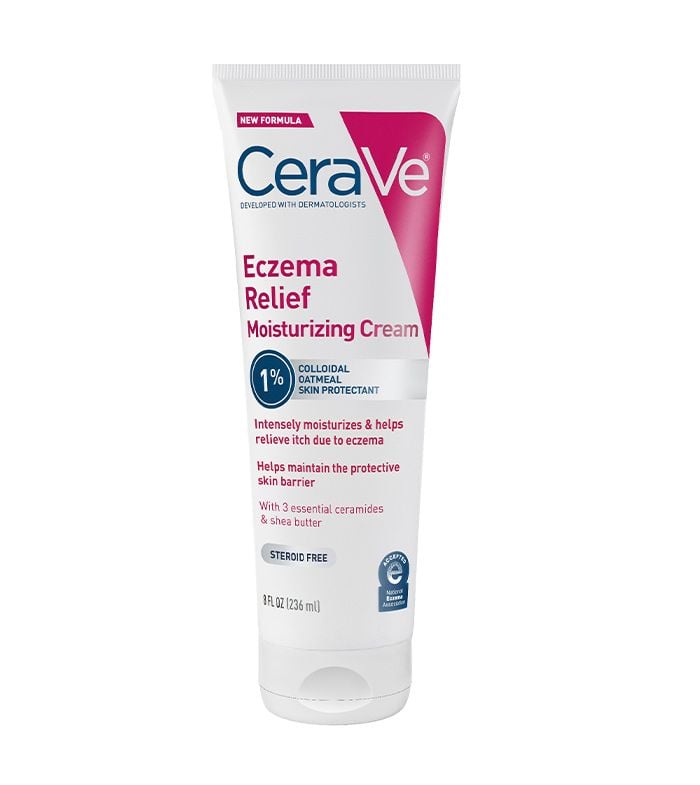
CeraVe Eczema Relief Moisturizing Cream. Its DailyMed label lists three ceramides, ceramide NP, ceramide AP, and ceramide 1 (which is also called ceramide EOP). That is the full trinity, which matches the family UCSF named in 1996. The cream also lists allantoin, niacinamide and hyaluronic acid as inactives. The active is colloidal oatmeal 1 percent.
Aveeno Eczema Therapy Daily Moisturizing Cream. Its label lists one ceramide, ceramide NP. The rest of the barrier work falls on panthenol, petrolatum, dimethicone and two oat forms (oat kernel oil and oat kernel extract). The box reads, verbatim from the label text in DailyMed: Colloidal Oatmeal and Ceramide, singular. The cream is a Seal holder and prints the National Eczema Association mark on the box.
Eucerin Eczema Relief Flare Up Treatment Cream. Its label lists one ceramide, called ceramide 3 on this label, which is the older name for ceramide NP. The box leans on licorice root extract for soothing and on oat kernel oil for the lipid side. Steroid free is printed in large type. The active is colloidal oatmeal 1 percent.
La Roche Posay Lipikar Eczema Cream. Its label lists zero ceramides. The inactive panel runs shea butter, glycerin, dimethicone, mineral oil, niacinamide, rapeseed seed oil and shelf ingredients. If you came for ceramides, this isn't the cream for the job, even though the brand's a dermatologist favorite for sensitive skin.
Count the ceramides and the field sorts itself. CeraVe has three. Aveeno and Eucerin have one each. Lipikar has none.
Does three ceramides beat one? In barrier repair chemistry, yes. The UCSF group's finding in The Journal of Investigative Dermatology is that it's the combination of the three lipid families, not the ceramide alone, that moves the clock on recovery. A single ceramide helps. A full set helps more. Cheap enough to settle: pick the one with all three if you want the chemistry the research describes.
Which creams carry the National Eczema Association Seal?
The Seal of Acceptance is the second filter. The NEA site is plain about what it requires. A Seal product cannot contain fragrance. It cannot contain UV absorbers. It cannot contain formaldehyde releasers. It must be clear of the NEA exclusion list, which the association maintains, and it has to pass sensitivity and irritation testing the brand pays for. The Seal does not require ceramides. It does not require any one ingredient at all. What it does is screen out the ingredients most likely to flare eczema prone skin.
Three of the four creams I read carry the Seal on the current NEA directory: CeraVe Eczema Relief Moisturizing Cream, Aveeno Eczema Therapy Daily Moisturizing Cream, and the Eucerin Eczema Relief line. La Roche Posay's Lipikar family is not listed under the eczema specific Seal directory as of today, though several non eczema Lipikar skus carry it. That's a dated finding, so by the time you read this it may have changed.
If a reader cares about the Seal more than the ceramide count, the field still points the same way. CeraVe and Aveeno both carry three ceramides or one, and the Seal.
Who is each cream for?
Look past the word eczema and the four creams aim at slightly different faces and bodies.
CeraVe Eczema Relief Moisturizing Cream is the fullest barrier formula of the group. Three ceramides, allantoin, niacinamide and hyaluronic acid, plus the oatmeal active. It's a tub, it spreads thick, and it sits well under cotton. The texture is a lot of cream. Dry hands in winter, dry patches on arms and shins, kids old enough to apply their own cream: this is the shape of the use case. The reader who wants ceramides, not just the word on the box, is the reader who picks it.
Aveeno Eczema Therapy Daily Moisturizing Cream is the oldest and most studied of the group. The company has run multiple published trials of colloidal oatmeal and the formulation has carried the NEA Seal for years. One ceramide, lots of oat, petrolatum in the mid part of the list for occlusive hold. If a reader's eczema responds to oats, it responds to this.
Eucerin Eczema Relief Flare Up Treatment is the lightest tubed cream of the four. Licorice root, one ceramide, no fragrance. Fitted to a face that flares and then clears, and to a reader who wants a tube instead of a tub.
La Roche Posay Lipikar Eczema Cream is a different animal. The brand's dermatologic reputation is real, but the ceramide content on this US sku is zero. It leans on shea butter, glycerin and niacinamide. If a reader wants the brand and does not mind trading ceramides for shea and niacinamide, this is still a real option. If ceramides are the reason to shop, this is not the right Lipikar.
The verdict
For the question people are actually typing (best eczema cream with ceramides): CeraVe Eczema Relief Moisturizing Cream, by the labels I read. It is the only one in the group that carries all three ceramides of the barrier lipid family on its US ingredient panel, and it still carries the oatmeal that earns the eczema claim and the Seal that screens out the fragrance and formaldehyde releasers eczema prone skin reacts to. The runner up is Aveeno Eczema Therapy, for a reader whose flares respond to oat and petrolatum. Eucerin is the tube pick. Lipikar is the one to leave on the shelf if the ceramide list is what you are shopping for.
The caveat
A cream is a moisturizer. It isn't a prescription. If a flare lasts past a week, if the skin is cracked or weeping, if a child is involved, the next step is a board certified dermatologist, not another cream. A barrier moisturizer with the right lipids helps the baseline and reduces how often a flare happens. It doesn't cure atopic dermatitis and it isn't a steroid. The AAD lists topical steroids, calcineurin inhibitors and newer JAK inhibitors among the treatments that actually move severe disease, and those are a conversation with a clinician, not a drugstore choice. Also true: a single ingredient list isn't a trial. It tells you what's in the cream. It doesn't tell you how your skin will react to this specific formula. A patch test on the inside of a forearm for a few days is cheap and worth it.
How these creams compare, at a glance
| Cream | Active (FDA) | Ceramides on the US label | NEA Seal | Best for |
|---|---|---|---|---|
| CeraVe Eczema Relief Moisturizing Cream | Colloidal oatmeal 1 percent | 3 (NP, AP, 1 / EOP) | Yes | The reader who wants ceramides, not just the word |
| Aveeno Eczema Therapy Daily Moisturizing Cream | Colloidal oatmeal 1 percent | 1 (NP) | Yes | Flares that respond to oat and petrolatum |
| Eucerin Eczema Relief Flare Up Treatment Cream | Colloidal oatmeal 1 percent | 1 (ceramide 3, which is NP) | Yes (line) | A face that flares and clears, tubed cream |
| La Roche Posay Lipikar Eczema Cream | Colloidal oatmeal 1 percent | 0 | Not on the eczema sku | Shea and niacinamide users who do not care about ceramides |
What can a cream with ceramides actually fix?
A ceramide containing moisturizer sits on top of what your skin is already doing. It can slow water loss. It can feed the lipid matrix. It can reduce how tight and flaky the skin feels. It can make a flare shorter and milder when it comes. That is a lot. It is also the ceiling.
A cream can't reach the immune part of atopic dermatitis. It can't fix a filaggrin gene variant, which is one of the main reasons some people have eczema and others don't. It can't replace a topical steroid for an open, red, actively inflamed patch, and it can't replace a prescription when a reader needs one. The Elias lab's lipid trinity work is a blueprint for barrier repair, not for disease remission. The AAD's own 2024 treatment review is honest about that order of operations: moisturizer first, prescription next, both together when the case needs both.
So the right question for a reader shopping ceramides is not "which cream will cure my eczema" but "which cream gives my skin the most help to hold onto its own water and lipids between flares". For that question, the ceramide count on the label is real evidence.
Three things I read while writing this
- The FDA Skin Protectant Final Monograph, which is the rule that lets a cream print the word eczema.
- The 1996 Man, Feingold, Thornfeldt and Elias paper, the study that made ceramides, cholesterol and fatty acids the mortar story every skincare brand tells now.
- The National Eczema Association's Seal of Acceptance program page, the one place the Seal's criteria live in plain words.
If you want more on the lipid trinity and why one ceramide is not the whole answer, we wrote the barrier cream post last year on the dermatologist consensus that landed on the same 23 ingredients, including the ceramide family. If you want the oatmeal half of the claim, we also read five oatmeal creams against the monograph in this piece. For the broader question of what label words a brand is allowed to use without any rule telling it what the word means, start with the seven buzzwords FDA has never defined.
Skinventry is built for exactly this kind of label read. Photograph any of these creams and the app pulls up the US Drug Facts panel, the full inactives in order, the parent company behind the brand and the public record, each line sourced. The ceramide count on the box, the Seal status, the FDA active and the owner chain all sit on one card, so the shopper never has to pull the DailyMed label herself. That is the shape of what the app does.
