For dry skin in your forties or fifties, the $182 Medik8 R-Retinoate Day & Night cream is a defensible retinyl retinoate pick, with a published clinical trial behind the molecule. The catch is that it isn't occlusive enough alone in winter, and the original 2010 clinical trial used a higher dose. Skip it if you're under 35 and retinol still works.
Is a single $182 Medik8 cream worth it for dry skin in your forties? The honest answer is more interesting than yes or no.
Start with the evidence. The 2010 trial in the British Journal of Dermatology that put the molecule on the map ran for twelve weeks at 0.06% and showed it outperforming both retinol and placebo on periorbital wrinkles, with no severe side effects.
What is retinyl retinoate, and how does it differ from retinol?
Retinyl retinoate is a hybrid molecule. Retinol bonded to all trans retinoic acid through an ester linkage. Synthesised at a Korean cosmetic chemistry lab in the late 2000s, it was designed to be more photostable than retinol (which oxidises within days of opening the bottle) and less irritating than tretinoin (which still requires a prescription in most countries).
The mechanism splits the difference. Once it crosses into a keratinocyte, intracellular esterases cleave the bond. You end up with one molecule of retinol and one of retinoic acid, ready to act. A 2012 study indexed on PubMed showed that the same molecule, encapsulated in a biodegradable polymer microsphere, kept producing measurable wrinkle change in human skin over an eight week course.
The cleaner argument for dry skin sits in the hyaluronic acid data, not the wrinkle data. A 2010 study found retinyl retinoate upregulated hyaluronan synthase 2 mRNA in keratinocytes more than retinol or retinaldehyde. Translation: it tells your skin to make more of its own moisture, not just hold borrowed water for an afternoon.
That matters when your barrier is already thin. If you've read the full retinoid guide, the takeaway was that the right vitamin A for dry skin is the one your skin can use without breaking. Retinyl retinoate fits that brief on paper. Whether it earns $182 in practice is a different question.
How does the Medik8 formula read on dry skin?
I pulled the INCI list for the R-Retinoate Day & Night Youth Activating Cream and read it the way a formulator would.
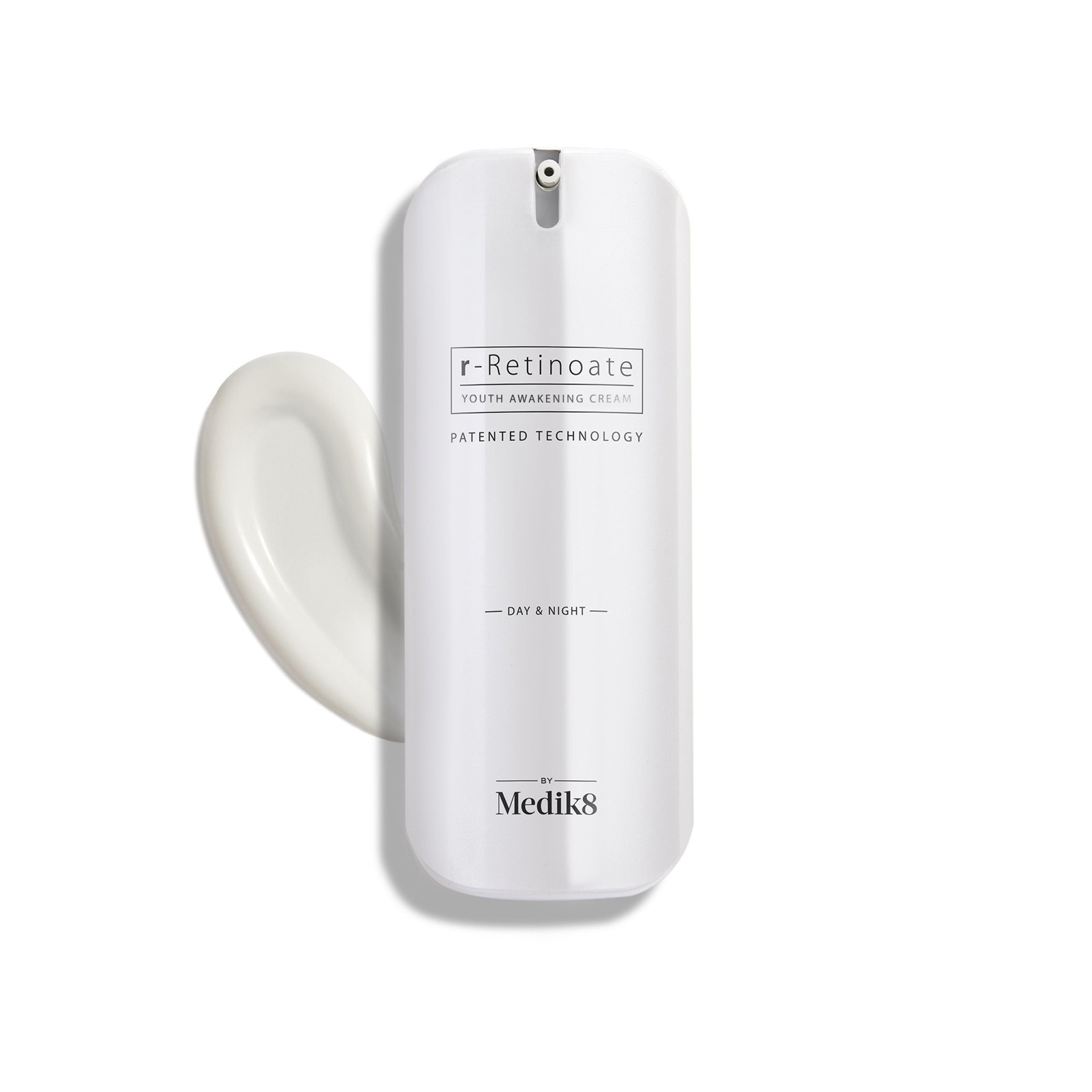
Water leads. Then comes heptyl undecylenate (an emollient with a dry slip finish), followed by caprylic capric triglyceride, a light skin softener derived from coconut. Polylactic acid sits fourth, which is unusual. It's the same biodegradable polymer used in PLLA injectable fillers, and in topical use it acts as a film former. After that you get cetearyl olivate (the emulsifier that holds the oil and water phases together), a few thickeners, then sodium hyaluronate, sorbitan olivate, and the retinyl retinoate itself.
The active sits mid list, after eleven other ingredients. For a cosmeceutical active that's roughly where you'd expect it. The Day & Night cream uses 0.05% retinyl retinoate. The Intense version doubles that to 0.1%.
Two formulation choices matter for dry skin. First, the emollient backbone is light. There's no shea butter, no petrolatum, no lanolin. The polylactic acid film gives some occlusive feel but it's not a true occlusive in the dermatological sense. Second, the cream contains two vitamin C derivatives lower down (tetrahexyldecyl ascorbate and ethyl ascorbic acid), which boosts the antioxidant story but also lowers the pH tolerance of the formulation. In a humid August, that's fine. In a very dry winter, it isn't enough on its own.
What Medik8 actually claims about R Retinoate
Medik8 calls the molecule an 8x more powerful form of vitamin A than retinol. The brand's US product page cites both internal studies and the 2010 Kim trial. They recommend Day & Night for first time vitamin A users and Intense for users who've already tolerated 0.5% retinol or 0.05% tretinoin.
Two of their claims are anchored to public data. The wrinkle improvement number traces back to the British Journal of Dermatology paper. The hyaluronic acid synthesis claim traces to the same author's follow up work. The third claim, that retinyl retinoate is eight times more powerful than retinol, comes from in vitro receptor binding affinity. That doesn't translate one to one to skin level efficacy. It's the kind of number a chemist would write and a marketing department would amplify.
The 50 millilitre tube retails for $182 on Medik8's US site as of June 2026. Sephora UK lists it at £165. Caretobeauty ships it to the US for roughly $130. Price tells you the molecule cost more to license and synthesise than retinol, not necessarily that the cream contains more of it.
What dermatologists say about the price
I went looking for what working dermatologists actually tell patients who ask about retinyl retinoate. Dr. Whitney Bowe lays out her position on her clinic's blog: retinyl retinoate is the form she points patients toward when prescription tretinoin produced too much peeling, on the basis that it delivers wrinkle improvement without the irritation that drives so many patients to quit retinoids altogether. For that group, the premium is defensible. The opposite case is one Dr. Adeline Kikam and other teledermatology educators have been making for years. Encapsulated retinol at 0.5% from a $40 drugstore brand covers the same ground for most users, and the retinyl retinoate premium only earns its keep when the cheaper retinoid has already failed. Both views can be true at once. The first reader has already tried retinol and reacted. The second hasn't.
What the formula leaves out
Medik8's formula stays narrow on purpose. Vitamin A, two vitamin C derivatives, hyaluronic acid, a polylactic acid film, and an emollient base. Nothing extra. There is no niacinamide or panthenol in it. Read the 23 barrier ingredients dermatologists actually agreed on if you want the case for niacinamide as a co star. And if you're going to pay a premium for the molecule, you should at least know how much of it you're buying.
Where it falls short for dry skin
This is the honest downside.
The R-Retinoate Day & Night is not a winter moisturiser by itself. The emollient phase is too light. If you live in a climate where indoor heating runs October through April, you need to layer it. A thin layer of squalane oil, an even thinner layer of petrolatum (Vaseline), or a ceramide cream on top can close that gap.
Dry skin readers who want one product that does everything will be disappointed.
The other limitation is the dose. The original 2010 BJD trial ran at 0.06% retinyl retinoate. The Day & Night cream runs at 0.05%. Close, but not the trial dose. If you want the trial concentration you need the Intense (0.1%), and the Intense costs more. The label discipline that catches this stuff is the same one that protects you from underdosed retinol.
And the price. $182 for 50 millilitres is six weeks of CeraVe Resurfacing Retinol with $100 left over. If a $40 retinol works for you, it works. The Medik8 premium stops being defensible the moment you realise you don't need the upgrade.
So is it worth it?
For someone whose skin peeled on tretinoin or on encapsulated retinol, it can be. That is the group Dr. Bowe points toward retinyl retinoate, and a squalane seal on top handles the dryness.
If you buy it, choose the Intense rather than the Day & Night, because the dose is closer to the trial, and use the sandwich approach: a layer of moisturiser, the cream, another moisturiser on top. Budget for an occlusive overcoat for the months between November and March. The cream rewards a reader who knows what to do with it. It punishes one who doesn't. The question isn't whether it works. The question is whether you've already tried the cheaper retinoid that would have. Photograph the tube or type its name and Skinventry shows the published ingredient list, so you can see where retinyl retinoate sits, along with who makes it and who owns the brand, each fact labeled with its source.
