The best fragrance free physical exfoliant for sensitive skin is a fine rice or bamboo micro powder, not a gritty walnut scrub. Our top pick is Naturium Fermented Rice Enzyme Cleanser, about $18. Use it at night, twice a week. Skip anything that says parfum, linalool, limonene, or essential oil.
Reactive skin does not need better exfoliation. It needs less exfoliation, and it needs the abrasive scrub in your hand to be free of the ingredient that is causing your face to burn in the first place. That ingredient is often fragrance. About 12.8% of patients tested by the North American Contact Dermatitis Group between 2019 and 2020 reacted to fragrance mix I alone, making it the third most common contact allergen after nickel and methylisothiazolinone, per the 2023 NACDG report in Dermatitis.
Fragrance is the number one cause of allergic contact dermatitis from cosmetics worldwide, per a 2024 systematic review in Contact Dermatitis covering European patch test clinics. If your skin flushes or stings after a scrub, the abrasion probably isn't the villain.
The parfum is.
Gentle is a marketing word, not a formulation standard. The FDA has never defined it. What actually matters for reactive skin is particle geometry, the surfactant base, and whether the ingredient deck sneaks fragrance in through a botanical essential oil hiding under a Latin name. Our shortlist below rules those out.
Who is this guide for?
You react to fragrance. Maybe you've been patch tested and know it. Maybe you just noticed that new perfumed toner made your cheeks burn for three days. Either way, you want texture that lifts flakes without tearing your barrier, and you want to know the bottle in your hand doesn't carry a fragrance ingredient hiding under a synonym.
This guide is for adults 21 and older. If you have active rosacea flares, eczema plaques, or a compromised barrier that stings when water hits it, don't exfoliate at all this week. Read our barrier repair explainer first and come back when the sting is gone.
How did we pick?
We rejected any product that listed any of these on the label: parfum, fragrance, aroma, linalool, limonene, citral, geraniol, eugenol, farnesol, benzyl alcohol as a fragrance component, or an essential oil declared for scent (lavandula, citrus limon, cinnamomum, and so on). The 26 fragrance allergens the EU requires be listed on packaging above 0.001% in leave on products, per the EU allergen list at ECHA, are all disqualifiers.
Next we cut anything with denatured alcohol high on the list, menthol, camphor, or witch hazel with alcohol. Those aren't fragrance ingredients, but they compound reactivity in the same skin. The picks below also had to meet a second bar: particle geometry.
Particle geometry matters more than most reviews acknowledge. Walnut shell powder, apricot pit powder, and pumice are cheap and abundant. They're also irregularly shaped, and the American Academy of Dermatology warns that mechanical exfoliation may be too irritating for dry, sensitive, or acne prone skin. Reactive skin can't afford that. What we wanted instead was one of three particle types: perfectly spherical jojoba wax beads, ground bamboo silica, or ultra fine rice powder that dissolves during rinsing.
How did we compare them?
On paper. This guide compares published information: each pick's ingredient list, the brand's own fragrance claims, the particle type, and the price. Reactive skin should still try anything new on a small patch of skin before it goes near the face.
Our pick: Naturium Fermented Rice Enzyme Cleanser
Naturium's Fermented Rice Enzyme Cleanser is a cream cleanser, about $18 for a 4 ounce tube. The exfoliating particles are what Naturium calls biodegradable micro powders, jojoba esters and rice germ powder, in a base with fermented rice filtrate and fruit enzymes.
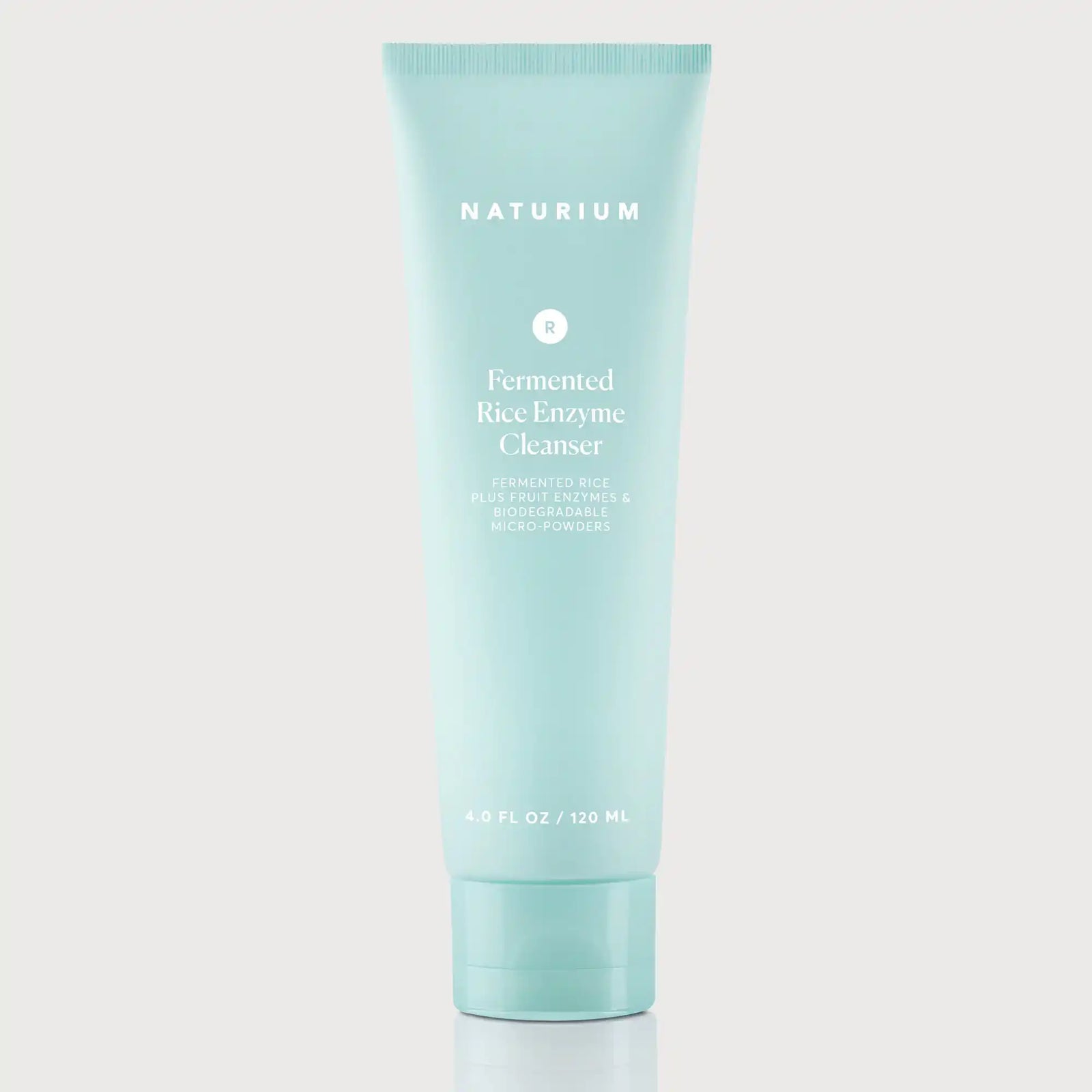
Naturium confirms this formula is fragrance free on the brand product page.
The one honest downside: this is a gentle polish, not a scrub, so anyone expecting grit may be tempted to press harder. Don't. Start with a pea sized amount and a light hand.
Runner up: DHC Face Wash Powder
DHC Face Wash Powder is a dry cleansing powder that foams when you add water, about $14 for a 50 gram pot, and the closest thing to a legacy formula on this list. DHC says it exfoliates with a protease enzyme that dissolves dead surface skin, so strictly it is an enzyme exfoliant, not a physical one.
The ingredient deck is short. No parfum. No essential oils. It does list lavender flower extract, which is not added fragrance but is worth knowing about if lavender is one of your triggers.
Why isn't it our top pick? Its exfoliation comes from an enzyme rather than a particle, so it is less of a scrub than this guide promises. If you want a physical polish, buy Naturium.
Also great as a tool: Foreo Luna 4 Sensitive
Foreo makes a silicone bristled cleansing device called the Luna 4 Sensitive. It costs $199. It isn't a scrub. It's a tool that combines with whatever cleanser you already trust, so the fragrance question moves off the exfoliant and onto the cleanser you pair with it.
Silicone is 35 times more hygienic than nylon bristles, per data Foreo published in a 2020 laboratory study. Silicone also can't harbor mold or bacteria the way nylon and boar bristle brushes do. For reactive skin that's a real feature.
The one caveat: it's a tool, not a treatment. If you pair it with a fragranced cleanser, you haven't solved the problem. You've just given the fragrance a better delivery vehicle.
Budget pick: colloidal oatmeal plus a soft washcloth
The cheapest fragrance free physical exfoliant on this list is not a product. It's a $3 canister of colloidal oatmeal from the pharmacy plus a soft flannel washcloth. Mix a teaspoon of oatmeal into your regular fragrance free cleanser, work it into a paste in wet palms, and buff gently with the washcloth as you rinse.
Colloidal oatmeal is one of the ingredients the FDA formally recognizes as a skin protectant. It calms histamine driven itch. Combined with the light abrasion of a woven cotton cloth, it hits the same target as a boutique powder scrub for a fraction of the price.
The tradeoff is time. You've got to mix it yourself, and the washcloth has to be washed hot after every use or it becomes a bacterial reservoir. If that sounds like too much friction, buy the Naturium.
Best pick for body: Aveeno Skin Relief Fragrance Free Body Scrub
Face and body have different needs. On the body, the stratum corneum is thicker and more forgiving. The Aveeno Skin Relief Fragrance Free Body Scrub, about $8, uses colloidal oat and a light dose of oat kernel flour as the abrasive. The base is glycerin heavy, which leaves the skin barrier hydrated rather than stripped. It's confirmed fragrance free on the National Eczema Association Seal of Acceptance database.
Don't use it on the face. The scrub particles are sized for legs and elbows, not cheek and jawline skin.
How the five picks compare
| Product | Price | Particle | Best for |
|---|---|---|---|
| Naturium Fermented Rice Enzyme Cleanser | $18 | Jojoba esters and rice germ powder | Overall face pick |
| DHC Face Wash Powder | $14 | Protease enzyme powder | Longtime users who want a legacy formula |
| Foreo Luna 4 Sensitive | $199 | Silicone bristles (a tool) | People who want a device, not a scrub |
| Colloidal oatmeal plus washcloth | $3 | Oat flour and cotton weave | Budget minded, willing to DIY |
| Aveeno Skin Relief Body Scrub | $8 | Colloidal oat plus oat kernel | Body only |
Should you use physical exfoliation in the morning or at night?
At night. Every time.
The reason is UV. When you exfoliate, you accelerate the shedding of the outermost stratum corneum, which is the layer that carries some of your natural photoprotection. Doing that in the morning and walking outside is asking for the exact hyperpigmentation you may be exfoliating to fade.
There's a second reason. Your barrier repairs itself overnight. Exfoliating at night gives the skin roughly eight hours of sleep, with the barrier fatty acids repopulating, before it faces UV or pollution again. Exfoliating in the morning gives it about forty minutes.
How often? For reactive skin, twice a week is the ceiling. Once a week is safer if you're already using retinoids or acids. Read our morning versus night routine breakdown for the full sequence.
What did we skip, and why?
We don't recommend the Dermalogica Daily Microfoliant on this list, though it comes up in every other reactive skin roundup. It's a rice bran powder in the same category as Naturium and DHC, and Dermalogica doesn't add synthetic fragrance. It does contain several botanical extracts and essential oils declared for skin benefit, including a lavender derived compound and citrus based ingredients that a fragrance allergic person may react to. If you aren't fragrance allergic and just have generally sensitive skin, Dermalogica is a fine pick. For the population this guide is written for, it isn't.
We also don't recommend St. Ives Apricot Scrub, Neutrogena Deep Clean Invigorating Foaming Scrub, or any drugstore scrub that lists walnut shell or apricot pit powder. Those particles are irregular in shape. A fragranced scrub with abrasive walnut is the worst possible combination for a reactive face.
Skip anything that says unscented, too. As our unscented label investigation covered in detail, the word unscented on a US cosmetic label often means masking fragrance was added to cover the raw material smell. Fragrance free means none was added at all. They aren't the same word.
The honest caveat
You might not need any of these products.
Board certified dermatologist Whitney Bowe, in a 2019 New York Times interview, said that most patients with sensitive skin overexfoliate, and that the correct frequency for many is zero times a week, not two. Your skin sheds cells on its own about every 28 days without intervention. If your only complaint is a soft flakiness at the wing of the nose after your retinol, a gentle chemical exfoliant like a low percentage mandelic acid usually beats any physical scrub.
Read our take on when to use leave on versus rinse off chemical exfoliants before you buy anything. The right answer for reactive skin might be no scrub at all.
Care and maintenance
Store powder cleansers dry. If steam gets into the jar, the enzymes activate and the powder clumps. Keep the lid tight. Keep the jar off the shower ledge.
Silicone tools rinse with soap and warm water after every use. Let the head air dry. Replace the whole device only when the internal battery quits, which for the Luna line is roughly two years on daily use.
Washcloths get washed hot after every session. A cloth used twice without washing is a bacterial culture. This isn't paranoid. It's the derm office minimum standard.
What's still open
There isn't good published data on how silicone brush heads hold up over five years of daily use.
Photograph a scrub's label and Skinventry shows its published ingredient list and checks claims like fragrance free against it, with each fact linked to its source. If you have found a fragrance free formula you like better than the Naturium, write back. The shelf changes fast.
